



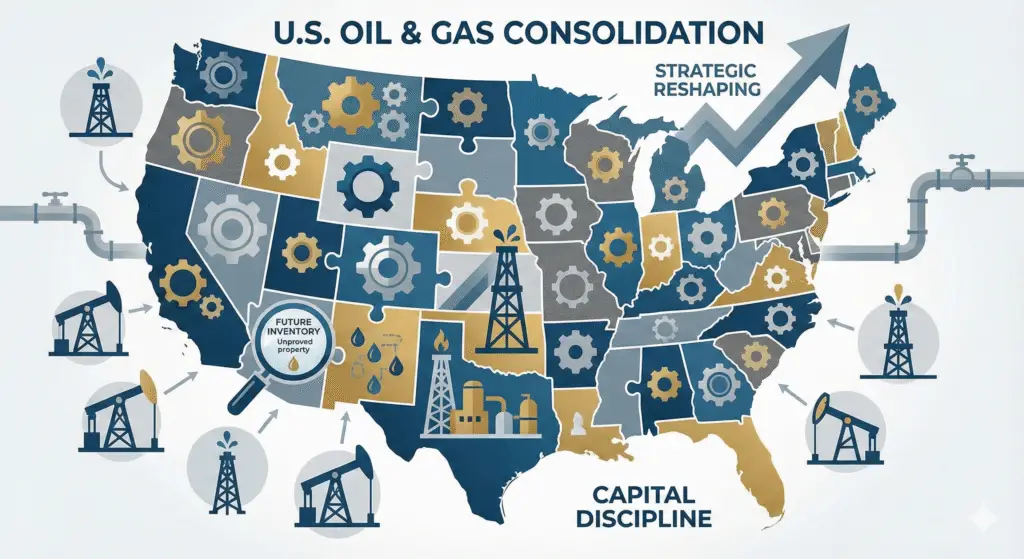
The American oil and gas industry, long characterised by its frontier spirit and a host of nimble players, is fundamentally changing. Forget the frantic “drill baby, drill” days. Today’s C-suite imperative is clear: scale, resilience, and long-term resource control. The evidence is stark: a new report reveals that the roster of top publicly traded exploration and production (E&P) companies has been dramatically streamlined, shrinking from 50 to just 40. This is not a cyclical trend; it is a structural transformation driven by a surge in high-value mergers and acquisitions (M&A).
For business leaders and investors, understanding the drivers and implications of this consolidation wave is non-negotiable. The ground is shifting, and yesterday’s strategies will not work in tomorrow’s concentrated market.
The Strategic Pivot: Securing Tomorrow’s Inventory
The headline figure is staggering: $206.6 billion in M&A activity over the last year. However, the truly insightful data point lies in where this capital is being deployed. The majority of the war chest is not being spent on proved, producing reserves, but on unproved properties—raw acreage that represents future drilling inventory.
In 2024, a significant 42% of acquired asset value was allocated to unproved properties, a substantial leap from previous years. This signals a decisive shift in corporate strategy. Companies are aggressively moving to secure their long-term production potential in core basins like the Permian. This drive is rooted in the recognition that the highest-quality, Tier 1 acreage is finite. To maintain production stability and competitive advantage for the next decade, companies must consolidate prime real estate now, even if it means sacrificing immediate production boosts. This strategic foresight is critical for C-suite executives looking to build shareholder value that can weather volatile commodity cycles.
Beyond the Deal: The Integration Challenge
The pursuit of scale is logical. Larger, integrated companies can leverage economies of scale, reduce overall operating costs, and secure better terms with services and equipment providers. The theory suggests M&A should lead to immediate cost synergies. Yet, the data tells a more complicated story: production costs per barrel of oil equivalent are rising post-merger.
This unexpected increase, despite falling commodity prices and anticipated synergies, highlights the severe operational and cultural challenges of integrating massive enterprises. Marrying two different drilling programmes, IT systems, supply chains, and employee cultures is a monumental task. The real value of a multi-billion-dollar deal is not unlocked at the closing bell; it is earned through years of meticulous, effective integration.
For a C-suite executive, this is a clarion call. The focus must shift from deal-making prowess to integration excellence. Business development managers need to be equipped to identify, quantify, and achieve the promised synergies from day one. Failure to execute a smooth integration can erode shareholder returns and negate the entire strategic rationale for the merger. Operational efficiency is now the ultimate metric of M&A success.
Capital Discipline: The Investor’s New Mandate
The current wave of consolidation is also a direct response to a fundamental shift in investor sentiment. Historically, the industry was rewarded for high-growth, debt-fuelled production increases. Now, investors demand capital discipline and predictable shareholder returns. The sector is moving away from the prior “growth at any cost” model towards a value-based one.
M&A, in this context, is a tool for portfolio optimisation. Companies are selling off non-core assets to finance major acquisitions in their primary, most profitable basins. This focus on streamlining portfolios and concentrating efforts on the best acreage is a sign of an industry maturing and adopting a more sustainable financial model. It demonstrates a commitment to free cash flow generation over unbridled expansion.
For business development teams, this means a shift in pitch. Deals must clearly articulate a path to enhanced Free Cash Flow (FCF), not just increased production volumes. Any new project or acquisition must be scrutinised through the lens of capital efficiency and its contribution to the core business’s resilience.
The Global Perspective and Competitive Landscape
This U.S.-centric consolidation has global implications. As American E&Ps become larger, financially stronger, and more focused, they become more formidable global competitors. They are better placed to compete with the international majors and national oil companies (NOCs), especially in the volatile environment of geopolitical uncertainty and the energy transition.
The market is signalling that scale is a prerequisite for survival in a lower-price environment, such as the one forecasted by the EIA. Consolidation provides the necessary buffer and financial firepower to continue investing in both traditional and transition-focused projects, like carbon capture and storage (CCS) or renewable energy ventures.
In conclusion, the shrinking number of top U.S. oil and gas companies is not a contraction of the industry; it is a strategic recalibration. It is the sound of the industry fortifying itself against future price volatility and positioning itself for long-term dominance through resource control. Success in this new environment demands strategic patience, disciplined capital allocation, and an unwavering commitment to operational integration excellence. The new rules of the game favour the lean, the focused, and the strategically integrated.