

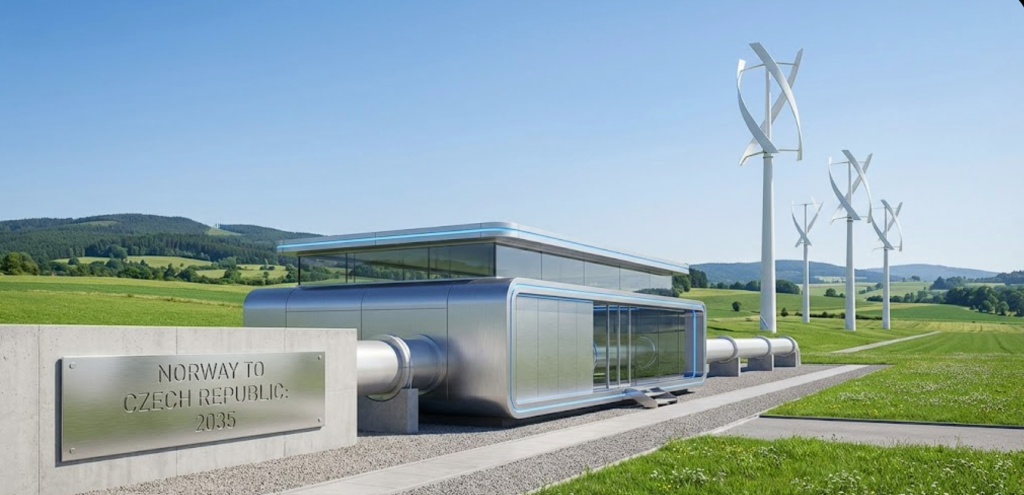
The European energy market is constantly shifting, but one thing remains certain: security of supply is the foundation of industrial competitiveness. In a move that significantly stabilises Central European energy planning for the next decade, Norway’s Equinor has signed a major 10-year gas supply agreement with the Czech utility Pražská plynárenská, with deliveries stretching through to 2035.
For executives managing European portfolios and capital expenditure, this deal is far more than a routine transaction; it is a critical anchor point in the region’s long-term energy strategy. It firmly cements Norway’s position as the indispensable, trusted backbone of European supply and fundamentally alters the risk profile for industrial investment across Central Europe.
A Decade of De-risked Planning
The commitment of natural gas supply for a decade provides unparalleled long-term certainty in a region historically vulnerable to supply shocks. By locking in a reliable flow of Norwegian gas, the Czech Republic—and, by extension, interconnected neighbouring nations—gains a predictable energy source that de-risks planning for:
- Industrial Electrification: Gas is essential as a transitional power source. This agreement ensures that the massive rollout of intermittent renewables has a stable thermal back-up for a decade, giving energy-intensive industries the confidence to invest in new, electrified facilities.
- Infrastructure Investment: A guaranteed decade of flow justifies sustained capital investment in regional gas storage, pipeline upgrades, and intra-European interconnector capacity. For infrastructure funds and midstream companies, this provides predictable revenue streams based on stable demand.
- Policy Compliance: The deal is in direct alignment with the EU’s core mandate of diversification, effectively strengthening the continent’s resilience and reducing any remaining dependency on less reliable, high-risk suppliers.
The strategic value here is the replacement of geopolitical uncertainty with contractual certainty—a trade-off that is highly valued by financial markets and asset owners alike.
The Return of the Long-Term Contract
For much of the past decade, the market dialogue focused on short-term LNG spot cargoes and the rapid phase-out of fossil fuels. This new 10-year agreement signals a vital strategic correction: long-term contracts are essential to the transition.
While the EU accelerates its clean energy build-out, gas remains a necessary ‘bridge fuel.’ Long-term deals like this one provide the volume stability and price predictability that are crucial for major utilities and industrial off-takers. It allows them to manage their hedging strategies and confidently project their energy costs well into the 2030s.
The subtle strategic message for other European utilities is clear: relying solely on volatile spot markets, while effective in managing short-term gluts, introduces unacceptable risk for long-term industrial operations. Seeking out secure, predictable supply from trusted North Sea partners must be a priority for risk management teams.
Norway’s Indispensable Role
The deal further reinforces the strategic importance of Norway to the continental project. As the EU actively sought to replace lost volumes, Norway stepped up to become Europe’s largest pipeline gas supplier.
Equinor’s ability to underwrite a decade of supply to a Central European capital demonstrates the robust nature of the North Sea’s production capacity and the efficiency of the European pipeline network. This provides European policy-makers and investors with a firm, stable variable in their complex energy equation, ensuring that industrial power remains a strategic enabler, rather than a crippling liability, for the foreseeable future.