



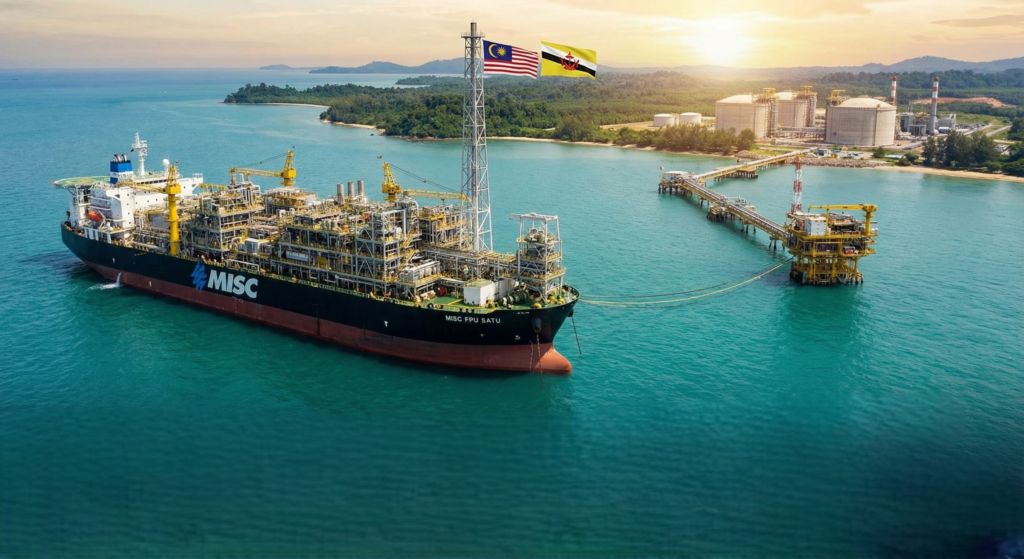
In the intricate chessboard of Southeast Asian energy, a significant move has just been made. MISC Berhad, the maritime arm of Malaysia’s Petronas, has secured a landmark contract to lease, operate, and maintain a Floating Production Unit (FPU) offshore Brunei. This is not merely an asset deployment; it is a strategic market entry that carries profound implications for regional energy security and the longevity of the Liquefied Natural Gas (LNG) sector.
For C-suite executives and business development managers, the specifics of this deal—a firm 12-year charter with Petronas Carigali Brunei Ltd (PCBL), commencing in 2029—offer a clear counter-narrative to the idea that upstream investment in mature Asian basins is drying up. On the contrary, it signals a deeper, more integrated phase of resource monetisation.
Breaking New Ground: The Strategic Entry
The most immediate significance of this deal is geographical. While MISC is a global heavyweight in energy shipping and offshore solutions, this represents its maiden FPU project in Brunei. Breaking into a new sovereign market, particularly one as established and tightly regulated as Brunei, is a complex feat of business development.
This success highlights a growing trend of intra-ASEAN energy integration. With Petronas Carigali acting as the operator, leveraging a Malaysian service provider like MISC to develop Brunei’s resources creates a symbiotic commercial ecosystem. For executives, this reinforces the value of “regional content” strategies. In an era of fragmented global supply chains, building robust, cross-border partnerships within Southeast Asia is becoming a primary lever for risk mitigation and operational efficiency.
The Asset: Locking in Long-Term Gas
The FPU itself is a substantial piece of infrastructure, designed to handle 450 million standard cubic feet of gas per day (MMscfd) and 1,170 barrels of condensate. But the asset’s technical specifications are secondary to its commercial purpose: sustaining feedstock for the Brunei LNG plant.
Brunei LNG is one of the world’s oldest liquefaction facilities. Like many legacy assets, it faces the challenge of natural decline in its feed-gas fields. By committing to a 12-year charter starting in 2029, MISC and Petronas are effectively underwriting the future of Brunei’s LNG exports well into the 2040s.
This offers a critical insight for the C-suite: Gas is here to stay. Despite the acceleration of renewables, the industrial and economic reality of Asia demands reliable baseload power and export revenue. Investments that extend the life of existing LNG infrastructure—”brownfield sustainability”—are emerging as high-yield, lower-risk opportunities compared to speculative greenfield exploration.
Financial Resilience in a Volatile Market
The structure of the deal is equally telling. In a market often plagued by short-termism, a 12-year firm contract is a gold standard for financial resilience. It provides MISC with over a decade of secured, predictable cash flow, insulating a portion of its balance sheet from the cyclical volatility of spot charter rates.
For business development managers, this underscores the continued appetite among National Oil Companies (NOCs) for Lease, Operate, and Maintain (LOM) models. By outsourcing the capital-intensive asset to a specialist like MISC, operators can keep their own balance sheets lighter while ensuring operational excellence. We expect to see a proliferation of these LOM contracts across Asia as NOCs seek to maximise production while managing capital discipline.
The Wider Asian Context
This move must be viewed against the backdrop of the wider Asian energy landscape. As analysed in our other reports, Asian LNG demand is facing headwinds from high prices and Chinese domestic production. However, this paradoxically increases the value of regional gas.
Gas produced in Brunei and shipped to nearby buyers in Japan, Korea, or Southeast Asia avoids the geopolitical chokepoints and high transport costs of long-haul cargoes from the Atlantic basin. MISC’s entry into Brunei strengthens this regional supply mesh.
Conclusion: A Signal for Smart Capital
MISC’s entry into Brunei is a “quiet” victory that speaks volumes. It demonstrates that the next wave of value in Asian oil and gas will not necessarily come from discovering massive new frontiers, but from the intelligent, efficient, and collaborative development of known resources.
For the C-suite, the takeaway is clear: Look for the gaps where mature infrastructure needs new feedstock. Look for the cross-border partnerships that can unlock these reserves. And do not underestimate the long-term value of holding the keys to Asia’s gas production. In the race for energy security, the steady, 12-year marathon often yields better returns than the 100-metre sprint.