



The Reserve Became a Price Instrument: Inside the 2026 Diesel Releases
The emergency stock system was built in 1974 to replace barrels that a crisis had removed. In October 2026 it is being used to hold down the price of one refined product. That is a different job done with the same tanks, and the invoice for it arrives later, as demand.
- The system is doing a job it was not designed for. Emergency stocks exist to replace barrels lost to a physical interruption. In October 2026 they are being used to manage the price of a refined product, which is a policy choice, not a mechanical one.
- Diesel is the constraint, not crude. Net diesel and gasoil exports from the Middle East and Russia fell more than 60 per cent year on year to about 820,000 barrels a day in September, and refinery damage, not wellhead capacity, is what caps the recovery.
- The releases buy time rather than barrels. Standard Chartered's Emily Ashford described the G7 action as having "bought time, rather than barrels", because it accelerates an existing pledge instead of adding new supply.
- Only about 200 million barrels of the 1.1 billion barrel public reserve is diesel. A product-focused policy is therefore drawing on roughly a fifth of the stockpile, which is a much shallower buffer than the headline figure suggests.
- The physical machinery is degrading. The US reserve is at about 284 million barrels, its lowest since 1982, and the US Government Accountability Office found a growing maintenance backlog, no long term plan since 2016 and no Congressionally set target size.
- Nearly 70 per cent of all US reserve releases since 1985 happened between 2014 and 2025. The reserve has been treated as a routine lever for a decade, which is why the 2026 crisis starts from a thin base rather than a full one.
- Refilling is the second shock. The IEA expects refinery output alone will not rebuild depleted stocks before the second half of 2027, so restocking becomes a new and persistent layer of demand after the war premium fades.
- For suppliers this is a scope signal, not a price signal. Tank integrity, terminal throughput, metering, pipeline reinstatement and refinery turnaround scope all follow a restocking cycle, and that scope is funded even when the oil price falls back.
Seven months, four decisions
On 11 March 2026 the IEA's 32 member countries unanimously agreed to make 400 million barrels of emergency stocks available. It was the sixth collective action since the agency was founded in 1974 and, as Fortune reported in October, by far the largest. The United States contributed a 172 million barrel release as its share.
By early October the market had absorbed most of it and was still tightening. On 2 October the G7, under the French presidency, held a videoconference convened by Emmanuel Macron and agreed a coordinated release of 100 million barrels over four months, about 830,000 barrels a day if spread evenly, with a substantial amount of diesel to be available within the first 20 days. Euronews reported that the joint statement committed the group to act together to ease pressure on energy prices, alongside measures to raise refinery output and a pledge not to restrict energy trade between partners.
On 7 October IEA member governments expressed support for accelerating the March releases and for prioritising diesel, in the agency's words, to the extent possible given the current tightness in diesel markets. Rigzone reported that about 325 million barrels had been released under the March action at that point, and that roughly 100 million barrels of pledged but unreleased volume remained.
On 15 October the governing board met and agreed to accelerate the remainder, including more than 20 million barrels of diesel to be released as soon as possible. Reuters reported that about 330 million barrels had been released by then, that some members had gone beyond their March pledges, and that Spain would release 4.4 million barrels in October against an 11.5 million barrel commitment. The United States told members that current plans did not go far enough.
Four decisions in seven months, each one faster and more product specific than the last. That escalation pattern is the story, not any single volume. The agency is no longer responding to a single interruption, it is managing a running shortage, and the instrument it has is a finite stock of oil.
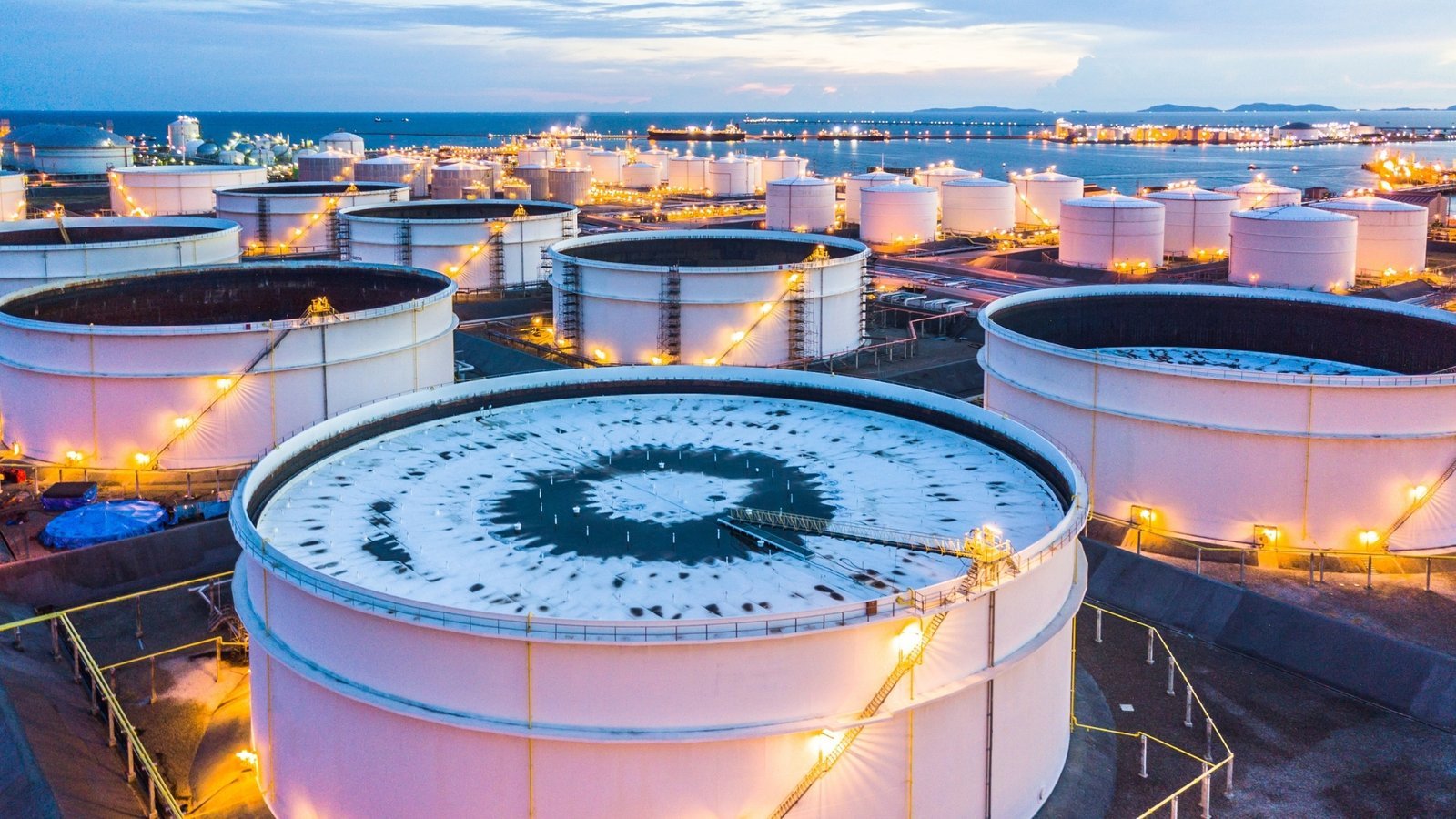 Project 54A crude oil storage tank farm illuminated at dusk. Emergency stocks are not a line in a spreadsheet, they are tanks, pumps and terminals with maintenance schedules and a physical floor.
The constraint moved downstream
In a classic supply interruption the missing thing is crude. Release crude, refineries process it, the shortage closes. That is not the 2026 shape. The barrels are reachable, the capacity to turn them into middle distillate is not.
The October IEA oil market report, summarised by the Arabian Post, put global diesel exports down about 700,000 barrels a day year on year in September, with Middle East and Russian shipments down 1.3 million barrels a day. Net diesel and gasoil exports from those two regions fell more than 60 per cent year on year, to about 820,000 barrels a day. Middle Eastern refined product exports stayed below half of pre-war volumes through September.
Prices followed the physical constraint rather than the crude benchmark. Wholesale diesel topped 200 US dollars a barrel in Singapore in September and reached about 220 US dollars in Europe and the United States, with refining margins on diesel approaching 95 US dollars a barrel. Crude cannot explain a 220 US dollar product. Refining scarcity does.
That is why Russia easing its own diesel export restrictions changes little. The binding constraint there is damaged refining capacity, not policy. And it is why releasing crude would have been close to useless for the problem actually being solved. You cannot refine your way out of a shortage of refining.
The consequence is a system operating outside its design envelope. The IEA's stockholding obligation is denominated in days of net oil imports, a crude-centric measure. The usable buffer for this crisis is the just over 200 million barrels of product held as diesel, not the 1.1 billion barrel headline.
| Dimension | The system as designed, 1974 | The system as used, 2026 |
|---|---|---|
| Trigger | A physical interruption to crude supply | A sustained price and margin squeeze in one product |
| Instrument | Crude released to replace missing barrels | Finished diesel released to cap a product price |
| Measure of adequacy | 90 days of net oil imports | Days of diesel cover, which is not a published obligation |
| Usable buffer | About 1.1 billion barrels of public stock | Just over 200 million barrels of diesel |
| Expected duration | Weeks to a few months | Seven months and still escalating |
| Exit condition | Supply returns, stocks refill quietly | Refining capacity returns, then a multi-year restock |
| Who is exempt | Net exporters hold no obligation | Net exporters are the constrained refiners |
A 1974 answer to a 1973 problem
The IEA was created in 1974 in direct response to the 1973 embargo. The design assumption was an abrupt, politically driven removal of crude from the market, lasting weeks or months, after which normal trade resumed. Members hold stocks equal to at least 90 days of net imports. Net exporters are exempt, because by the logic of the model they cannot be cut off from themselves.
Two things in that design have aged badly. The first is the exemption. The constrained refiners in 2026 are in the Middle East and Russia, which are net exporters and therefore hold no obligation. The buffer sits with the consumers, while the damage sits with the producers. The second is the denominator. Measuring preparedness in days of crude import cover tells you nothing about whether you can keep trucks and tractors moving, which is a diesel question.
The system has also drifted in practice. The GAO review found that the United States Department of Energy has released more than 500 million barrels since 1985, and that nearly 70 per cent of all those releases happened between 2014 and 2025. A reserve designed for rare emergencies has been used as a routine market lever for a decade.
Routine use has a compounding cost. Each non-emergency draw lowers the base from which the next genuine emergency starts, and each one normalises the next. The 2026 crisis did not begin with a full tank, it began with a tank that had been tapped repeatedly through a decade of smaller shocks.
None of this makes the current releases wrong. Diesel at 220 US dollars a barrel is a real economic injury and governments have few fast levers. It does mean the instrument is being used at the edge of its competence, which is exactly when the physical limits start to matter more than the policy intent.
The caverns are the constraint nobody priced
A strategic reserve is not a number in a spreadsheet, it is salt caverns, pumps, pipelines and terminals with maintenance schedules. The GAO report, published in May and released publicly in June 2026, found that investment has not kept pace with the reserve's needs and that the Department of Energy has warned ageing equipment will increasingly limit its ability to carry out fill or drawdown orders.
The numbers around it are stark. The US reserve has fallen to about 284 million barrels, its lowest level since 1982, and is on track toward roughly 243 million. Energy Secretary Chris Wright has warned that drawing the reserve down too far risks damaging the salt caverns themselves, which is a one way loss of capability rather than a temporary loss of inventory.
The governance gap is as important as the engineering one. GAO found the Department has not completed a long term review since 2016, and that Congress has never set a target size for the reserve. Its recommendation was that Congress require long term plans on a set timeline and that the Department reassess the technical criteria governing drawdown and refill speeds. The Department concurred.
Read those three findings together and a pattern appears. Nobody owns the question of how big the reserve should be, the equipment that moves oil in and out is deteriorating, and the political demand on it is rising. That is the shape of a capability that fails quietly, at the moment it is most needed, and is then expensive to rebuild.
No target size
Congress has never set one and the Department has not completed a long term review since 2016, so there is no agreed definition of adequate.
Degrading hardware
A growing maintenance backlog, with the Department warning that ageing equipment will increasingly limit fill and drawdown orders.
Physical floor
Drawing too deep risks damaging the salt caverns, which converts an inventory decision into a permanent capacity decision.
Rising political demand
Nearly 70 per cent of all releases since 1985 fell in 2014 to 2025, and the 2026 sequence has escalated four times in seven months.
The overhang is the second shock
Every barrel released has to be bought back, and the buying happens into a market that is already short. Aramco's Amin Nasser has estimated that more than 1 billion barrels have been drawn from stockpiles worldwide, including company inventories. Observed global oil inventories were 509 million barrels below end-February levels by September, with onshore stocks near their lowest since at least 2016.
The IEA's own October assessment is that supply stays severely constrained well into 2027. Diesel markets may return to a modest surplus in the first quarter of 2027, but refinery output alone will not rebuild depleted stocks before the second half of that year. Restocking is therefore not a quick correction, it is a demand layer with a multi-year duration.
This is the part most commercial planning gets wrong. The instinct is to treat the war premium as the whole story and to assume prices normalise when the fighting stops. The restocking cycle says otherwise. When the acute disruption ends, a large, price-insensitive buyer re-enters the market to refill both public and commercial tanks, and it keeps buying after the headlines move on.
Project 54 made the related argument in selling into a supply shock: a risk premium is not structural demand and should not be capitalised into a growth plan. The mirror of that warning is also true. Restocking demand is structural, it is funded, and it is much easier to sell into than a price spike, because it comes with scope attached.
Note the asymmetry in who pays. Governments release at high prices to suppress those prices, then buy back later. If they buy back well, the cost is modest. If they buy back into their own restocking-driven rally, the public purse funds both ends of the trade. That is a real fiscal argument for setting a target size and a refill rule in advance, which is precisely what GAO says does not exist.
Sell against the restocking cycle, not the headline
An operator has no budget line called oil price, and none called IEA policy either. What they do have is a maintenance plan, a storage estate, a terminal, and a refinery with a turnaround window. The commercial translation of this story is scope, and the scope is unusually legible.
Storage that has been cycled hard needs inspection, tank integrity work, floating roof and seal repair, bottom survey and recoating. Terminals that have run at unusual throughput need metering verification, pump and valve overhaul, and custody transfer assurance. Refineries that have run hard on distillate yield face deferred turnaround scope, catalyst changes and hydrotreater capacity questions. Pipelines reinstated under pressure need integrity programmes that were postponed during the emergency.
That scope is counter-cyclical to the price narrative, which is the useful part. It is funded while the crude price falls back, because it is driven by physical wear and by a restocking obligation, not by sentiment. A demand generation programme pointed at tank integrity and terminal throughput in late 2026 is pointed at real budget.
The positioning that works here is evidence of availability and response time, not cost per unit. We set that case out in proof assets under confidentiality, and it applies with force now: a buyer rebuilding a reserve wants certainty of delivery and credible lead times, and will pay for them.
One discipline to hold. Do not publish commentary on the oil price and call it demand generation. It attracts readers with no budget authority and converts at close to zero. Publish on the scope that the restocking cycle creates, and the audience is the person who signs for it.
Three things worth watching
First, whether a seventh collective action is called. The March action was the largest in the agency's history and has been accelerated twice. A further action, or an explicit extension beyond the 400 million barrels, would confirm that emergency stocks have become the default price instrument rather than an exceptional one. The agency has said it stands ready to release more if and when required.
Second, whether anyone sets a target size. The GAO recommendation is the most consequential document in this story, because a reserve with no defined adequate level cannot be said to be too low or high. If the United States adopts a target and a refill rule, the restocking demand becomes schedulable and the market can price it. If it does not, refilling happens opportunistically and the overhang is harder to forecast.
Third, the diesel crack rather than the crude benchmark. The crude price is what gets quoted, but the number that tells you whether the policy is working is the distillate margin. If cracks ease toward normal while crude stays elevated, releases are reaching the constraint. If cracks stay near 95 US dollars a barrel, they are not, and the instrument is being spent for little.
A fourth, quieter possibility deserves naming as a risk rather than a forecast. Trade restriction is now on the table. The G7 pledge not to restrict energy trade between partners is political, not legal, and does not cover non-member destinations, and a United States diesel export ban has been openly discussed. If that happens, the question stops being how much diesel exists and becomes who is allowed to buy it, which is a far harder environment for any supplier with cross-border contracts.
Listen & take it with you
Prefer audio, or need the deck for an internal review? The full briefing is available as a podcast episode and a downloadable slide presentation.
Your 2027 plan assumes the oil price falls back once the conflict ends. Which assumption are you most confident about?
Frequently asked
The March 2026 collective action made 400 million barrels available, the sixth collective action since the agency was founded in 1974 and the largest. About 330 million barrels had been released by the governing board meeting on 15 October 2026. On 2 October the G7 agreed to accelerate a further 100 million barrels over four months, and on 15 October members agreed to speed up the remaining volumes including more than 20 million barrels of diesel.
Because refining, not crude supply, is the binding constraint. Net diesel and gasoil exports from the Middle East and Russia fell more than 60 per cent year on year to about 820,000 barrels a day in September, and Middle Eastern refined product exports stayed below half of pre-war volumes. Wholesale diesel reached about 220 US dollars a barrel in Europe and the United States with cracks near 95 US dollars, a price gap that crude releases cannot close.
IEA governments hold about 1.1 billion barrels of public emergency stocks as of October 2026, down from above 1.2 billion in March, including just over 200 million barrels of diesel. The United States reserve specifically stands at about 284 million barrels, its lowest since 1982, and is on track toward roughly 243 million barrels.
IEA member countries must hold emergency stocks equal to at least 90 days of net oil imports. Net exporters are exempt, on the logic that they cannot be cut off from their own production. The measure is denominated in crude import cover, which is why it does not describe a country's resilience to a shortage of a specific refined product such as diesel.
Refilling adds a new layer of demand to a market that is already short. More than 1 billion barrels have been drawn from stockpiles worldwide and observed global inventories were 509 million barrels below end-February levels by September. The IEA expects refinery output alone will not rebuild depleted stocks before the second half of 2027, so restocking is a multi-year, largely price-insensitive source of demand rather than a quick correction.
Get the next intelligence drop
Join energy and industrial leaders getting our marketing, AI-growth and revenue-architecture intelligence, direct, no filler.
You're on the list
Welcome to The Energy Growth Brief, watch your inbox for the next dispatch.