








The commercial structures of enterprise energy and industrial software vendors are functionally misaligned with modern buyer behavior. By implementing a formal B2B pipeline velocity framework, organizations can correct this structural misalignment, compress sales cycles, and reduce the systemic customer acquisition cost (CAC) drag on the corporate balance sheet.
According to research, modern energy sector buyers complete approximately 61% of their evaluation journey anonymously through independent research, peer validation, and technical documentation reviews before initiating direct contact with a vendor. This “Point of First Contact” (POFC) has compressed from 69% in 2024 to 61% in 2026, driven by procurement committees leveraging specialized AI-first tools to define shortlists asynchronously.
When a vendor gatekeeps vital product information behind “Request a Demo” barriers, they do not generate qualified leads; they merely opt out of the buyer’s anonymous selection process. To compress an 8-month sales cycle down to 4 months, vendors must deploy the B2B pipeline velocity framework to construct a digital environment that enables rep-free, self-directed evaluation for the entire buying committee.
The B2B Pipeline Velocity Framework Corrects the 95:5 Capital Misallocation Trap
Industrial software and grid technology vendors routinely trigger the “9:1 valuation trap” by misallocating up to 90% of their customer acquisition budgets toward chasing the tiny sliver of the market currently in an active sales cycle. Data proves that at any given moment, only about 5% of potential B2B buyers are “in-market” to purchase a solution. The remaining 95% of target accounts are “out-of-market” because they are bound by multi-year contracts, lack immediate budget, or are in a different operational cycle.
Despite this distribution, 96% of B2B marketers expect campaigns to deliver conversion results within two weeks. This expectation forces go-to-market (GTM) teams to run aggressive bottom-funnel performance marketing campaigns targeted at the same 5% active pool. The result is a hyper-competitive GTM environment that has driven acquisition costs to a steep $1,200 benchmark. B2B software companies now spend an average of $2.00 in marketing and sales costs to generate just $1.00 of new annual recurring revenue (ARR).
For enterprise energy software, this CAC drag stretches payback periods to 18–24 months. When capital is trapped in an inefficient, bloated 8-month lag time, the company’s valuation multiple faces severe discounts from institutional buyers. By shifting resources to establish brand memory with the 95% out-of-market segment before they enter a buying cycle, companies can build long-term brand equity. Executing this strategic pivot via the B2B pipeline velocity framework flips the acquisition ratio, compressing the sales cycle and unlocking premium multiples by converting passive interest into closed-won revenue twice as fast.
Restrictive Technical Access Defeats Shortlist Acquisition Strategy
Modern GTM success requires a transition from traditional outbound sales methods to self-directed buyer enablement. Analysts indicate that 61% of B2B buyers—particularly digital-native Millennial and Gen Z professionals who now dominate procurement committees—actively prefer a “rep-free” experience during the early and mid-stages of evaluation. They do not want to be sold to. They want direct, un-gated access to technical specifications, product architecture schemas, and real-world examples.
When a vendor gatekeeps this documentation behind restrictive CRM-captures, they introduce friction that pushes the buyer directly to competitors. Research shows that 81% of buyers have already established a preferred vendor shortlist by the time they first contact a sales rep, and 95% of winning shortlists are decided on Day 1 of the formal evaluation. Entering the sales cycle late is highly prohibitive; the vendor’s website must act as the initial pre-sales engineering interface.
To remain viable, software providers must eliminate the initial sales barrier, allowing buying committees to clear technical and operational hurdles independently behind the scenes. This is achieved by utilizing the B2B pipeline velocity framework to establish optimized outbound structures that scale technical enablement without forcing premature human interaction.
NERC CIP-003-9 Cybersecurity Requirements Introduce Severe Procurement Friction
Within the energy and utility sectors, GTM teams frequently underestimate the friction introduced by cybersecurity and supply chain compliance. On April 1, 2026, the North American Electric Reliability Corporation (NERC) enforced new updates, bringing low-impact Bulk Electric System (BES) cyber assets into the regulatory compliance scope. This expansion directly impacts an estimated 15% to 25% of previously exempt distributed energy resources (DERs), pulling over 3,300 utilities and independent power producers into active compliance tracking.
Under CIP-003-9 Section 6 (Attachment 1), utilities must document and implement formal vendor electronic remote access security controls. This standard eliminates legacy VPN “standing access” for software providers. Every remote maintenance, troubleshooting, or firmware update session must be fully authorized via an identity-aware proxy or jump host, multi-factor authenticated (MFA) at the user-level before traffic reaches the protected asset, and time-limited, fully supervised, and completely recorded.
Regulatory Risk Warning: Because NERC CIP violations carry severe penalties ranging from $600,000 to $2 million per day, per violation, utility buying committees will instantly freeze procurement if a vendor cannot demonstrate immediate, auditable alignment with these standards—a compliance mapping that must be embedded directly within the vendor’s B2B pipeline velocity framework.
Double Materiality Assessments and CSRD Mandates Freeze Procurement Progress
In addition to cybersecurity, sustainability reporting regulations have transitioned from voluntary PR exercises to rigid, legally binding compliance mandates. The European Union’s Corporate Sustainability Reporting Directive (CSRD) requires large EU-listed entities and global corporations to publish granular disclosures on environmental, social, and governance (ESG) impacts. Under the European Sustainability Reporting Standards (ESRS), companies must report on over 1,000 qualitative and quantitative data points, including comprehensive Scope 3 greenhouse gas (GHG) emissions.
Although the EU Omnibus I simplification package narrows direct applicability to companies with more than 1,000 employees and €450 million in turnover, the directive’s value chain provisions remain active. Large utilities are legally obligated to audit the ESG and carbon footprints of their third-party software and hardware providers to meet value chain obligations.
This means that if an enterprise software provider cannot present auditable metrics across ESRS E1 (Climate Change), ESRS E5 (Resource Use/Circular Economy), and ESRS S2 (Workers in the Value Chain), their deal will stall within the buyer’s compliance department. Proactively surfacing these metrics on-demand is a core tactical component of an industrialized B2B pipeline velocity framework.
Sales Cycle Duration Directly Adjusts Corporate Weighted Average Cost of Capital
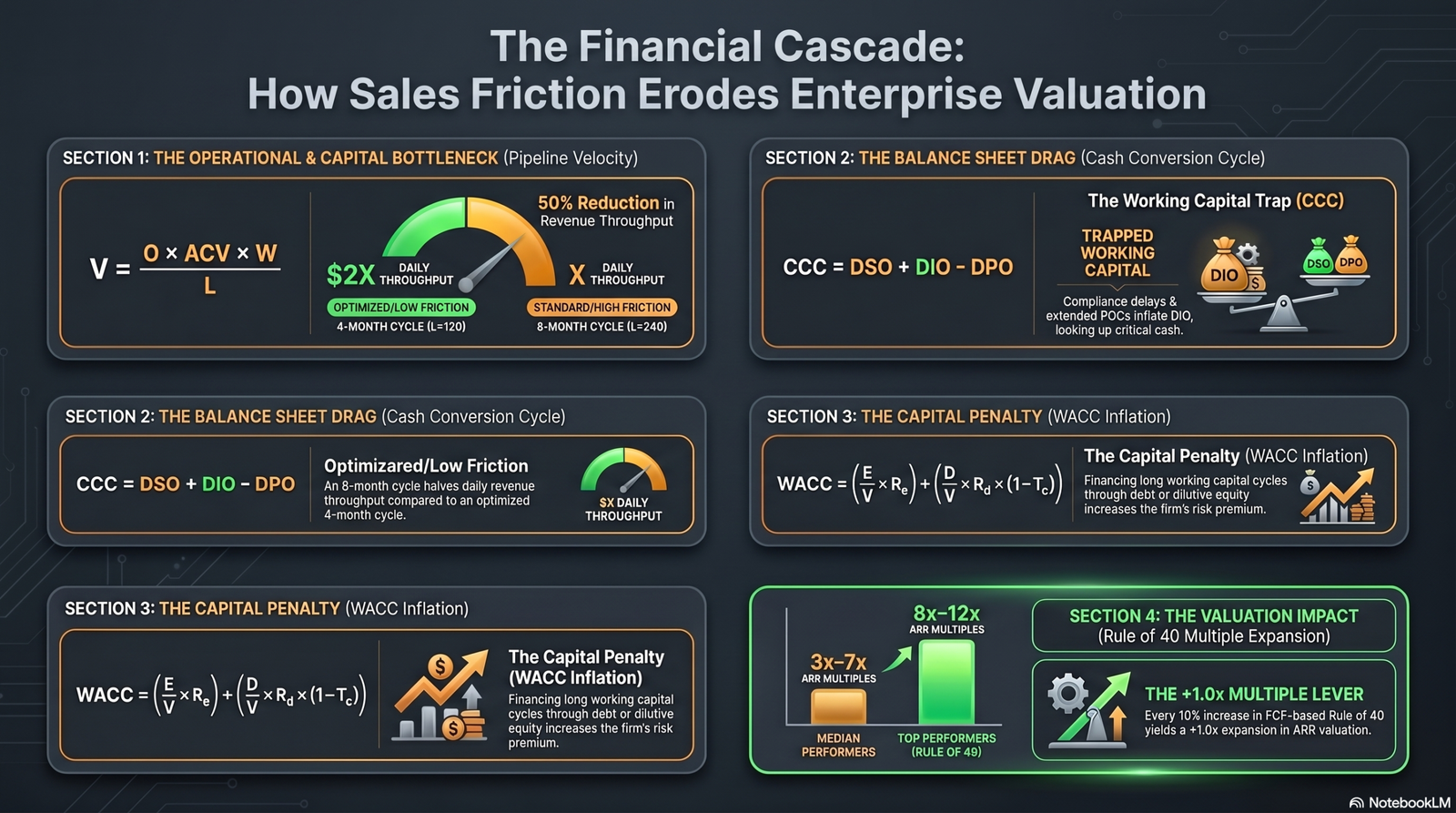
A prolonged, 8-month procurement cycle is not just an administrative nuisance; it is a financial drag that erodes the vendor’s enterprise valuation. Within the B2B pipeline velocity framework, this capital inefficiency is modeled mathematically through the relationship between the Pipeline Velocity equation, the Cash Conversion Cycle (CCC), and the firm’s 加重平均資本コスト(WACC).
The daily revenue throughput of a B2B sales engine is defined by the Pipeline Velocity formula:
$$V=frac{Otimes ACVtimes W}{L}$$
どこ:
-
$V$ is Pipeline Velocity (revenue generated per day).
-
$O$ is the number of active, qualified opportunities.
-
$ACV$ is the Average Annual Contract Value (average deal size).
-
$W$ is the win rate percentage.
-
$L$ is the sales cycle length in days.
An 8-month sales cycle ($L = 240text{ days}$) directly halves the daily dollar throughput compared to an optimized 4-month cycle ($L = 120text{ days}$). This lag directly inflates the Days Inventory Outstanding (DIO) component of the Cash Conversion Cycle:
$$text{CCC}=text{DSO}+text{DIO}-text{DPO}$$
In software and high-tech GTM, DIO represents the days capital is tied up in unbilled pre-sales engineering, proof-of-concept (POC) integrations, and compliance verification cycles. To finance these long working capital cycles, companies are often forced to raise high-cost debt ($D$) or dilutive equity ($E$), increasing the risk premium and the firm’s overall cost of capital:
$$text{WACC}=left(frac{E}{V}times R_eright)+left(frac{D}{V}times R_dtimes(1-T_c)right)$$
This balance sheet drag actively depresses the firm’s Rule of 40 score (Revenue Growth Rate + Profit/FCF Margin). Empirical valuation data shows that private SaaS and industrial software companies trade at a median of 3x to 7x ARR, but top performers exceeding the Rule of 40 command premium multiples of 8x to 12x ARR. Each additional 10 percentage points of Free Cash Flow-based Rule of 40 is associated with an approximate $+1.0text{x}$ expansion in the company’s EV/Revenue multiple ($+0.7text{x}$ on an EBITDA basis). Overcoming this lag requires the implementation of an end-to-end B2B pipeline velocity framework that frees up working capital, reduces GTM costs, and expands enterprise value.

Real-World Case Analysis: Smart Grid Software Provider Halves Procurement Lag
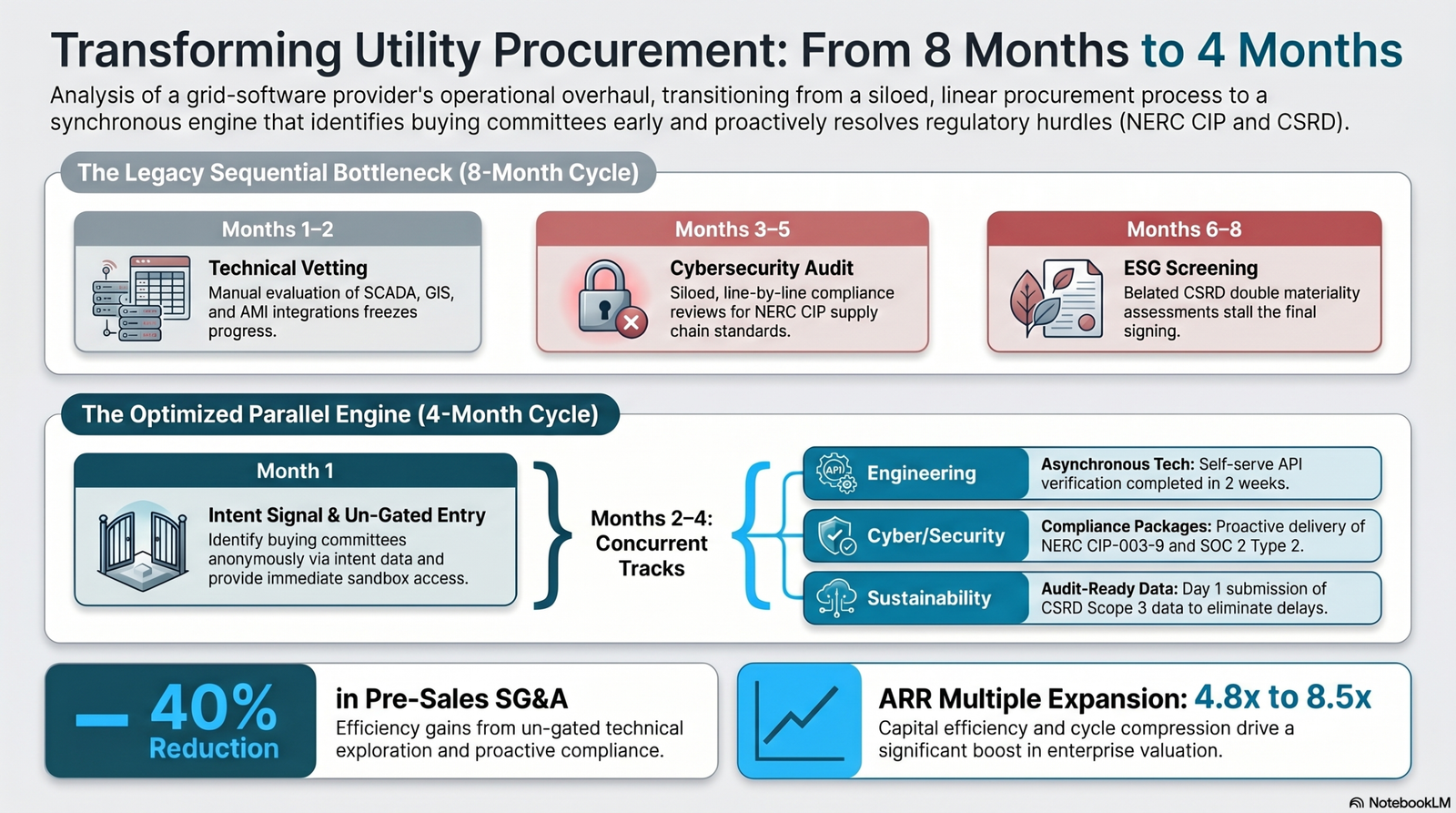
An enterprise grid-software provider, focused on integrating smart capacity planning modules for regional bulk electric systems, was consistently bogged down in grueling 8-month procurement cycles. The commercial friction occurred sequentially across multiple corporate silos within the utility buying committees, resulting in high pre-sales engineering costs and a deteriorating cash conversion cycle.
The historical bottlenecks were concentrated in three distinct phases:
-
Month 1–2 (Technical Vetting): Engineering paused evaluation to resolve legacy SCADA, GIS, and AMI integration issues.
-
Month 3–5 (Cybersecurity Audit): Utility compliance teams executed manual NERC CIP-013 supply chain and CIP-007-7 patch evaluations.
-
Month 6–8 (ESG Screening): Corporate sustainability departments ran manual, complex CSRD double materiality assessments.
To resolve this, the provider implemented a three-stage GTM overhaul built entirely around the B2B pipeline velocity framework:
1. Anonymous Committee Identification via Intent Signal Architecture
Instead of relying on traditional cold outreach, the provider integrated a signal-driven revenue orchestration platform to track first-party and third-party intent signals. When anonymous utility accounts repeatedly visited technical documentation pages or searched for specific compliance keywords (e.g., “CIP-003-9 remote access”), the system flagged them early in their research journey. This allowed marketing to deliver tailored, helpful resources directly to the buying committee’s professional networks long before they initiated direct contact.
2. Elimination of Technical Friction (The Rep-Free Sandbox)
The grid-software provider completely un-gated its developer APIs, product architecture schemas, and integration guidelines, removing the restrictive “Request a Demo” gating walls. They deployed a self-serve developer sandbox that allowed utility engineers to test integration capabilities with legacy SCADA, GIS, and AMI systems independently behind the scenes. This allowed the buying group to complete 70% of their technical exploration asynchronously, reducing the technical vetting phase from a 2-month sequential sales bottleneck to a 2-week parallel process.
3. The Procurement-Ready Vendor Package
To address security, legal, and financial gating hurdles, the provider constructed a pre-packaged, audit-ready compliance dossier. Instead of waiting for the client’s procurement department to send lengthy questionnaires, the provider proactively delivered a comprehensive package containing:
-
A SOC 2 Type 2 attestation report compiled under SSAE No. 18.
-
A pre-compiled NERC CIP compliance guide proving alignment with CIP-003-9, CIP-013-1, and CIP-007-7.
-
CSRD-aligned sustainability disclosures, including verified Scope 3 GHG emissions data and supply chain labor standards assessments mapped directly to ESRS templates.
This proactive compliance package allowed the utility’s legal, compliance, and sustainability teams to audit the vendor in parallel with the engineering evaluation.
The operational results of this strategy were immediate and highly measurable. By compressing the average sales cycle from 8 months to 4 months through the B2B pipeline velocity framework, the provider reduced pre-sales SG&A costs by 40%. The pipeline coverage ratio normalized to a healthy $4text{x}$ benchmark, eliminating forecasting risk. This improvement in capital efficiency and growth rate expanded the company’s implied ARR multiple from $4.8text{x}$ to $8.5text{x}$, unlocking significant enterprise value prior to their next financing round.

Strategic Takeaways Mandate Immediate Reallocation of GTM Resources
-
The 61% Anonymous Journey is Non-Negotiable: Modern B2B energy buyers complete 61% of their evaluation journey via independent research. Gatekeeping technical specs behind demo requests forces high-value prospects to select un-gated competitors.
-
The 9:1 Trap Destroys Capital Efficiency: Misallocating 90% of acquisition budgets to the 5% in-market segment drives CAC to unsustainable heights and degrades enterprise valuation. Shifting focus to an automated B2B pipeline velocity framework safeguards commercial capital.
-
Regulatory Gaps Ice Deals Instantly: Strict NERC CIP-003-9 vendor remote access standards and CSRD Scope 3 carbon reporting mandates stall procurement unless addressed proactively via an audit-ready compliance engine.
-
Sales Velocity Drives Multiple Expansion: Compressing sales cycles from 8 months to 4 months doubles pipeline daily dollar output, accelerates CAC payback, and expands private multiples toward the premium 8x–12x ARR tier.
Critical Regulatory and Financial Inquiries Require Standardized Resolution
Direct Impact of the B2B Pipeline Velocity Framework on EBITDA Margins
By un-gating technical documentation and deploying self-serve sandboxes, vendors allow buying committees to complete up to 70% of their technical exploration asynchronously. This reduces the need for constant, highly manual pre-sales engineering intervention during the early and mid-funnel stages. Additionally, accelerating the sales cycle reduces the customer acquisition cost (CAC) payback period from 18–24 months down to under 12 months, lowering overall SG&A expenses and expanding EBITDA margins.
Primary Regulatory Triggers in NERC CIP-003-9 Affecting GTM Operations
Under NERC CIP-003-9, low-impact Bulk Electric System (BES) cyber systems must implement documented vendor electronic remote access security controls. Vendors can no longer rely on shared VPN accounts; every session must be user-identified, MFA-authenticated, time-limited, and recorded. If a vendor cannot provide proof of secure jump host integrations or session-disabling capabilities, utility procurement teams are legally blocked from shortlisting them. An institutionalized B2B pipeline velocity framework bypasses this friction by making compliance docs available on day one.
Quantifying Scope 3 Emissions for Utility Buyers Under CSRD Mandates
SaaS and software vendors must calculate and disclose their corporate carbon footprint across both upstream and downstream activities following the GHG Protocol. This includes direct operational emissions, data hosting energy use, and supply chain impacts. Under CSRD ESRS E1 standards, large buyers require these metrics to build their own value chain sustainability disclosures; providing a pre-compiled, audited ESG data package eliminates major procurement delays.
著者について:
について プロジェクト54 チーム is a specialized group of B2B market analysts and GTM strategy architects focused on driving commercial efficiency across the energy, industrial technology, and enterprise SaaS sectors.