







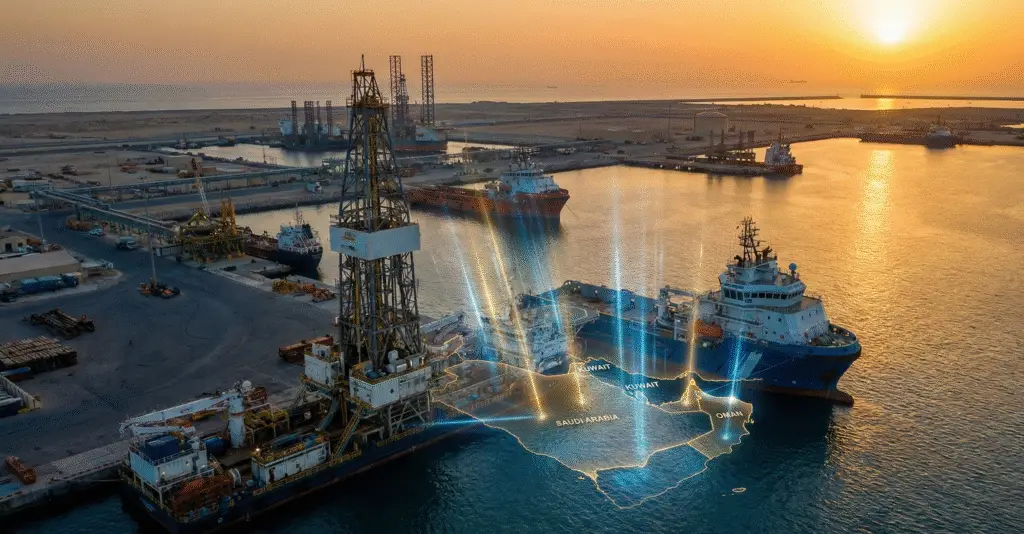
The planned $35 billion, 15-year expansion of natural gas exports from Israel’s offshore Leviathan field to Egypt has been thrust into an unexpected and high-stakes political holding pattern. A recent directive from Israeli Prime Minister Benjamin Netanyahu has paused the export arrangement, reportedly due to diplomatic disputes with Cairo over regional security dynamics. For energy executives and business development leaders tracking the MENA region, this event is a critical case study in how geopolitical tensions can instantly override long-term commercial logic and threaten the viability of multi-billion dollar infrastructure.
The Strategic Angle: Supply, Demand, and Regional Nexus
The core of this issue is the policy risk associated with cross-border energy trade. The Leviathan field, operated by a partnership led by Chevron, is a lynchpin of the Eastern Mediterranean gas ecosystem. The original agreement aimed to double the existing gas exports to Egypt, a country facing rapidly rising domestic energy demand, particularly for electricity generation, where demand is projected to increase by up to $50\%$ over the next decade.
Egypt’s strategic goal is two-fold: meet its own soaring internal needs, and critically, supply its underutilized LNG liquefaction terminals (Idku and Damietta) for profitable re-export to Europe and Asia. The Leviathan expansion was foundational to this strategy, providing a stable, long-term source of feed gas that domestic production struggles to match.
Key Context: The initial export agreement represented a high point of energy diplomacy between the two nations, fostering a new era of regional integration built on shared infrastructure and economic benefit. The current pause shatters this perception of stability.
Risks and Upside Scenarios for Investors
The immediate risk is a failure to meet the contractual deadline for initial incremental flows, currently self-imposed by Chevron and partners for November 30, 2025. Should this date pass without a clear resolution and the deal be abandoned, it would constitute one of the largest politically induced setbacks to gas development in the Eastern Mediterranean in years.
$\quad$ Immediate Risks
- Financial & Capex Risk: Investors and partners in the Leviathan field, who have made development decisions based on this $\text{\$35}$ billion long-term contract, face significant risk to their revenue forecasts and return on capital employed (ROCE).
- Energy Security for Egypt: A delayed or abandoned deal complicates Egypt’s short-term energy planning, potentially forcing it to increase expensive LNG imports or implement temporary power cuts to manage peak demand, eroding confidence in its energy re-export model.
- Regional Project Financing: The uncertainty impacts future cross-border projects. Financiers and sovereign wealth funds (SWFs) will likely apply a significantly higher political risk premium to new Eastern Mediterranean gas pipeline and development projects.
$\quad$ Upside Scenarios and Precedents
While the situation is fraught, it is important to remember that such political pauses often serve as negotiation leverage rather than outright cancellations.
- Diplomatic Resolution: Energy diplomacy has a history of resolving crises. A successful diplomatic intervention, perhaps brokered by a third-party ally or a regional body like the East Mediterranean Gas Forum (EMGF), remains the most likely long-term path. The economic incentive for both nations is immense, providing a strong anchor for negotiation.
- Infrastructure Resilience: The existing pipeline infrastructure (e.g., the Arish-Ashkelon pipeline) remains intact and operational, unlike the Iraq-Turkey Pipeline (ITP), which faced over two years of inactivity due to legal disputes. The current issue is a policy decision on incremental flows, not a physical disruption of existing capacity.
- Precedent of ITP Restart: The recent reopening of the Iraq-Turkey Pipeline, following a long suspension, offers a precedent where Baghdad and the Kurdistan Regional Government (KRG) ultimately found a commercial-political framework to restart oil exports overseen by Iraq’s State Oil Marketing Organization (SOMO). A new framework for gas oversight may be necessary here.
Strategic Implications for C-Suites
For energy executives in the MENA region, particularly those in upstream development and infrastructure finance, this situation offers two clear lessons:
- Stress Test Policy Variables: Any regional project development must now incorporate rigorous stress testing for sudden, politically driven policy reversals, even on fully negotiated, $\text{15-year}$ agreements. The $\text{2025}$ energy landscape requires dynamic risk models that price in regional geopolitical volatility.
- Diversify Feedstock and Off-take: Egypt’s position highlights the vulnerability of its LNG re-export strategy to a single major gas source. For other nations, this reinforces the strategy of feedstock diversification (e.g., integrating renewables and hydrogen alongside gas) and ensuring multiple, geographically diverse off-take agreements to mitigate customer concentration risk.
The coming weeks, leading up to the November 30 deadline, will be critical. The resolution will define the geopolitical risk premium for all future infrastructure financing across the Levant and North Africa.
Sources: