







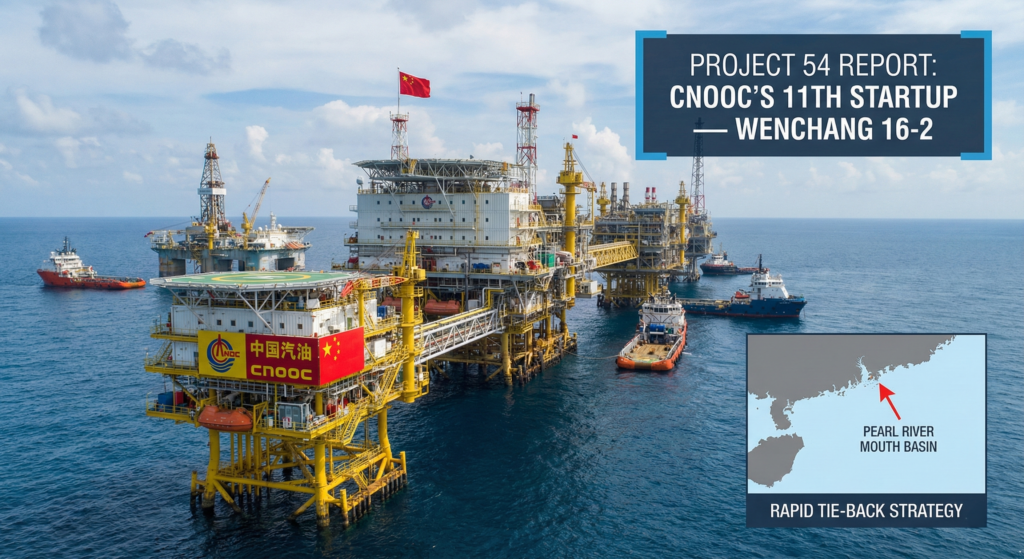
In the global oil and gas theatre, 2025 has been a year of contrasting narratives. While many Western International Oil Companies (IOCs) focus on share buybacks and portfolio consolidation, China’s state-backed offshore giant, CNOOC Limited, is engaged in a sprint for capacity. The company’s recent announcement of its 11th domestic project startup of the year—the Wenchang 16-2 Oilfield—is more than just a production milestone; it is a definitive signal of where the capital and strategic focus of the Asian energy market currently resides.
For C-suite executives and business development managers observing the region, CNOOC’s performance offers a masterclass in two critical areas: Capital Efficiency via Infrastructure Leveraging and State-Mandated Energy Security.
The Wenchang 16-2 Model: Economy of Scale in Action
The specific details of the Wenchang 16-2 project reveal the tactical playbook CNOOC is using to maintain this frenetic pace. Located in the Pearl River Mouth Basin with an average water depth of 150 metres, the project is not a massive greenfield behemoth. Instead, it is a smart, tactical tie-back.
CNOOC has constructed a new jacket platform that integrates production and drilling functions but—crucially—relies on adjacent, existing facilities for processing and power. This “satellite” approach drastically reduces the upfront CAPEX and shortens the timeline from Final Investment Decision (FID) to First Oil.
With peak production expected to reach 11,200 barrels of oil equivalent per day (boe/d) of light crude in 2027, the project is a high-margin addition to the portfolio. It requires minimal new infrastructure while extending the economic life of the existing Wenchang hub. For business development managers, this highlights a booming market in Asia not for massive new megastructures, but for brownfield modification, subsea tie-back technologies, and life-extension services.
The Macro Context: The “Ballast Stone” Strategy
CNOOC’s acceleration is not happening in a vacuum. It is the tip of the spear for Beijing’s “Seven-Year Action Plan” to boost domestic supply. The National Energy Administration recently confirmed that China is on track to hit a record 215 million metric tons of crude output in 2025, with offshore fields accounting for over 60% of that growth.
In Chinese policy circles, domestic oil and gas are referred to as the “ballast stone”—the stabilising force ensuring national security amidst global geopolitical volatility. While the energy transition is accelerating (China is also the world leader in solar and wind deployment), fossil fuels remain non-negotiable for baseline security.
For the C-suite, this clarifies the investment horizon. Unlike in Europe, where regulatory pressure is curbing upstream investment, the Asian offshore sector has a state-guaranteed mandate for growth. Service companies and technology providers that align themselves with this efficiency-plus-security narrative will find a receptive and capital-rich audience.
Beyond Volume: The Tech and Green Pivot
It would be a mistake to view CNOOC as a traditional volume-chaser. The 2025 strategy is heavily layered with technological sophistication. The company is rolling out its “Hi-Energy” AI model across these new startups. This digital twin and predictive analytics capability allows for unmanned platforms and remote operations—vital for keeping OPEX low in mature basins like the South China Sea.
Furthermore, the “Green Power Substitution” initiative is gaining traction. CNOOC aims to consume over 1 billion kWh of green electricity this year. Integrating offshore wind with oil and gas platforms is no longer a pilot concept in China; it is becoming standard operating procedure to lower the carbon intensity of every barrel produced.
Conclusion: The New Asian Benchmark
CNOOC’s ability to bring 11 projects online in a single year—alongside major international startups like Yellowtail in Guyana and Buzios7 in Brazil—sets a new benchmark for operational velocity.
For competitors and partners alike, the message is clear: The Asian upstream sector is not winding down; it is speeding up. However, the nature of the game has changed. It is no longer about finding the biggest field; it is about who can connect the most barrels to existing steel in the shortest amount of time. In 2025, speed is the ultimate currency, and right now, CNOOC has the fastest chequebook in the East.
The contrasting fortunes of two major deals—Saudi Aramco’s increased stake in MidOcean Energy and ADNOC’s withdrawal from the Santos acquisition—mark a definitive pivot in the region’s corporate strategy. We are moving from an era of unchecked asset accumulation to one of tactical, risk-adjusted partnerships.
The Santos Wall: Valuation Meets Regulation
The withdrawal of the $19 billion bid for Australia’s Santos Ltd by XRG (an ADNOC subsidiary) and its consortium partners is the most significant M&A correction of 2025. While officially attributed to “commercial disagreements” over valuation, the deal faced substantial headwinds that every BD leader in the region must recognize.
- Regulatory Friction: Acquiring a strategic national asset in a Tier-1 jurisdiction like Australia is becoming increasingly difficult for sovereign-backed entities. The scrutiny from foreign investment review boards is intensifying, adding a “political risk premium” to any full takeover bid.
- Operator Risk: Becoming the operator of record for assets like Santos’s Barossa or Gladstone LNG projects invites direct exposure to local environmental activism, labor disputes, and tax regime changes. For a Gulf NOC, this operational drag can outweigh the strategic value of the reserves.
The MidOcean Model: The Proxy Play
Contrast this with Saudi Aramco’s approach. By increasing its stake in MidOcean Energy to 49%, Aramco is essentially effectively “outsourcing” its M&A engine.
MidOcean, managed by institutional investor EIG, acts as a specialized vehicle. It acquires the assets (like interests in four Australian LNG projects and Peru LNG), manages the regulatory approvals, and handles the operational partnerships. Aramco, as the major shareholder:
- Secures the Offtake: Gaining access to the LNG volumes for its growing trading desk.
- Limits Exposure: Avoiding the direct “sovereign buyer” label that complicates deals in Western markets.
- Deploys Capital Efficiently: Gaining exposure to multiple geographies (Latin America and Asia-Pacific) for a fraction of the cost of a single corporate takeover.
Strategic Drivers: Volume Over Vanity
This shift is driven by a fundamental realization: You don’t need to own the well to trade the gas.
For MENA executives, this signals a change in the flow of outbound capital. The “Checkbook Diplomacy” of buying entire companies is fading. It is being replaced by sophisticated joint ventures, equity-light offtake agreements, and investments in agile midstream vehicles.
Key Takeaways for Business Development:
- Target the Vehicle, Not the Asset: If you are selling into this market, structure your deals as partnerships or minority equity opportunities rather than full divestments.
- The Trading Desk is King: The ultimate goal for both ADNOC and Aramco is to feed their trading arms. Any deal that brings flexible LNG volumes (destination-free cargoes) will be prioritized over fixed-asset acquisitions.
- Jurisdiction Matters: Expect capital to flow away from “difficult” regulatory environments (like Australian M&A) toward more transactional markets or US Gulf Coast brownfield expansions where offtake financing is king.
The failure of the Santos deal is not a retreat; it is a refinement. The Gulf’s capital is still looking for a home in the global gas market, but the terms of engagement have strictly changed.
For energy executives operating in the region, this standoff is not merely a diplomatic row; it is a material disruption to the supply/demand balance of North Africa and a signal that geopolitical risk is re-pricing regional infrastructure assets.
Context: The Interdependency Trap
The deal in question was designed to solve two problems simultaneously. Israel has a gas surplus and limited export routes (no LNG facilities of its own). Egypt has a gas deficit, soaring domestic electricity demand, and idle LNG export capacity at Idku and Damietta.
- The Plan: Chevron and its partners committed to investing heavily to expand Leviathan’s production and build a new offshore pipeline (Nitzana route) to bypass existing infrastructure bottlenecks.
- The Reality: Israeli Prime Minister Netanyahu paused the approval process in late 2025, linking the gas deal to broader security negotiations regarding the Gaza border and Sinai.
This politicization of the molecule flow breaks the “commercial shield” that has largely protected the Israel-Egypt gas trade from political volatility over the last five years.
Risks: Capex, Counterparties, and Credibility
The immediate casualty of this pause is investor confidence.
- Stranded Capex Potential:
The expansion of Leviathan Phase 1B and Phase 2 requires Final Investment Decisions (FIDs) worth billions. These FIDs are predicated on firm offtake agreements. If the Egyptian offtake is uncertain, the partners (Chevron, NewMed, Ratio) cannot greenlight the upstream capex. The “November 30” deadline was a critical gate for these decisions; passing it without resolution puts the entire project timeline in jeopardy.
- Egypt’s Energy Fragility:
Egypt is already grappling with power shortages. The government had factored these incremental Israeli volumes into its 2026-2030 power generation strategy. If this gas does not arrive, Egypt faces two expensive choices:
- Increase reliance on fuel oil for power generation (higher emissions, higher cost).
- Import more LNG from the global spot market, draining foreign currency reserves.
- The LNG Re-Export Model:
Egypt’s strategy to earn hard currency by re-exporting Israeli gas as LNG to Europe is effectively paused. This denies Cairo a critical revenue stream needed to service its sovereign debt and stabilize its currency.
Upside Scenarios and Strategic Pivots
Is the deal dead? Likely not. The economic logic remains overwhelming for both sides.
- The “Grand Bargain” Scenario: History suggests that energy often becomes the sweetener in larger diplomatic deals. A resolution to the security disputes could see the gas deal approved as part of a broader normalization package. If unlocked, the project could move fast, with the partners likely prioritizing the new pipeline to recover lost time.
- Alternative Routes: This friction may accelerate Israel’s exploration of alternative export routes, such as the long-discussed pipeline to Turkey or a Floating LNG (FLNG) facility. For BD executives, this opens new potential engagement channels: if the Egypt route is deemed too politically risky, technology providers for FLNG could see renewed interest from Israeli operators.
Executive Takeaway
The paralysis of the Leviathan expansion serves as a case study in political risk management. For companies investing in MENA cross-border infrastructure, the lesson is clear: Commercial viability is necessary, but insufficient. Contracts must include robust buffers for political force majeure, and supply portfolios must be diversified. Until the valve is politically reopened, the Eastern Mediterranean remains a high-beta energy market.