
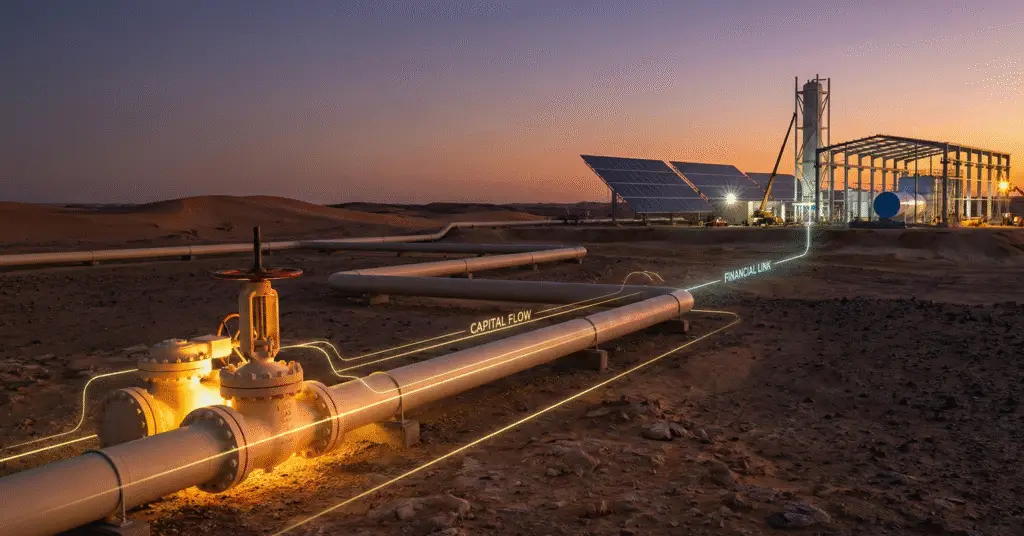
The energy landscape in the Middle East and North Africa (MENA) is undergoing a quiet, yet profound, capital restructuring. National Oil Companies (NOCs) across the GCC are systematically unlocking massive capital from their core infrastructure assets—pipelines, storage facilities, and transmission networks—to fund a two-pronged strategy: sustaining dominance in core oil and gas, and aggressively accelerating diversification into low-carbon fuels and downstream projects.
This strategy, known as infrastructure monetization, is not just a financing tactic; it is a fundamental shift in corporate strategy that optimizes the balance sheet and future-proofs national energy entities against the volatile commodity cycle.
The Mechanics of Monetization: Leasebacks, IPOs, and Joint Ventures
The core mechanism involves selling minority equity stakes or executing sophisticated lease-and-leaseback agreements for established, de-risked midstream and downstream assets. These assets appeal to global institutional investors—pension funds, sovereign wealth funds, and infrastructure-focused private equity—who seek long-term, utility-like, fixed-return investments.
Key precedents underscore the scale and regional alignment of this trend:
- Saudi Aramco (KSA): Completed a lease-and-leaseback deal worth $11 billion for assets related to its Jafurah unconventional gas project. This follows earlier landmark transactions that set the regional precedent.
- ADNOC (UAE): Has raised over $14 billion from selling stakes in its pipeline entities to global giants like BlackRock and KKR, demonstrating the appeal of the UAE’s stable regulatory framework.
- OQ Gas Networks (Oman): Successfully executed a $750 million IPO of 49% of its pipeline division, drawing in major Gulf and international investors.
- Bapco Energies (Bahrain): Initiated its inaugural infrastructure monetization by selling a minority interest in the vital Saudi-Bahrain oil pipeline, while retaining operational control.
This strategic capital raise is a sophisticated answer to two distinct market pressures: the need for massive capital expenditure (capex) in complex, high-risk upstream and green-field projects, and the imperative to deliver consistent returns to state stakeholders.
Where the Capital Is Flowing: Sustaining and Diversifying
The billions of dollars unlocked from these transactions are not sitting idle. The capital is immediately recycled into strategic priorities that define the next decade of MENA energy policy.
I. Core Upstream and LNG Expansion
A significant portion of the capital is flowing back into core hydrocarbon assets to maintain and expand production capacity. NOCs are mandated to sustain market share, which requires continuous investment to offset natural field decline and increase capacity targets.
- Gas Development: Funds are being channeled into massive gas projects, such as Saudi Arabia’s Jafurah, which will be a non-associated gas resource critical for domestic power, industrial feedstock, and blue hydrogen. The monetization model provides an immediate cash injection to de-risk and accelerate these large-scale ventures.
- LNG Buildout: The capital reinforces commitments to liquefied natural gas (LNG) projects, particularly the expansions led by Qatar, which aim to secure long-term global gas market share.
II. The Green Pivot: Hydrogen and Renewables
The second, and increasingly critical, destination for the capital is diversification into the energy transition. Leveraging sovereign balance sheets to fund these capital-intensive, nascent sectors is a key strategic advantage for MENA.
- Blue Hydrogen: Monetized funds enable the construction of key carbon capture and storage (CCS) and hydrogen production facilities. For example, the Jafurah gas project feeds directly into the blue hydrogen value chain, with the new infrastructure financing ensuring its rapid deployment.
- Large-Scale Renewables: The capital underwrites the equity contributions needed for giga-scale solar, wind, and battery storage projects. This allows developers like ACWA Power (often in partnership with NOCs) to secure favorable long-term financing for projects like the 1 GW solar/storage complex in Egypt.
The Upside Scenarios and Strategic Risks
The strategic upside for the MENA region is significant. By isolating infrastructure as a distinct asset class, NOCs are enhancing their efficiency, providing transparency on asset value, and fostering deeper engagement with the global private sector. The model creates an efficient, self-funding cycle: stable core assets finance the dynamic, high-growth expansion assets.
However, risks persist:
- Geopolitical Risk Premium: While long-term contracts mitigate some investor risk, sustained regional instability can still affect valuations and investor appetite for future rounds.
- Contractual Complexity: These deals are often highly complex, involving bespoke regulatory and legal frameworks to guarantee long-term returns (e.g., take-or-pay agreements). Ensuring the stability of these contracts over 20-30 years is paramount.
- Regulatory Consistency: Maintaining a stable and predictable regulatory environment is essential to keep the cost of capital low. Any abrupt changes to fiscal terms or foreign ownership limits could deter future institutional investment.
For executives and business development leaders, the message is one of opportunity: The Great Unbundling is creating a stream of multi-billion dollar brownfield and greenfield opportunities. The region is actively looking for partners who can bring not just capital, but also specialized technology, operational excellence, and a long-term view to manage these mission-critical assets. The monetization trend, first clearly established in 2025, is set to be the dominant financial model for MENA energy for the foreseeable future.
The Strategic Angle: Supply, Demand, and Regional Nexus
The core of this issue is the policy risk associated with cross-border energy trade. The Leviathan field, operated by a partnership led by Chevron, is a lynchpin of the Eastern Mediterranean gas ecosystem. The original agreement aimed to double the existing gas exports to Egypt, a country facing rapidly rising domestic energy demand, particularly for electricity generation, where demand is projected to increase by up to $50\%$ over the next decade.
Egypt’s strategic goal is two-fold: meet its own soaring internal needs, and critically, supply its underutilized LNG liquefaction terminals (Idku and Damietta) for profitable re-export to Europe and Asia. The Leviathan expansion was foundational to this strategy, providing a stable, long-term source of feed gas that domestic production struggles to match.
Key Context: The initial export agreement represented a high point of energy diplomacy between the two nations, fostering a new era of regional integration built on shared infrastructure and economic benefit. The current pause shatters this perception of stability.
Risks and Upside Scenarios for Investors
The immediate risk is a failure to meet the contractual deadline for initial incremental flows, currently self-imposed by Chevron and partners for November 30, 2025. Should this date pass without a clear resolution and the deal be abandoned, it would constitute one of the largest politically induced setbacks to gas development in the Eastern Mediterranean in years.
$\quad$ Immediate Risks
- Financial & Capex Risk: Investors and partners in the Leviathan field, who have made development decisions based on this $\text{\$35}$ billion long-term contract, face significant risk to their revenue forecasts and return on capital employed (ROCE).
- Energy Security for Egypt: A delayed or abandoned deal complicates Egypt’s short-term energy planning, potentially forcing it to increase expensive LNG imports or implement temporary power cuts to manage peak demand, eroding confidence in its energy re-export model.
- Regional Project Financing: The uncertainty impacts future cross-border projects. Financiers and sovereign wealth funds (SWFs) will likely apply a significantly higher political risk premium to new Eastern Mediterranean gas pipeline and development projects.
$\quad$ Upside Scenarios and Precedents
While the situation is fraught, it is important to remember that such political pauses often serve as negotiation leverage rather than outright cancellations.
- Diplomatic Resolution: Energy diplomacy has a history of resolving crises. A successful diplomatic intervention, perhaps brokered by a third-party ally or a regional body like the East Mediterranean Gas Forum (EMGF), remains the most likely long-term path. The economic incentive for both nations is immense, providing a strong anchor for negotiation.
- Infrastructure Resilience: The existing pipeline infrastructure (e.g., the Arish-Ashkelon pipeline) remains intact and operational, unlike the Iraq-Turkey Pipeline (ITP), which faced over two years of inactivity due to legal disputes. The current issue is a policy decision on incremental flows, not a physical disruption of existing capacity.
- Precedent of ITP Restart: The recent reopening of the Iraq-Turkey Pipeline, following a long suspension, offers a precedent where Baghdad and the Kurdistan Regional Government (KRG) ultimately found a commercial-political framework to restart oil exports overseen by Iraq’s State Oil Marketing Organization (SOMO). A new framework for gas oversight may be necessary here.
Strategic Implications for C-Suites
For energy executives in the MENA region, particularly those in upstream development and infrastructure finance, this situation offers two clear lessons:
- Stress Test Policy Variables: Any regional project development must now incorporate rigorous stress testing for sudden, politically driven policy reversals, even on fully negotiated, $\text{15-year}$ agreements. The $\text{2025}$ energy landscape requires dynamic risk models that price in regional geopolitical volatility.
- Diversify Feedstock and Off-take: Egypt’s position highlights the vulnerability of its LNG re-export strategy to a single major gas source. For other nations, this reinforces the strategy of feedstock diversification (e.g., integrating renewables and hydrogen alongside gas) and ensuring multiple, geographically diverse off-take agreements to mitigate customer concentration risk.
The coming weeks, leading up to the November 30 deadline, will be critical. The resolution will define the geopolitical risk premium for all future infrastructure financing across the Levant and North Africa.
Sources: