



What the Chevron and Microsoft Deal Means for Energy Suppliers
Chevron's 20 year take or pay agreement with Microsoft creates something that did not exist inside a supermajor two years ago: a power generation budget line that is not upstream capital expenditure. It is governed differently, approved on a different clock, and bought by a different committee. This dossier sets out what changes for suppliers, which credentials now decide awards, and which other producers with cheap associated gas are close behind.
- The budget line is new and it is not upstream. Jeff Gustavson described Kilby on Chevron's 3 August 2026 earnings call as 2.67 gigawatts of firm behind the meter capacity on a 20 year take or pay agreement, targeting mid teens returns and contracted cash flows independent of commodity price cycles. That is an infrastructure mandate, with infrastructure approval gates, sitting inside an exploration and production company.
- The buying committee is wider than the project. Turbine slot holders, electrical balance of plant vendors, EPC contractors, joint venture partners, school district and state incentive counsel, air permit consultants and emissions mitigation specialists now sit inside one decision. For most suppliers the oilfield procurement door is no longer the door.
- Turbine slots, not capital, set the schedule. GE Vernova reported 116 gigawatts of gas equipment under backlog and slot reservations at the end of the second quarter of 2026, 53 gigawatts firm and 63 gigawatts reserved, and Scott Strazik said it is taking reservations for 2031 deliveries. Chevron reserved seven 7HA machines under a slot reservation agreement announced on 28 January 2025, seventeen months before the Microsoft contract was signed.
- The constraint has already spread past the turbine island. Wood Mackenzie data reported by Data Center Knowledge puts transformer lead times at more than 160 weeks in 2026 against 140 weeks in 2023, and sizes the United States data centre electrical equipment market at about 20 billion dollars in 2026 rising to 65 billion by 2030. That projection is the clearest statement of where the next scarcity premium sits.
- Incentive fluency is a priced skill, not administrative noise. Texas JETI limits school district maintenance and operations taxable value by 100 per cent during construction and 50 per cent in operation across ten years, and state comptroller documents reported by WIRED and Grist put the Energy Forge saving at more than 227 million dollars over a decade. A bid that is silent on the incentive and audit case leaves work for someone else to do.
- Emissions mitigation became a line item while federal rules were loosening. EPA finalised repeal of most of the 2024 Carbon Pollution Standards on 14 September 2026, including the carbon capture based standards for new base load combustion turbines, yet Energy Forge One's own TCEQ application names selective catalytic reduction and oxidation catalyst and lists 11,564,704.59 tons a year of carbon dioxide equivalent. The binding requirement now comes from the customer, not the regulator.
A contracted infrastructure mandate inside an exploration and production company
The useful way to read the Microsoft agreement is not as a bigger energy project. It is a new place for money to sit. Chevron's upstream capital is judged on reserves, production and the oil price. The Kilby budget line is judged on contracted availability against a 20 year take or pay obligation to a single investment grade counterparty. Jeff Gustavson, president of Chevron New Energies, put the terms on the record on the company's second quarter 2026 earnings call on 3 August 2026: 2.67 gigawatts of firm behind the meter capacity, mid teens returns, and long duration contracted cash flows that are independent of commodity price cycles.
That single sentence rewrites the procurement test. An upstream package is bought against a production forecast and a cycle view, and it can be deferred when the strip moves. A take or pay generation package is bought against a delivery date that has a liquidated consequence attached. The question a buyer asks moves from what does this cost per unit to what does this do to my commercial operation date, and the second question tolerates a much higher price than the first.
It also changes who signs. Gustavson described Kilby as a repeatable model and said Chevron is executing at speed and scale, with the final investment decision expected later this year while permitting and EPC activities progress. On the same call he said Chevron is already in advanced discussions on additional opportunities with existing and potential customers for future projects. A repeatable model implies a standing organisation, standard terms and a vendor list that gets reused. Suppliers who qualify once qualify for the sequence.
The scale is worth keeping in proportion. Chevron has never disclosed Kilby's capital cost. The only figure from a filed document is the 6 billion dollars carried in a Reeves County Emergency Services District tax abatement notice of March 2026; around 7 billion dollars has been reported by multiple outlets, and both should be treated as estimates rather than company numbers. What Chevron has confirmed is that the project sits inside its 2026 organic capital outlook of 18 to 19 billion dollars. So this is not a new pot of money. It is a reallocation inside an existing one, which is why it competes on returns and why its approval gates look like upstream gates even though its revenue does not.
One more structural point the origin analysis made and that holds here. The plant does not join the ERCOT interconnection queue. That removes a regulatory dependency and replaces it with a procurement dependency, and procurement dependencies are the supplier's business. Everything that used to be absorbed by a utility interconnection schedule is now a line in a private construction programme that somebody has to deliver on a date.
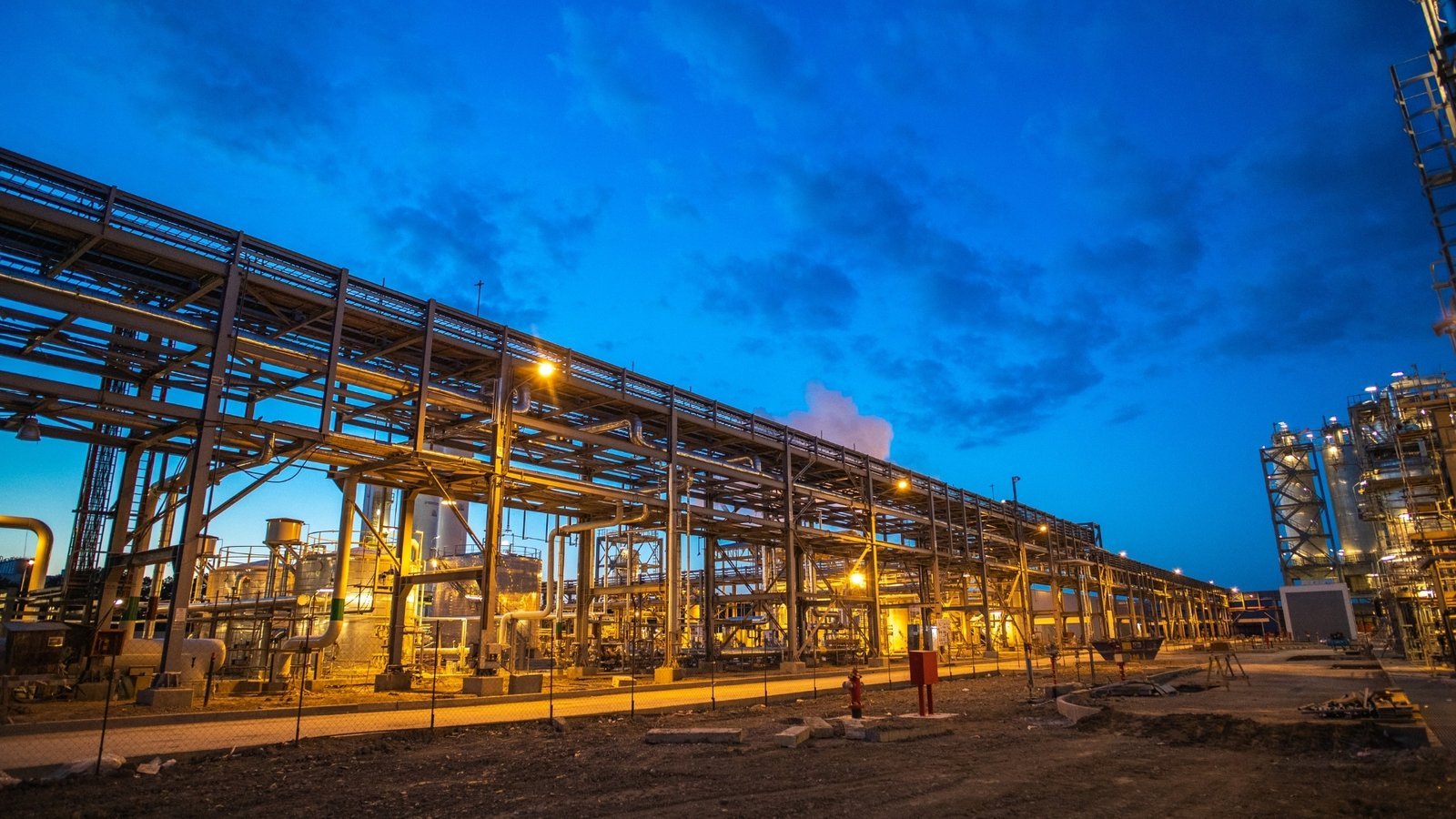 Projet 54Long industrial pipe rack corridor running through a processing plant at dusk
Six seats that did not exist in an upstream procurement decision
The origin article identified the widened committee. It is worth naming the seats, because each one has a different qualification test and most suppliers are only prepared for one of them.
First, the turbine slot holder. Gustavson said Chevron has deep relationships with GE Vernova and other manufacturers and that turbine availability is tight. The equipment decision is effectively made before the project exists, which is covered in the next section. Second, electrical balance of plant. This is the seat most oilfield suppliers underestimate. Wood Mackenzie data reported by Data Center Knowledge shows transformer demand running at about 1,500 units a year and projected above 9,000 by 2030, with lead times stretched from 140 weeks in 2023 to more than 160 weeks in 2026, and data centres accounting for roughly 40 per cent of total United States electrical equipment demand by 2030 against single digits historically. Steve Carlini of Schneider Electric told the same publication that operators are placing orders many years in advance, mainly for critical equipment like UPS and switchgear.
Third, EPC and construction capacity, which Gustavson confirmed is already in motion ahead of the investment decision. Fourth, the capital partners. Kilby is not a wholly owned Chevron asset: the developer is Energy Forge One LLC, a joint venture with Joulent, and National Grid Ventures agreed in July 2026 to invest 1.75 billion dollars for a 35 per cent stake in Joulent. Three balance sheets with three approval processes means a vendor qualification can be blocked in a place the Chevron relationship does not reach.
Fifth, incentive and tax counsel, which Section four covers. Sixth, emissions and permitting, which Section five covers. The named control technology for Kilby sits in a public document: the TCEQ plain language summary for permits 181895, PSDTX1684 and GHGPSDTX260 specifies selective catalytic reduction for nitrogen oxides and oxidation catalyst for carbon monoxide and volatile organic compounds.
Who is not on the committee is equally instructive. Nobody in this list buys on an oilfield services framework agreement, a drilling rate card or a master service agreement negotiated with upstream supply chain. A supplier whose only Chevron credential is an upstream vendor number is, for the purposes of this budget line, a new vendor. That is a qualification project with a lead time of its own, and it should be started against the next project rather than this one.
There is also a scope widening worth planning for. Water is a named audit category in Texas, cooling and controls sit at the interface between the plant and the data hall, and operations and maintenance for a twenty year firm obligation is a separate commercial conversation from construction. The project is phased over several years, so there is more than one procurement wave and a capability statement built around a single commercial operation date will miss most of them.
The order book is the calendar
Chevron did not buy turbines because it won a contract. It won a contract because it already held turbines. The primary document is the Engine No. 1, Chevron and GE Vernova joint press release of 28 January 2025, which announced a venture targeting up to 4 gigawatts for United States data centres, described the first projects as power foundries serving the Southeast, Midwest and West without initially flowing power through existing transmission grids, and stated that seven United States made GE Vernova 7HA natural gas turbines had been secured under a slot reservation agreement. The Microsoft contract followed on 22 June 2026, seventeen months later.
That sequence is the single most important commercial fact in this dossier for a supplier. Equipment is reserved before the customer exists. If your sales cycle starts at final investment decision, you are arriving after the specification has been fixed by whoever held the slot.
The order books explain why. The numbers below are the latest reported by each manufacturer.
Two details inside that table matter more than the headline. GE Vernova's 63 gigawatts of slot reservations are not firm orders, which means capacity exists on paper that has not converted, and conversion is where the rest of the supply chain gets its signal. And Siemens Energy is expanding in exactly the place the scarcity is migrating to: alongside turbine unit additions it said transformer and switchgear capacity will grow by about 50 per cent by 2030. Chief executive Christian Bruch put the addressable market at up to 120 gigawatts a year, about half of it in the United States.
Pricing has moved with the scarcity. Estimates from Moses Sutton, senior analyst at BNP Paribas Equity Research, reported alongside GE Vernova's second quarter results, put heavy duty turbines at about 790 dollars per kilowatt, HA class combined cycle at about 950 dollars per kilowatt and aeroderivative units at about 1,800 dollars per kilowatt. Those are analyst estimates, not list prices, but the direction tells a supplier what the buyer's cost base looks like and therefore how much a schedule saving is worth.
The practical consequence is a different sales motion. Sell against the reservation, not the project. Track slot reservation announcements, OEM capacity expansions and air permit filings, because a permit application names equipment models and capacities that a press release does not. Price on schedule certainty rather than unit cost, and bring a modular or fast tranche option, because the phasing of these projects deliberately puts smaller and faster equipment ahead of the heavy frames.
| GE Vernova | 116 gigawatts of gas equipment under backlog and slot reservations, comprising 53 gigawatts firm backlog and 63 gigawatts slot reservations, up from 100 gigawatts in the prior quarter. Company expects about 125 gigawatts by the end of 2026. | Taking reservations for 2031 deliveries, with Scott Strazik saying GE Vernova is on track to be more than halfway contracted for 2031 by the end of the year, and that it needs more time before articulating the timing of 2032 contracting. | Second quarter 2026 results, reported by Utility Dive |
| Siemens Energy | 69 gigawatts of gas turbine backlog, with 15 gigawatts booked in the quarter and 6 gigawatts shipped. | Lead times of three years or more. Delivery capacity of 15 to 16 gigawatts for the year. | Third quarter 2026 results, reported by Utility Dive |
| Mitsubishi Heavy Industries | About 35 gigawatts of large frame backlog. | Not stated in the source. | 2026 analysis by oilprice.com, reported figure rather than a company disclosure |
| Manufacturing capacity, GE Vernova | 20 gigawatts a year currently, with a stated target of 30 gigawatts a year by 2030. | Not applicable. | Second quarter 2026 results, reported by Utility Dive |
| Manufacturing capacity, Siemens Energy | 30 units of medium turbine capacity added since 2025, 15 large turbine units to be added in 2027 for a total of 35, and about 100 medium units targeted by 2028. Transformer and switchgear capacity to grow by about 50 per cent by 2030. | Not applicable. | Third quarter 2026 results, reported by Utility Dive |
JETI, Senate Bill 6 and an audit that arrived in August
The origin article called incentive fluency a differentiator. The reason is that the incentive case is now part of the project's financial model rather than a rebate claimed afterwards, which means it is in the room when scope and schedule are set.
The Texas instrument is JETI, created by House Bill 5, with final rules effective 16 January 2024. Per the Texas Comptroller, it limits taxable property value for school district maintenance and operations taxes over a ten year period: 100 per cent limitation during construction of up to two years, then 50 per cent once operational. Eligible categories include utility services such as dispatchable energy, and renewables are expressly excluded. There is a 30,000 dollar application fee to the school district, the Comptroller reviews within 60 days, and final approval rests with the governor and the school district. For the Energy Forge project, state comptroller documents reported by WIRED and Grist indicate a saving of more than 227 million dollars over ten years, with the Pecos Barstow Toyah school board approving the abatement application in February 2026. Those are reported estimates, not company disclosures.
Two features of that structure matter to a vendor. The benefit is tied to appraised property value, so equipment selection, siting and phasing have tax consequences, and a supplier who can speak to those consequences is contributing to the model rather than to the cost line. And the approval is local and political: a school board vote in a county of modest means is a visible decision, which is why Good Jobs First and local reporting have become part of the project's risk register.
The federal position on carbon capture is the other incentive lever worth knowing. After the One Big Beautiful Bill Act, 45Q pays 85 dollars a tonne for point source capture with saline sequestration and 180 dollars a tonne for direct air capture into dedicated geologic storage, with parity so that utilisation and qualified enhanced oil or gas recovery storage earn the same value as saline storage, inflation adjustment from 2027 against a 2025 base index year, and transferability preserved, subject to new restrictions on foreign entities of concern. That matters for the producer led model specifically, because a producer with carbon dioxide pipeline and storage capability can convert an emissions liability into a credit stream. ExxonMobil's project with NextEra is sited near its own carbon dioxide pipeline infrastructure for exactly that reason.
The regulatory half of the fluency test is Texas large load law. Senate Bill 6, effective on signature 21 June 2025, applies to loads of 75 megawatts and above unless the Public Utility Commission of Texas sets a lower threshold. It requires large loads with on site backup generation able to serve at least 50 per cent of demand to disclose facility and generation information to their utility and to ERCOT, and allows ERCOT to direct them with reasonable notice to deploy that backup or curtail load during emergencies. It imposes mandatory curtailment on noncritical large loads during firm load shed, sets a flat study fee of at least 100,000 dollars for initial transmission screening studies, requires applicants to disclose whether they are seeking substantially similar interconnection elsewhere in Texas, and requires demonstrated site control. Co located net metering arrangements with existing generators require a formal Public Utility Commission review that can impose conditions including load reductions or hold harmless commitments for stranded assets.
Then August happened. On 3 August 2026, Governor Abbott directed the Public Utility Commission and ERCOT to conduct a comprehensive verification and audit of data centre projects in the interconnection queue, saying that noncompliant projects should be denied access to the Texas grid, and ERCOT announced it would not meet the 7 August Batch Zero deadline and would seek a good cause exception. Holland and Knight records the audit scope as covering tax incentives, public financial assistance, electricity demand, on site generation, water sourcing and reuse, cooling technologies, community impacts and project ownership. BloombergNEF, reported by POWER Magazine, estimated that 49.8 gigawatts of data centre capacity could face delays, almost 20 per cent of the United States 253 gigawatt data centre pipeline, at a cost to projects of 8 to 15 billion dollars on an assumed three month slip, against ERCOT peak demand of 91.3 gigawatts. Those are estimates.
Read those two items together and the supplier conclusion is specific. The audit scope is a list of the documents a project now has to be able to produce, and most of them are produced by vendors: generation design, water sourcing and reuse, cooling technology, incentive filings. No source found states whether the audit reaches islanded behind the meter projects, and that question should not be answered on a supplier's behalf. What is clear is that a vendor whose package arrives with its own water, emissions and incentive documentation reduces a risk the buyer is currently being audited on, and a vendor whose package arrives without it adds one.
The customer is now the regulator
On 14 September 2026 the Environmental Protection Agency finalised the repeal of the majority of the provisions of the 2024 Carbon Pollution Standards for greenhouse gases from fossil fuel fired electric generating units, including the carbon capture based standards for new base load stationary combustion turbines, and issued a supplemental proposal to repeal what remains, including efficiency based standards for new or reconstructed stationary combustion turbines. EPA's own fact sheet puts the saving from the final repeal at up to 310 billion dollars and a further 370 million dollars from the proposed rescission.
On a naive reading that should end the carbon conversation for a gas fired behind the meter plant. It does not, for one reason: the obligation did not come from the federal rule in the first place. It comes from the offtaker. The customer here is a hyperscaler with public climate commitments underwriting decades of new combustion, which is the dynamic the origin article identified and which is unchanged by a repeal.
The numbers that will be argued over are already public and they are the applicant's own. The TCEQ plain language summary for permits 181895, PSDTX1684 and GHGPSDTX260 lists thirteen pollutants for the Energy Forge One plant, including nitrogen oxides at 886.34 tons a year, PM10 at 605.49 tons a year, and carbon dioxide equivalent at 11,564,704.59 tons a year, with selective catalytic reduction named for nitrogen oxides and oxidation catalyst for carbon monoxide and volatile organic compounds. Third party models put the figure in a similar place from the outside: the Environmental Integrity Project, cited by TechCrunch, modelled more than 13 million tons of carbon dioxide a year alongside 3,200 tons of criteria air pollutants and 278,000 pounds of hazardous air pollutants, and a WIRED analysis reproduced by Grist on 17 May 2026 put the plant above 11.5 million tons of carbon dioxide equivalent a year. The models are estimates; the 11,564,704.59 tons figure is in a filed application.
For a supplier, the commercial consequence is that emissions mitigation has moved from compliance to specification. Selective catalytic reduction and oxidation catalyst are already in the permit, so the differentiated scope sits around them: continuous emissions monitoring and reporting that a customer can put in its own disclosure, methane management across the gas gathering that feeds the plant, heat rate and water performance, and carbon capture readiness.
Capture readiness is where the producer led model has a structural advantage, and it is worth being precise about what is and is not committed. Chevron has not announced carbon capture at Kilby. ExxonMobil has: the 1.2 gigawatt plant it is developing with NextEra is sited on 2,500 acres near its own carbon dioxide pipeline infrastructure with integrated capture and sequestration, and ExxonMobil's earlier plan, announced in December 2024, described more than 1.5 gigawatts with capture of more than 90 per cent of emissions. Frontier Infrastructure and Baker Hughes announced 256 megawatts of behind the meter gas fired power at the Sweetwater Carbon Storage Hub in Wyoming in March 2025. A vendor selling into this space should expect capture readiness to be specified even where capture is not built, because the option has a value set by 45Q and an owner who may already hold the pipeline.
The honest qualification is that none of the Kilby offtake terms covering carbon, fuel indexation or curtailment are public. Who carries the cost of a future capture retrofit is therefore unknown, and it is the kind of term that decides whether mitigation scope is an owner cost or a vendor obligation. Suppliers should ask rather than assume.
The pattern, not the account
The origin article predicted the model would be copied by other producers with cheap associated gas. That has stopped being a prediction. The table below lists the producer led and producer adjacent behind the meter projects that are on the record.
The pattern across them is consistent. The producer contributes three things a conventional independent power producer cannot: in basin gas that is a disposal problem before it is a commodity, land and existing gathering infrastructure, and a capital projects organisation used to multi billion dollar schedules. What the producer usually does not contribute is the power plant operating capability or, in some cases, the balance sheet, which is why most of these structures involve a partner. Diamondback is explicitly looking for one: president Kaes Van't Hof said the company aims to be a premier partner for data centre operators seeking affordable land and natural gas access, that it is pursuing partnerships with independent power producers for a large in basin behind the meter plant, and that discussions with hyperscalers remain confidential.
There is a clock on the fuel advantage, and suppliers should price with it in view. VanEck wrote in July 2026 that gas at Waha had been worth less than nothing for nearly 30 per cent of the previous three and a half years, but that the Permian will add more than 10 billion cubic feet a day of takeaway capacity over three years, including Blackcomb at 2,500 million cubic feet a day by the fourth quarter of 2026 and Hugh Brinson phases from late 2026 into early 2027, and that the winter 2026 and 2027 basis had already tightened to about minus 1.07 dollars per million British thermal units against minus 3.60 dollars the previous winter. VanEck calls this a structural inflection point. The negative price that makes the arbitrage dramatic is narrowing, which argues for acting on this demand now rather than treating it as a decade long tailwind.
It also means in basin power demand becomes part of the gas balance rather than a curiosity. VanEck states the Microsoft and Chevron agreement projects 600 million cubic feet a day of consumption, which is an estimate, and East Daley Analytics has described Permian data centre projects collectively consuming in the hundreds of millions of cubic feet a day. For midstream, treating, compression, water and gas quality suppliers, that is a demand sink with a credit rating attached, which is a better customer than a flare.
The coverage conclusion for a supplier is to stop account mapping and start pattern mapping. The qualifying signals are observable without a relationship: an acreage position with high associated gas, an announced slot reservation or OEM partnership, an air permit application, a JETI or local abatement filing, and a named investment grade offtaker. A project with four of those five is credible. A project with an announcement and nothing else is a press release, and pipeline sized off announced gigawatts will overstate the addressable market substantially.
Finally, a note on where the next scarcity premium sits, because it is not where it sat eighteen months ago. Wood Mackenzie projects the United States data centre electrical equipment market rising from about 20 billion dollars in 2026 to 65 billion by 2030, with transformer demand going from roughly 1,500 units a year to more than 9,000 and lead times already beyond 160 weeks. Ben Boucher of Wood Mackenzie described the constraint as a combination of power limitations and equipment constraints. Schneider Electric has committed more than 700 million dollars of United States investment through 2027 in response. Turbine slots were the 2025 story. Transformers, switchgear, medium voltage distribution and uninterruptible power supply blocks are the 2027 one, and that is the scope a supplier can still get in front of.
| Project Kilby, Chevron and Microsoft, developed by Energy Forge One LLC with Joulent | Reeves County, Texas, near Pecos | 2.67 gigawatts contracted | 20 year take or pay power purchase agreement announced 22 June 2026. Final investment decision expected by the end of 2026, first power targeted late 2028. Permit application filed with TCEQ. National Grid Ventures agreed in July 2026 to invest 1.75 billion dollars for a 35 per cent stake in Joulent. | Chevron, 22 June 2026, and Chevron second quarter 2026 earnings call, 3 August 2026 |
| ExxonMobil and NextEra | Southeastern United States | 1.2 gigawatts | 2,500 acres sited near ExxonMobil carbon dioxide pipeline infrastructure, with integrated carbon capture and sequestration. Marketing to hyperscale developers planned from the first quarter of 2026. NextEra separately targets 15 gigawatts of gas capacity for data centre hubs by 2035. | Reported by Data Center Dynamics and CNBC, December 2025 |
| Diamondback Energy | Permian Basin | Non divulgué | 65,000 acres and about 1.17 billion cubic feet a day of gas. Seeking an independent power producer partner for a large in basin behind the meter plant. Hyperscaler discussions described as confidential. | Kaes Van't Hof, reported by Data Center Dynamics |
| FO Permian Partners with HiVolt Energy | Midland County, Texas | More than 5 gigawatts targeted, with an initial 150 megawatts described as immediately available | 320 acres inside a 3,200 acre tract with access to more than 5 gigawatts of gas supply. Reciprocating engines with redundant battery systems, operated by HiVolt Energy. Phase one expected by 2026. | Reported by Data Center Dynamics |
| Frontier Infrastructure and Baker Hughes | Sweetwater Carbon Storage Hub, Wyoming | 256 megawatts | Behind the meter gas fired power co located with carbon storage. | Announced March 2025, per the Global CCS Institute |
| Chevron, Engine No. 1 and GE Vernova power foundries | Southeast, Midwest and West of the United States | Up to 4 gigawatts targeted | Seven United States made GE Vernova 7HA turbines secured under a slot reservation agreement. Initial in service targeted by the end of 2027. | Joint press release, 28 January 2025 |
Écoutez et emportez-le avec vous
Vous préférez le format audio ou vous avez besoin de la présentation pour une analyse interne ? Le compte rendu complet est disponible sous forme d’épisode de podcast et de diaporama téléchargeable.
Which credential will win the most behind the meter power awards in 2027?
Questions fréquemment posées
In practice yes, and it is not the upstream route. The buyer is Energy Forge One LLC, a joint venture with Joulent in which National Grid Ventures agreed in July 2026 to invest 1.75 billion dollars for a 35 per cent stake, and the sponsor organisation is Chevron New Energies under president Jeff Gustavson. The decision gates look like capital project gates, with a final investment decision expected by the end of 2026, and the contract shape is a 20 year take or pay obligation rather than a commodity sale. A supplier whose only Chevron credential is an upstream vendor number should treat qualification into the power organisation as a separate project with its own lead time, and should aim it at the next project in the sequence rather than this one, because Gustavson said on the 3 August 2026 earnings call that Chevron is already in advanced discussions on additional opportunities.
Three groups. Those holding or able to influence equipment delivery slots, because GE Vernova reported 116 gigawatts of gas equipment under backlog and slot reservations at the end of the second quarter of 2026 and is taking reservations for 2031, and the specification is effectively set at reservation rather than at award. Those in electrical balance of plant, where Wood Mackenzie data reported by Data Center Knowledge shows transformer lead times beyond 160 weeks in 2026 and a United States data centre electrical equipment market projected to grow from about 20 billion dollars in 2026 to 65 billion by 2030. And those who can take a documentation burden off the owner, meaning emissions monitoring, methane management, water sourcing and reuse, cooling and the incentive filings, all of which are categories in the data centre audit that Governor Abbott ordered on 3 August 2026.
Faster at the front and slower at the back than an upstream package. The front is fast because the binding commitments are made early: the slot reservation for seven GE Vernova 7HA turbines was announced on 28 January 2025 and the Microsoft power purchase agreement followed on 22 June 2026, seventeen months later, with the final investment decision expected by the end of 2026 while permitting and EPC activities were already progressing. The back is slower because the plant is phased, with first power targeted for late 2028 and capacity added over several years, which creates more than one procurement wave. A supplier selling against a single commercial operation date will be early for one wave and late for the rest.
Yes, because the requirement is contractual rather than regulatory. The Environmental Protection Agency finalised repeal of the majority of the 2024 Carbon Pollution Standards on 14 September 2026, including the carbon capture based standards for new base load stationary combustion turbines, and proposed to repeal the remaining standards. The offtaker's own climate commitments do not move with that. The figures that will be discussed are already filed: the TCEQ plain language summary for permits 181895, PSDTX1684 and GHGPSDTX260 lists nitrogen oxides at 886.34 tons a year, PM10 at 605.49 tons a year and carbon dioxide equivalent at 11,564,704.59 tons a year, with selective catalytic reduction and oxidation catalyst named as controls. Third party models from the Environmental Integrity Project and from WIRED, reproduced by Grist on 17 May 2026, land in a similar range and are estimates. Carbon capture readiness is worth pricing as an option, because 45Q now pays 85 dollars a tonne for point source capture into saline storage with parity for qualified enhanced recovery storage, although Chevron has not announced capture at Kilby.
The ones with cheap associated gas, land and a capital projects organisation. ExxonMobil is developing 1.2 gigawatts with NextEra in the southeastern United States on 2,500 acres near its own carbon dioxide pipeline infrastructure with integrated carbon capture, and NextEra has said it targets 15 gigawatts of gas capacity for data centre hubs by 2035. Diamondback Energy holds 65,000 acres in the Permian and about 1.17 billion cubic feet a day of gas and is seeking an independent power producer partner for an in basin behind the meter plant. FO Permian Partners has 320 acres in Midland County inside a 3,200 acre tract behind a target of more than 5 gigawatts, with HiVolt Energy operating reciprocating engines and battery systems. Frontier Infrastructure and Baker Hughes announced 256 megawatts at the Sweetwater Carbon Storage Hub in Wyoming in March 2025. Qualify them on observable signals rather than announcements: a slot reservation or OEM partnership, an air permit application, a local incentive filing and a named investment grade offtaker.
Obtenez la suite gouttelettes de renseignement
Rejoignez les leaders des secteurs de l'énergie et de l'industrie et recevez directement nos informations stratégiques en matière de marketing, de croissance par IA et d'architecture des revenus, sans superflu.
Vous êtes sur la liste
Bienvenue dans The Energy Growth Brief, consultez votre boîte de réception pour le prochain numéro.