



Who Actually Spends on Low Carbon? Six Majors Compared
Shell, BP, TotalEnergies, Chevron, ExxonMobil and Equinor all publish a low carbon number, and almost none of them mean the same thing by it. BP's audited low carbon energy spend in 2025 was USD 464 million, 3.2 per cent of group capital expenditure. Wood Mackenzie data put BP at 12 per cent. Both are defensible. The gap between them is the only thing worth understanding here.
- The ranking is produced by the definitions, not by the strategies. Each company draws the low carbon boundary in a different place, and the boundary is worth more percentage points than any actual change in spending.
- BP's audited number is the smallest and the most surprising. Low carbon energy capital expenditure was USD 464 million in financial year 2025, 3.2 per cent of USD 14.5 billion group capital expenditure, down 71 per cent from USD 1,596 million in 2024. BP's broader transition businesses line of USD 1.5 to 2 billion for 2026 includes electric vehicle charging and biofuels, which sit in the Customers segment.
- Shell's percentage fell in 2026 without a single dollar being cut. Group cash capital expenditure guidance rose from USD 20 to 22 billion to USD 24 to 26 billion to absorb the ARC Resources acquisition announced in April 2026. The denominator moved, the numerator did not.
- Shell's constraint is a balance sheet cap, not a budget. The company holds Low Carbon Options plus Power below 10 per cent of group capital employed, with Power capital employed under USD 15 billion. That is a limit on how much capital can sit in the business, which is a different instruction to a supplier than an annual spending target.
- TotalEnergies' leading number is partly a gas number. Integrated Power explicitly combines renewables with gas fired combined cycle plant, batteries, trading and retail electricity. Its September 2026 Strategy and Outlook indicates roughly two thirds of 2030 generation growth from renewables and one third from flexible gas generation.
- Independent rankings contradict the filings, in the same direction. Wood Mackenzie data reported via the Financial Times in April 2025 ranked low carbon as a share of capital expenditure at TotalEnergies 29 per cent, ExxonMobil 17 per cent, Shell 17 per cent and BP 12 per cent. BP's own audited low carbon energy spend for 2025 was 3.2 per cent. Both numbers are real. They are measuring different things.
- The clearest single event of the retreat is an asset transfer. On 3 August 2026 Shell agreed to sell its European onshore renewables portfolio, about 500 MW operating or under construction across the United Kingdom, Italy, the Netherlands and Spain plus a 3.5 GW pipeline, to TotalEnergies. Price undisclosed. Assets moving from a retreating European major to the one still expanding.
- Hurdle rates are now the gate, and they are published. Shell wants power returns north of 10 per cent before the end of the decade. Equinor wants nominal equity returns above 10 per cent on power projects. TotalEnergies targets about 12 per cent segment return on average capital employed by 2030, from 9.7 per cent in 2025.
Six companies, six definitions, one table
The table below uses 2026 guidance where it exists, and states the denominator so the percentage can be checked. Every percentage in it is calculated by Project 54 from the cited figures rather than published by the company, because with one exception none of them publish the ratio.
Two entries are estimates and are labelled as such. ExxonMobil does not disclose an annual low carbon figure, so the roughly USD 3.3 billion a year shown is simply the company's approximately USD 20 billion 2025 to 2030 envelope divided straight line across six years. Equinor publishes a percentage but no dollar amount, so the implied figure is about 10 per cent of roughly USD 12 billion of organic capital expenditure.
One entry is not a number at all. Chevron reports a single combined line of about USD 1 billion covering both the lowering of carbon intensity in its own operations and the growth of New Energies, and does not split the two. Not disclosed is the finding, and it should be read as one.
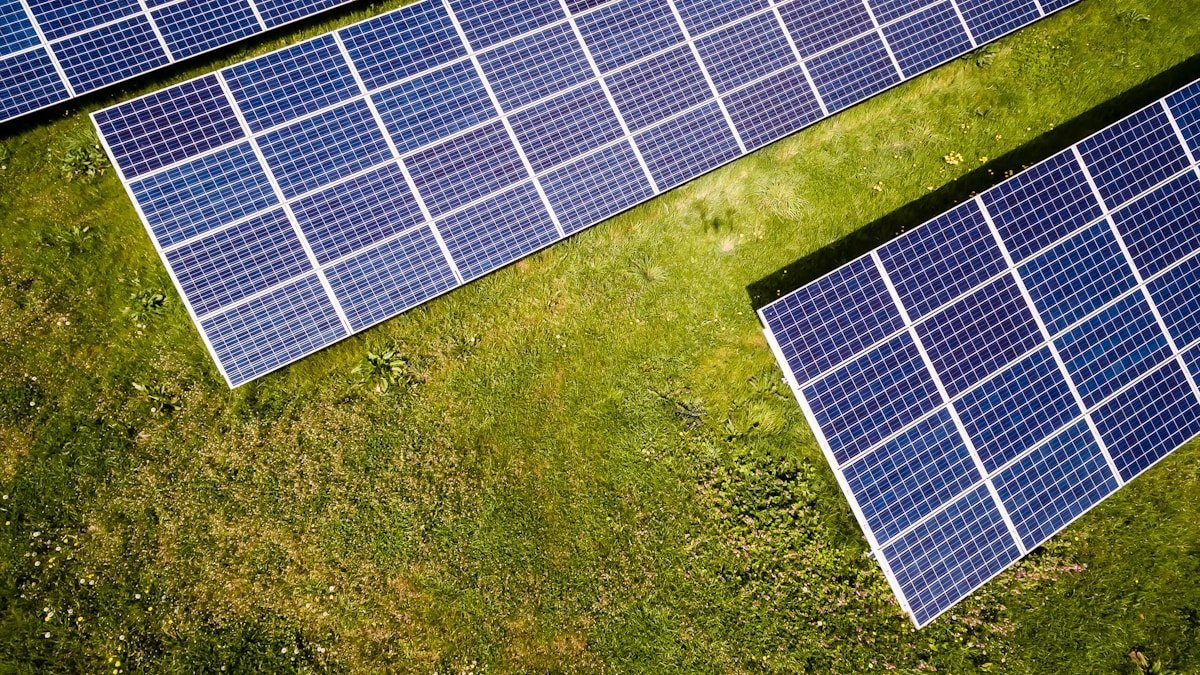 Projet 54A utility scale solar array. Only one of the six majors compared here is still buying assets like this at scale, and in August 2026 it bought another major's.
| Entreprise | Low carbon capex 2026 | Total capex 2026 | Partager | What the definition includes | Direction |
|---|---|---|---|---|---|
| TotalEnergies | About USD 3.0 billion, mainly electricity | About USD 15 billion net investments | About 20 per cent | Integrated Power: renewables plus gas fired CCGTs, batteries, power trading and retail electricity and gas, plus low carbon molecules | Expanding, the only one |
| ExxonMobil | Not disclosed annually. About USD 3.3 billion a year, Project 54 estimate from a USD 20 billion 2025 to 2030 envelope | USD 27 to 29 billion | About 12 per cent, estimate | CCS, hydrogen, lithium, biofuels, Proxxima resins, carbon materials, and reducing Exxon's own emissions | Cut, from about USD 30 billion to about USD 20 billion |
| BP | Transition businesses USD 1.5 to 2 billion, of which low carbon energy under USD 0.8 billion | USD 13.5 to 14.0 billion | 11 to 14 per cent, or under 6 per cent on the narrow line | Transition includes renewables, hydrogen and CCS plus biogas, biofuels and EV charging | Cut hard |
| Shell | Renewables and Energy Solutions USD 2 to 3 billion a year, 2025 to 2028 guidance | USD 24 to 26 billion, raised from USD 20 to 22 billion | About 8 to 12 per cent | Renewable power generation plus marketing, trading and optimisation of power and pipeline gas, plus hydrogen and CCS development. Low carbon fuels sit outside, in Marketing | Cut and divesting |
| Equinor | About 10 per cent of capex to the power business. No dollar figure disclosed | About USD 12 billion organic | About 10 per cent | Renewables plus Low Carbon Solutions, CCS and hydrogen, under a single power business framing | Cut. 2030 capacity target scrapped |
| Chevron | About USD 1 billion combined for own operational carbon intensity and New Energies. Not split | USD 18 to 19 billion, plus USD 1.3 to 1.7 billion affiliate | About 5 per cent | CCUS, hydrogen, renewable fuels, lithium, plus own operations carbon intensity. No wind or solar | Flat and opaque |
The audited 2025 numbers, which are smaller than the guidance implies
Guidance is a plan. Financial year 2025 actuals are a record, and they diverge.
BP's group capital expenditure in 2025 was USD 14.5 billion, down from USD 16.2 billion in 2024. Within that, low carbon energy capital expenditure was USD 464 million, against USD 1,596 million the year before. That is a fall of 71 per cent in one year, and it puts low carbon energy at 3.2 per cent of group capital expenditure. This is the number that most contradicts the public conversation about BP, and it is in BP's own reporting.
Shell's group cash capital expenditure in 2025 was USD 20,915 million, with Renewables and Energy Solutions at USD 1,866 million against USD 2,549 million in 2024, so 8.9 per cent of the group and falling. TotalEnergies' net investments were USD 17,091 million with low carbon at roughly USD 3.5 billion, of which about USD 3 billion was electricity, so about 20 per cent. Equinor's organic capital expenditure was USD 13.1 billion. ExxonMobil's cash capital expenditure was USD 29.0 billion.
Against those company figures, the International Energy Agency's World Energy Investment 2026 provides the sector level anchor. It reports that the oil and gas sector invested around USD 23 billion in low emissions energy technologies in 2025, and that low emissions spending accounted for close to 4 per cent of the sector's total capital expenditure, with 2026 expected at USD 22 to 24 billion. Four per cent for the sector as a whole is a useful corrective to any single company's framing.
Six boundaries, drawn in six different places
Shell counts trading. Renewables and Energy Solutions is defined to include renewable power generation and the marketing, trading and optimisation of power and pipeline gas. Pipeline gas trading sits inside the segment with the low carbon sounding name, while low carbon fuels sit outside it, in Marketing. Shell's binding constraint is also not a budget: it holds Low Carbon Options plus Power below 10 per cent of group capital employed, with Power capital employed under USD 15 billion.
BP counts retail. Transition businesses at USD 1.5 to 2 billion includes electric vehicle charging and biofuels, which report into the Customers segment. Strip those out and the low carbon energy line is under USD 800 million a year, and the 2025 actual was USD 464 million. Biogas moved into gas and low carbon energy from the first quarter of 2025, which moves the boundary again.
TotalEnergies counts gas fired power. Integrated Power is explicitly renewables plus combined cycle gas turbines plus storage plus trading plus retail supply. The September 2026 Strategy and Outlook indicates about two thirds of generation growth to 2030 coming from renewables and about one third from flexible gas generation. The highest headline percentage in the group is therefore partly a gas number, which does not make it wrong, only different from what a reader assumes.
ExxonMobil counts its own emissions and products that are not energy. The roughly USD 20 billion footprint covers carbon capture, hydrogen, lithium, biofuels, Proxxima polymer resins and carbon materials, together with abating Exxon's own emissions, with roughly 60 per cent aimed at third party customers' emissions. Chevron does not split its single combined line at all. Equinor gives only a percentage.
The consequence is simple and should be stated plainly. Any league table of majors by low carbon spending is a league table of accounting boundaries unless the author reconstructs the figures on one definition. Most published tables do not.
No, and the disagreement is large enough to matter
Wood Mackenzie data reported via the Financial Times in April 2025 ranked low carbon as a share of capital expenditure at TotalEnergies 29 per cent, ExxonMobil 17 per cent, Shell 17 per cent and BP 12 per cent. Set those against the filings. Wood Mackenzie's 17 per cent for Shell is roughly double Shell's own broadest segment figure of 8.9 per cent. Its 12 per cent for BP is close to four times BP's audited low carbon energy spend of 3.2 per cent. The analyst numbers are not wrong, they are built on a wider boundary than the companies' own narrow lines, but a reader comparing the two without noticing will reach false conclusions.
Wood Mackenzie's own commentary in September 2025 held that leading European majors will cap low carbon investment at 30 per cent of total budgets, with most international and national oil companies at 10 to 20 per cent. Tom Ellacott, Senior Vice President for Corporate Research, framed the driver bluntly: investors will continue to reward near term priorities such as distributions, stable cash flow and balance sheet strength.
Carbon Tracker's Absolute Impact 2026, published in April 2026, assessed 30 companies and concluded that targets remain incompatible with the Paris Agreement, highlighting the gap between targets and delivery strategies, though its company level scores sit behind a login. The Transition Pathway Initiative's Transition Planning 2026, published by the LSE centre in June 2026, examined 22 oil, gas and diversified mining companies and found significant gaps between stated ambition and implementation. BloombergNEF put global energy transition investment at USD 2.3 trillion in 2025, up 8 per cent, and published Energy Supply Ratios 2026 in September 2026, but company rankings are gated.
One widely circulated recent figure should be treated with care. A trade article on 8 October 2026 cited Energy Intelligence's Low Carbon Investment Tracker as showing low carbon investment across 50 oil and gas firms falling to USD 960 million in the second quarter of 2026, down 70 per cent quarter on quarter and the lowest since the fourth quarter of 2017. That is a secondary report of a subscription only tracker and Project 54 has not verified it against the source. It is included because it points the same way as everything else, and excluded from the table because it is unconfirmed.
About ten per cent, three points below the group, and improving slowly
This is the question that decides whether the only expanding programme in the group is a strategy or a subsidy, and TotalEnergies discloses enough to answer it.
Integrated Power produced adjusted net operating income of USD 2,215 million in financial year 2025, up 2 per cent, and cash flow from operations excluding working capital of about USD 2.6 billion. Gross installed renewable capacity was 34.1 GW at the end of 2025. Segment return on average capital employed was 9.7 per cent in the segment table, described as 10 per cent in the narrative text of the same release, an internal inconsistency worth noting. Group return on average capital employed was 12.6 per cent, which Chief Executive Patrick Pouyanne has described as the best among the majors for a fourth consecutive year.
So the power business is running roughly three percentage points below the group, at or around a plausible cost of capital rather than clearly above it. The September 2026 Strategy and Outlook targets about 12 per cent segment return by 2030, with free cash flow balanced in 2026 and positive from 2027, net capital expenditure of USD 14 to 17 billion a year for 2027 to 2032, electricity at about 20 per cent of 2030 energy production rising to 25 per cent by 2035, and generation of 100 to 120 TWh in 2030.
Pouyanne's own framing of why he is doing it is the most useful quote in this whole comparison, because it explicitly rejects the environmental case for the commercial one. On the second quarter 2026 earnings call on 23 July 2026 he said the new world is electrification. It's not green, by the way. It's electricity, electrification, domestic resource.
The retreat, in their own words
Murray Auchincloss, Chief Executive of BP, announcing the strategy reset on 26 February 2025: today we have fundamentally reset bp's strategy. He added that we are reducing and reallocating capital expenditure to our highest returning businesses to drive growth.
Anders Opedal, President and Chief Executive of Equinor, on retiring the 10 to 12 GW 2030 renewables capacity target around the June 2026 Capital Markets Day: we have seen for several years that we will not reach that target. In February 2025, announcing the earlier halving of transition investment, he had said that to underline that value creation is at the core of our decision making, we now retire the gross capex ambition.
Machteld de Haan, Shell's Downstream, Renewables and Energy Solutions Director, on 3 August 2026 as Shell sold its European onshore renewables portfolio to TotalEnergies: we are recycling capital and prioritising areas where we have differentiated capabilities.
Mike Wirth, Chairman and Chief Executive of Chevron, on the 2026 capital programme on 5 December 2025: our 2026 capital program focuses on the highest return opportunities while maintaining discipline and improving efficiency. Darren Woods, Chairman and Chief Executive of ExxonMobil, on the revised 2030 plan on 9 December 2025: ExxonMobil is not defined by our products but by our capabilities.
Read together, none of these is a statement about climate. All five are statements about returns and capital allocation. That is the register in which a supplier should now pitch.
Three conclusions a commercial team can act on
First, sell to the balance sheet, not to the brand. Shell's binding constraint is a capital employed cap, Low Carbon Options plus Power below 10 per cent of group capital employed with Power under USD 15 billion, rather than an annual budget. A proposition that adds capital employed is competing directly against that cap. One that is contracted, leased or delivered as a service is not. Reframing a capital request as an operating cost is not a finance trick here, it changes which internal limit the deal has to clear.
Second, there are only two durable buyers of renewable electricity at scale left in this set. TotalEnergies, at roughly USD 3 to 4 billion a year with 34.1 GW installed and actively buying other majors' portfolios, and a long way behind it Equinor at about 10 per cent of roughly USD 12 billion and shedding capacity targets. The American pair are buying something else entirely: carbon capture, hydrogen, lithium, biofuels and specialty resins. That is a different supplier base, in subsurface, compression, electrolysers and specialty chemicals, and its pacing is explicitly conditioned on policy support.
Third, the hurdle rates are published, so use them. Shell has said it expects a return on the power business north of 10 per cent before the end of the decade. Equinor wants nominal equity returns above 10 per cent on power projects. TotalEnergies is targeting about 12 per cent segment return by 2030 from 9.7 per cent today. Any proposal that cannot be shown to move a project's internal rate of return above those published thresholds will not clear the gate, whatever its carbon merit. The corollary is that carbon benefit is now a tie breaker between economically acceptable options, not an argument on its own.
A closing caution on the numbers in this piece. Chevron's New Energies split, Equinor's renewables and Low Carbon Solutions dollar figures, ExxonMobil's annual low carbon capital expenditure, BP's 2025 actual spend on the full transition aggregate and the price Shell received for its European renewables are all undisclosed. Where this dossier shows a figure for them, it is a Project 54 calculation from the stated envelope and is labelled as an estimate.
Écoutez et emportez-le avec vous
Vous préférez le format audio ou vous avez besoin de la présentation pour une analyse interne ? Le compte rendu complet est disponible sous forme d’épisode de podcast et de diaporama téléchargeable.
You are comparing two majors' low carbon commitment for an account plan. What do you check first?
Questions fréquemment posées
TotalEnergies, on every definition. It guides to about USD 3 billion of low carbon investment within roughly USD 15 billion of net investments for 2026, around 20 per cent, and in financial year 2025 spent roughly USD 3.5 billion of USD 17,091 million. It is also the only one of the six expanding, and in August 2026 it agreed to buy Shell's European onshore renewables portfolio. The caveat is that its Integrated Power segment includes gas fired generation, batteries, trading and retail supply alongside renewables.
Far less than the public conversation suggests. BP's audited low carbon energy capital expenditure in financial year 2025 was USD 464 million, against group capital expenditure of USD 14.5 billion, so 3.2 per cent. That was a fall of 71 per cent from USD 1,596 million in 2024. BP's broader transition businesses guidance of USD 1.5 to 2 billion for 2026 is a wider boundary that includes electric vehicle charging and biofuels, and its narrow low carbon energy line is guided at under USD 800 million a year.
Largely because the denominator moved. Shell raised 2026 group cash capital expenditure guidance from USD 20 to 22 billion to USD 24 to 26 billion to absorb the ARC Resources acquisition announced in April 2026. Renewables and Energy Solutions guidance stayed at USD 2 to 3 billion a year. The share fell without a dollar being cut from the low carbon line, although Shell separately divested its European onshore renewables portfolio and Sprng Energy in India during 2026.
They are no longer in the same category. TotalEnergies invests about USD 3 billion a year in low carbon, mainly electricity, within about USD 15 billion of net investments, and holds 34.1 GW of gross installed renewable capacity. Shell's Renewables and Energy Solutions segment is guided at USD 2 to 3 billion a year within USD 24 to 26 billion of capital expenditure, and that segment includes the marketing and trading of power and pipeline gas rather than generation alone. The decisive evidence came on 3 August 2026, when Shell agreed to sell its European onshore renewables portfolio, about 500 MW operating or under construction plus a 3.5 GW pipeline, to TotalEnergies.
Because they use wider boundaries. Wood Mackenzie data reported via the Financial Times in April 2025 ranked low carbon as a share of capital expenditure at TotalEnergies 29 per cent, ExxonMobil 17 per cent, Shell 17 per cent and BP 12 per cent. BP's own audited low carbon energy spend for 2025 was 3.2 per cent of group capital expenditure and Shell's broadest segment figure was 8.9 per cent. Neither source is wrong. Analyst figures typically fold in biofuels, electric vehicle charging, gas fired power, carbon capture and efficiency spending that the companies' narrow lines exclude.
Not wind and solar. ExxonMobil's roughly USD 20 billion envelope for 2025 to 2030, cut from about USD 30 billion, covers carbon capture, hydrogen, lithium, biofuels, Proxxima polymer resins, carbon materials and the abatement of Exxon's own emissions, with roughly 60 per cent aimed at third party customers' emissions. Chevron publishes a single combined line of about USD 1 billion for 2026 covering both the carbon intensity of its own operations and the growth of New Energies, which spans carbon capture, hydrogen, renewable fuels and lithium, and does not split the two.
Marginally, and below the group. Integrated Power delivered adjusted net operating income of USD 2,215 million in 2025, up 2 per cent, with cash flow from operations excluding working capital of about USD 2.6 billion, and a segment return on average capital employed of 9.7 per cent, described as 10 per cent in the narrative text of the same release. Group return on average capital employed was 12.6 per cent, so the power business runs roughly three percentage points below the group. TotalEnergies targets about 12 per cent segment return by 2030, with segment free cash flow balanced in 2026 and positive from 2027.
Close to 4 per cent of its capital expenditure. The International Energy Agency's World Energy Investment 2026 reports that the oil and gas sector invested around USD 23 billion in low emissions energy technologies in 2025, representing close to 4 per cent of the sector's total capital expenditure, and expects USD 22 to 24 billion in 2026. That figure is the most useful single corrective to any individual company's framing of its own commitment.
Obtenez la suite gouttelettes de renseignement
Rejoignez les leaders des secteurs de l'énergie et de l'industrie et recevez directement nos informations stratégiques en matière de marketing, de croissance par IA et d'architecture des revenus, sans superflu.
Vous êtes sur la liste
Bienvenue dans The Energy Growth Brief, consultez votre boîte de réception pour le prochain numéro.