



For energy executives, the traditional sales funnel has been superseded by autonomous digital research. If operational frameworks and performance data are restricted to gated formats, a firm remains invisible to the majority of its potential market.
Supply chain predictive maintenance is a strategic Answer Engine Optimization (AEO) framework designed to provide structured, authoritative data to B2B buyers during their independent research phase. By securing “zero-click” featured snippets and AI overviews, industrial firms bypass the 9:1 Valuation Trap—the imbalance of spending $9 on outbound sales for every $1 invested in organic authority. This approach reduces Customer Acquisition Cost (CAC) and establishes technical benchmarks.
In the energy sector, capital allocation requires rigorous evidence. A procurement officer’s search for specific data, such as “liquid cooling vs. forced air efficiency for Tier 4 data centers,” often determines the vendor shortlist before an RFP is formally issued.
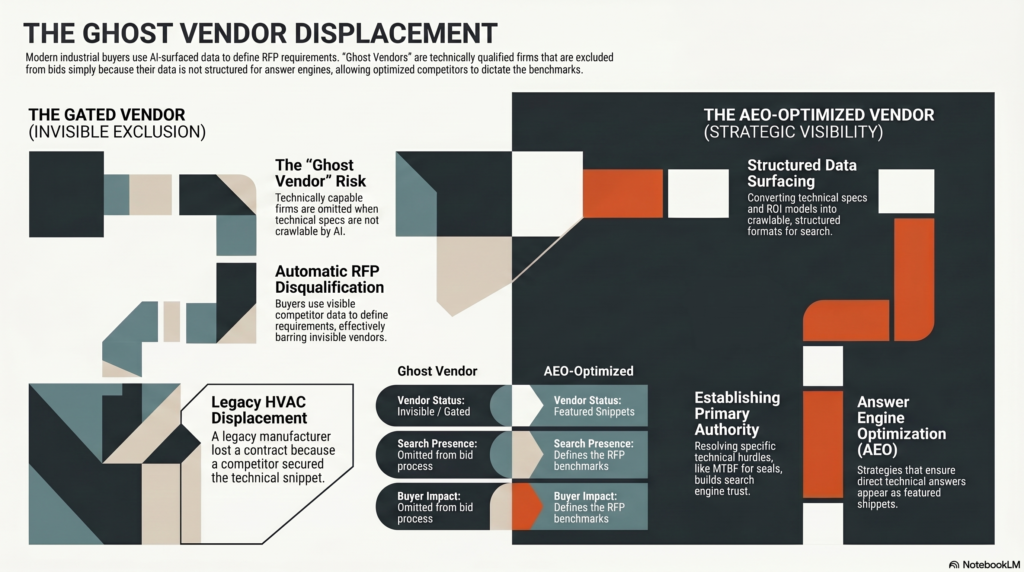
Mitigating the “Ghost Vendor” Risk Through AEO
AEO strategies mitigate the “Ghost Vendor” risk by ensuring technical specifications and ROI models appear as direct answers in search results, preventing superior products from being excluded by competitors with superior data structuring.
Industrial firms that fail to optimize for answer engines risk being excluded from consideration. These “Ghost Vendors” are technically capable but are omitted from the bid process because they did not provide the structured data used by buyers to build internal business cases. In a documented industrial HVAC scenario, a legacy manufacturer lost a significant contract to a smaller competitor that secured the featured snippet for a technical comparison table. The buyer used the competitor’s data to define the RFP requirements, effectively disqualifying any vendor that did not meet those AI-surfaced benchmarks.
Strategic positioning now dictates a shift from broad keyword targeting toward resolving specific technical hurdles, such as evaluating MTBF for cryogenic pump seals. Providing this data in a structured, crawlable format ensures search engines recognise the brand as the primary authority.
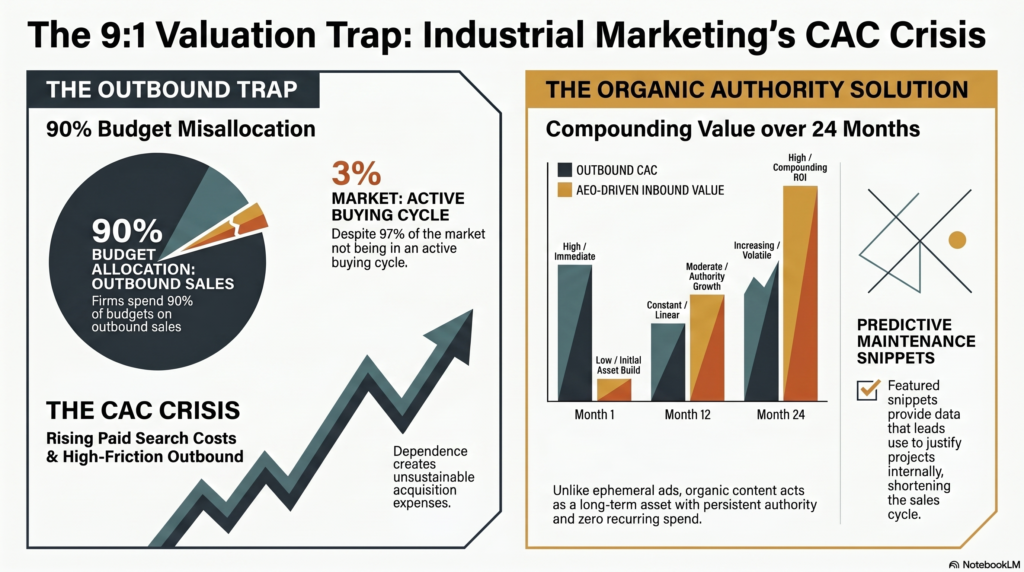
The 9:1 Valuation Trap in Industrial Marketing
The 9:1 Valuation Trap refers to a financial imbalance where industrial companies allocate 90% of budgets to high-friction outbound sales while neglecting the organic authority that captures the 97% of the market not currently in an active buying cycle.
This imbalance creates a CAC crisis. Dependence on outbound sales or gated white papers limits reach to a narrow market segment while the cost of paid search continues to increase. Conversely, supply chain predictive maintenance content acts as a long-term asset. Securing a featured snippet provides persistent authority and generates high-intent leads without recurring advertising expenditure.
Evidence suggests that firms rebalancing this ratio toward organic authority see reduced sales cycle duration. When a lead reaches the sales desk, they have frequently used the firm’s snippet data to justify the project internally, lowering the barrier to final conversion.
Entity-Based SEO and Authority Alignment
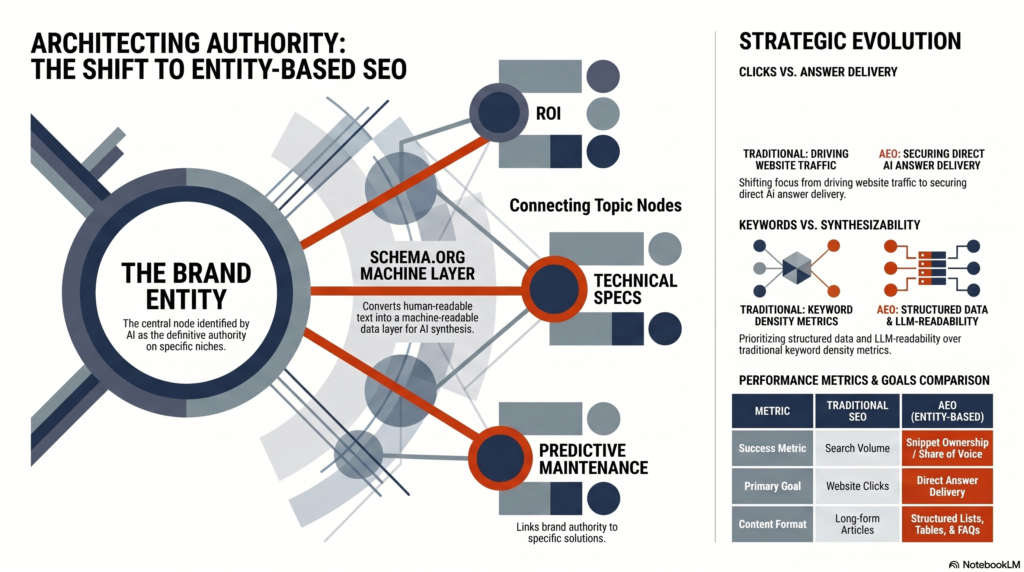
Entity-based SEO prioritises the relationship between concepts over simple keyword matching, allowing AI engines to identify a brand as the definitive authority on specific technical niches.
For energy companies, answer engines prioritise nodes of authority. If a site consistently provides structured data regarding predictive maintenance for offshore wind sub-stations, algorithms categorise the brand as an entity associated with that solution. This is facilitated through Schema.org markup, which converts human-readable text into a machine-readable data layer.
Without this structured layer, expert insights remain undifferentiated text. With it, they become verified facts suitable for synthesis into Google AI Overviews and other LLM-driven summaries.
|
Strategy Component |
Traditional SEO |
AEO (Entity-Based) |
|
Primary Goal |
Website Clicks |
Direct Answer Delivery |
|
Success Metric |
Search Volume |
Snippet Ownership / Share of Voice |
|
Content Format |
Long-form Articles |
Structured Lists, Tables, & FAQs |
|
Technical Focus |
Keyword Density |
Schema Markup & LLM Synthesizability |
Structured Data as a Risk Mitigation Tool
Structured technical data reduces operational risk for buyers by providing immediate, verifiable benchmarks that facilitate project validation and stakeholder alignment.
Analysis from BloombergNEF suggests that incorrect technical assumptions in transition technologies carry high financial penalties. Buyers seek information that de-risks their decisions. A clear, structured list of pre-requisites for hydrogen pipeline monitoring allows a VP of Operations to proceed with planning confidence.
For the vendor, this reduces the technical burden on sales engineering teams. The website functions as a self-service technical portal, allowing personnel to focus on bespoke architecture rather than fundamental information delivery.
AEO Implementation Requirements for Industrial Firms
Execution of an AEO strategy requires three core components: identifying high-intent “Answer Gaps,” restructuring content for machine readability, and implementing Schema.org markup across all assets.
- Identify Answer Gaps: Utilise search data to isolate the specific questions asked by C-suite prospects.
- Restructure for Synthesis: Ensure technical pages begin with a 40–50 word direct answer to a specific query.
- Table Prioritisation: Present comparison data and specifications in HTML <table> formats rather than images or PDFs.
- FAQ Integration: Use H3 headers for questions and direct paragraphs for answers to facilitate extraction.
This transition is a technical requirement. It necessitates collaboration between subject matter experts (SMEs) and content engineers to ensure data is both accurate and structured.
Key Takeaways
- Autonomous Research – Buyers complete 61% of their journey independently; visibility in AI snippets is essential.
- Structured Sales Enablement – A site functioning as an answer engine reduces sales engineering overhead and lowers CAC.
- Benchmark Control – The vendor providing the data used for the RFP internal draft dictates the project requirements.
- Entity Dominance – Success depends on being recognised as the “definitive entity” for technical niches like supply chain predictive maintenance.
- Information Accessibility – Technical data must be moved from gated PDFs into structured HTML to permit AI indexing.
- Validation Speed – AEO provides immediate technical validation, accelerating the transition from research to intent.
Frequently Asked Questions
How does AEO differ from SEO?
SEO is designed to rank pages for clicks; AEO is designed to provide direct answers. AEO focuses on securing featured snippets where the brand is cited as the authoritative source by AI agents.
What is the impact of AEO on supply chain predictive maintenance?
It surfaces specific ROI and technical requirements during the procurement research phase, ensuring a solution becomes the benchmark against which competitors are measured.
Does AEO reduce website traffic?
Total traffic may decrease as users find answers in snippets, but the quality and intent of the remaining traffic increase. In B2B industrials, high-intent leads are more valuable than high-volume vanity traffic.
Why is Schema markup necessary?
Schema markup is JSON-LD code that helps AI identify specific data points, such as technical specifications or FAQs, increasing the probability of winning a featured snippet.
About the Author
Project 54 Team is a Senior Strategy Consultant at Project 54, specialising in industrial digital transformation and AI-native authority frameworks for the energy sector.
Explore This Topic Further
[PODCAST PLAYER: THE DEATH OF THE LEAD MAGNET]
Duration: 22 minutes.
[SLIDE DECK: AEO FOR ENERGY EXECUTIVES]
Summary of strategic insights and implementation data.
Download Slides (PDF) | Download Slides (PPTX)
External Links: