









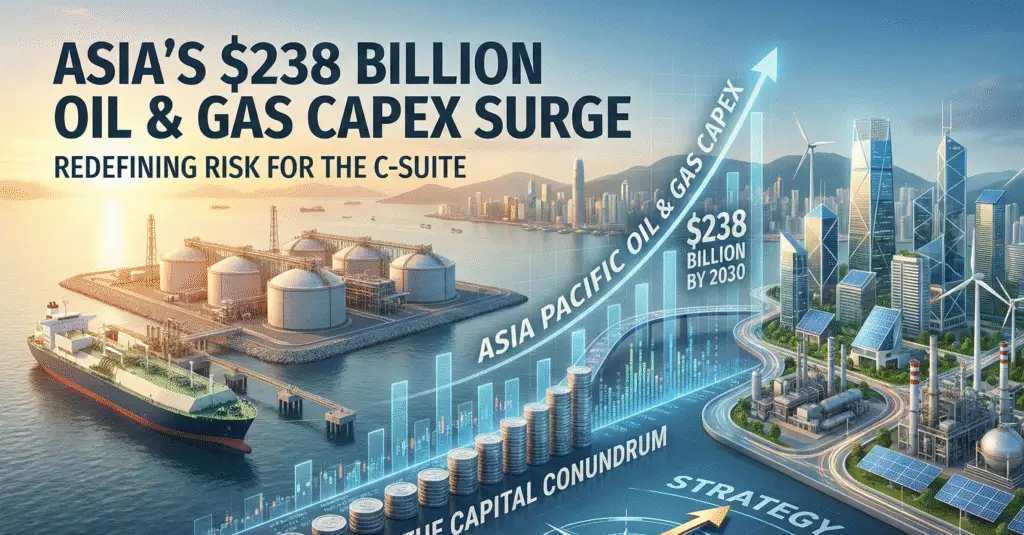
The Capital Conundrum: Why Asia’s $238 Billion Oil and Gas CAPEX Surge is Redefining Risk

The Asia Pacific region is rapidly cementing its status as the singular most critical theatre for the global oil and gas industry. Despite the accelerating rhetoric of the energy transition, the region’s capital expenditure (CAPEX) forecast is not just robust—it is aggressively expanding. Projected to reach a staggering $238.09 billion by 2030, up from $191.01 billion in 2025, this 4.5% Compound Annual Growth Rate (CAGR) signifies a monumental vote of confidence in regional hydrocarbon assets.

However, this capital surge is a nuanced challenge, not a straightforward opportunity. For C-suite executives and business development managers, understanding where this money is flowing, and why it is becoming increasingly concentrated, is essential to securing market share and maintaining financial viability. This is a story about the new, tighter rules of capital deployment in a high-demand, high-scrutiny environment.


The Unstoppable Upstream Imperative


The first, and most compelling, insight from the market analysis is the sheer dominance of the upstream sector, which commanded over 71% of the CAPEX market share in 2024. This trend is not accidental; it is a direct result of state-driven energy security mandates across Asia. National oil companies (NOCs) are leading the charge to bolster indigenous supply, viewing deep-water gas, LNG, and even challenging shale blocks as vital national interests.

For international operators, this means the playing field has narrowed. Projects must now offer genuinely competitive break-even levels and scale that justify the significant political and financial risk. The focus is on large, world-class assets—specifically, deep-water gas and the associated LNG value chain. Indonesia’s push for major LNG capacity additions and Malaysia’s commitment to floating LNG units are clear examples. These are projects that can capture a significant chunk of global LNG trade, offering long-term, insulated revenue streams far less sensitive to oil-price volatility.


Green Finance as the New Market Filter


The most significant headwind to the capital boom is the tightening grip of ‘green finance’ rules. This is where the subtlety for the C-suite lies. Institutions like the Monetary Authority of Singapore are actively slashing fossil-fuel lending eligibility, hiking borrowing costs, and scrutinising Environmental, Social, and Governance (ESG) performance with unprecedented rigour.

This is not a blanket ban, but a powerful market filter. For mid-scale or marginal upstream ventures, the cost of capital is now significantly higher, potentially making them uneconomic. The consequence is a flight to quality: developers are being forced to pivot towards projects with immense scale and robust economics that can comfortably absorb a 200 to 300 basis-point jump in borrowing costs.

The Actionable Insight for Leadership: Project Selection is Portfolio Management. The C-suite must rigorously re-evaluate the break-even points for every planned Final Investment Decision (FID). If a project does not rank in the top quartile globally for cost-competitiveness and scale, its access to traditional finance is now fundamentally compromised. Business development should be exclusively focused on strategic partnerships with NOCs on flagship deep-water or LNG projects that can bypass these green-finance bottlenecks through scale or sovereign backing.


Beyond the Wellhead: Downstream’s Quiet Revolution


While upstream dominates current spend, the downstream sector is quietly becoming the fastest-growing segment, expanding at a projected 5.1% CAGR. This is overwhelmingly driven by the insatiable demand for petrochemical feedstocks. As the transportation and power sectors gradually diversify, the petrochemical industry is set to become the dominant source of oil-demand growth.

China and India are leading the build-out of new petrochemical capacity, often at the expense of older facilities in Europe. This signals a sustained, long-term requirement for feedstocks like naphtha and natural gas liquids (NGLs).

The Business Development Opportunity: A forward-thinking strategy involves integrating upstream gas production directly into local petrochemical complexes. This value chain optimisation—from wellhead to final polymer—offers enhanced margins, de-risks against refined product demand erosion, and positions firms to capture growth in Asia’s high-value manufacturing base. This is the new nexus of energy and industrial strategy.


A Geopolitical Dimension: Insulating Supply


The geopolitical landscape of Asia adds another layer of complexity. Ongoing maritime-security risks and regional competition necessitate a greater focus on domestic and regional supply chains. This pressure underpins the immense onshore CAPEX—accounting for over 65% of the market in 2024—in countries like China (shale) and India (tight oil).

For service specialists and equipment providers, this means a continuous flow of contracts tied to high-tech horizontal drilling, real-time reservoir imaging, and gas-gathering infrastructure. Success depends on local content compliance and establishing resilient, in-country operations that satisfy NOC requirements for supply security.

The Asia Pacific CAPEX surge is a definitive signal that the region’s energy future remains deeply tied to oil and gas for the foreseeable future. The challenge for the C-suite is one of sophisticated capital allocation. The market is increasingly unforgiving to the mediocre; it rewards the bold, the big, and the strategically integrated. Firms must adapt to a financial environment that demands both significant scale and robust ESG strategy, effectively turning the ‘green’ hurdle into a competitive moat for well-executed projects. This is how leaders will carve out a dominant position in the world’s most dynamic energy market.

To:

Project 54