


The Clause That Decides Who Carries the Risk
Take-or-pay means the buyer pays for contracted volume whether or not it takes delivery. That one sentence is why Cheniere could tell the market, at the end of 2025, that it is contractually entitled to $108.1bn of consideration it has not yet earned - a figure its own filing says excludes substantially all of the variable, commodity-linked half of its pricing. For anyone selling into a buyer that signs these contracts, the clause explains more about how that buyer behaves than its strategy deck does.
- The number to quote is $108.1bn. At 31 December 2025 Cheniere disclosed that much transaction price allocated to unsatisfied performance obligations - $107.7bn in LNG revenues and $0.4bn in regasification - against $105.2bn a year earlier, weighted average recognition timing eight years. Source: Cheniere Energy, Inc. Form 10-K for the year ended 31 December 2025.
- Read the footnote before you use the figure. The same filing says the table excludes “substantially all variable consideration under our SPAs and TUAs”. The commodity-linked fee, generally 115% of Henry Hub, is largely NOT in the $108.1bn. The number is therefore close to a measure of the take-or-pay leg on its own, which is what makes it interesting rather than merely large.
- Take-or-pay is not take-and-pay, and the difference is the whole clause. The buyer keeps the right not to lift. What it loses is the right not to pay the fixed fee. Cheniere's wording is “contracted volumes irrespective of their election to cancel or suspend deliveries of LNG cargoes” - an election the buyer still has.
- The same company sits on both sides of the mechanism, which is the clearest way to see it. Cheniere's purchase obligations table shows $25.6bn of natural gas supply agreements outside IPM ($7.3bn due in 2026, $13.3bn across 2027-2030, $5.0bn thereafter), and it describes its IPM agreements as generating “a take-or-pay style fixed liquefaction fee”. Seller of one take-or-pay, buyer of another.
- The clause has an exit, and it is about delivery, not price. Cheniere discloses that its long-term SPAs let the customer terminate on events including a failure “to make available specified scheduled cargo quantities”, “delays in the commencement of commercial operations” and, under most of them, force majeure. A buyer locked into price is not locked into a seller who cannot deliver.
The buyer keeps the right not to lift, and loses the right not to pay
Take-or-pay is one of the few contract terms in energy that means exactly what its name says, and it is routinely explained badly anyway. It does not oblige a buyer to take the gas. It obliges the buyer to pay for it either way. The right to decline a cargo survives; the saving that would normally come with declining does not.
The clearest statement of the mechanism is not in a textbook, it is in a filing. Cheniere Energy sells LNG under long-term sale and purchase agreements, and in its 2025 Form 10-K it writes that certain customers may elect to cancel or suspend deliveries, “in which case the customers would still be required to pay the fixed fee with respect to the contracted volumes that are not delivered as a result of such cancellation or suspension”. Elsewhere in the same document it describes its revenue as resting on “contracted volumes irrespective of their election to cancel or suspend deliveries of LNG cargoes”.
Read those two phrases together and the structure is complete. There is an election, and the buyer keeps it. There is a fee, and the buyer owes it regardless. The commercial content of take-or-pay is the word irrespective.
This is why the phrase take-and-pay exists as a separate term. Under take-and-pay the buyer pays for what it takes. The one word swap moves the entire risk of a demand shortfall from the seller to the buyer, which is also why take-or-pay contracts are what get financed and take-and-pay contracts are what get renegotiated.
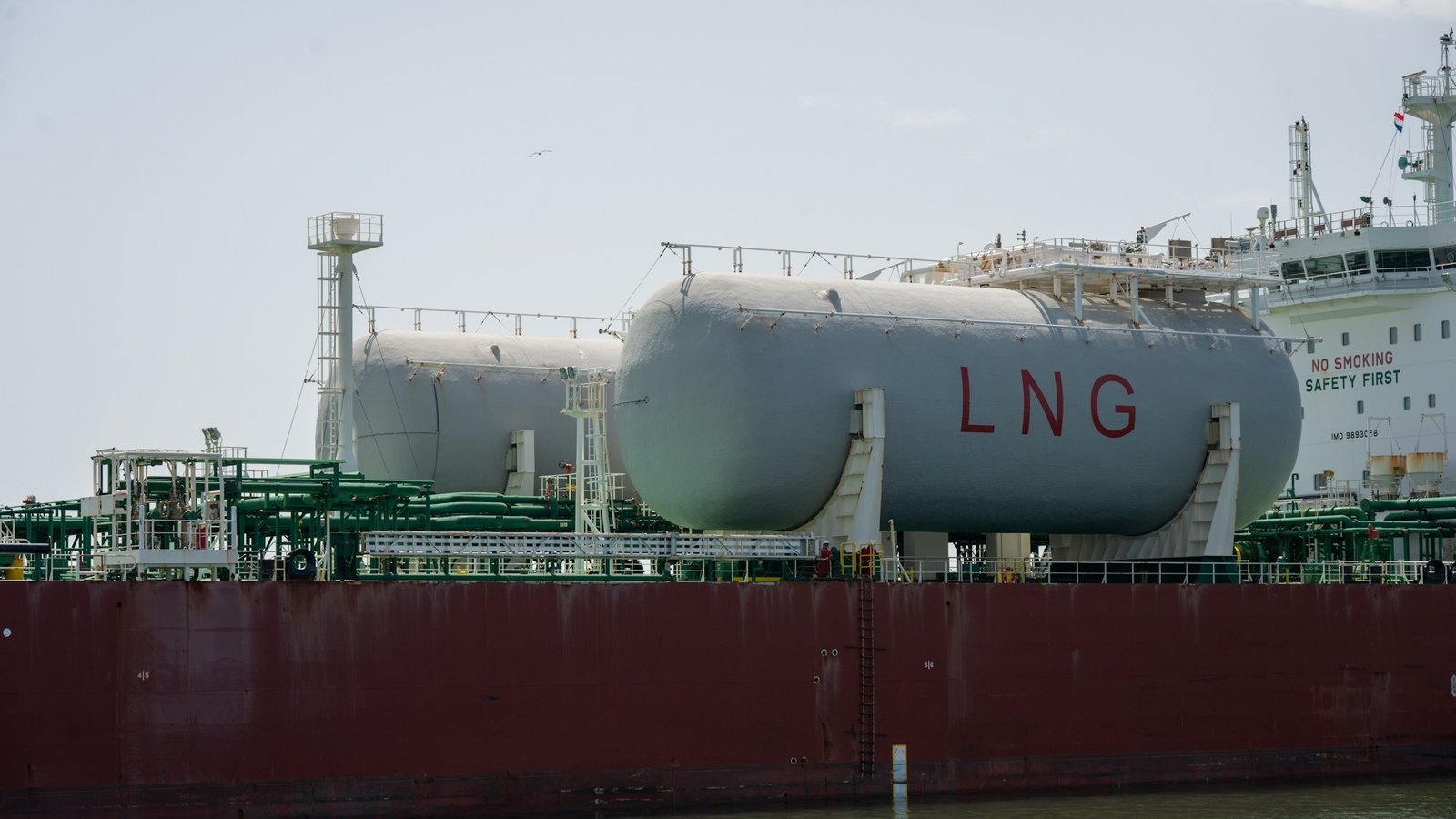 المشروع 54LNG cargo tanks on deck. Under a take-or-pay sale and purchase agreement the buyer owes the fixed fee on its contracted volume whether or not a cargo like this one is ever lifted.
$108.1bn of consideration not yet earned, and the footnote that makes the number matter
Every long-term supplier claims its order book gives it visibility. Take-or-pay is the version of that claim which has to be written down in the accounts, because the seller is contractually entitled to the money whether or not it ships anything.
In the revenue note of its 2025 Form 10-K, under the heading “Transaction Price Allocated to Future Performance Obligations”, Cheniere discloses the aggregate transaction price allocated to performance obligations it has not yet satisfied. At 31 December 2025 that was $108.1bn - $107.7bn of LNG revenues and $0.4bn of regasification revenues - against $105.2bn a year earlier. The weighted average recognition timing is eight years, which the filing defines as an estimate of the number of years over which half of the unsatisfied transaction price will have been recognised.
The figure is worth more than its size, because of what the company says is missing from it. The filing lists the exemptions it has elected and states that the table omits “substantially all variable consideration under our SPAs and TUAs”. Cheniere's SPA pricing has two legs: a fixed fee per MMBtu, and a variable fee generally equal to 115% of Henry Hub. The variable leg - the commodity-linked, market-exposed half - is largely not in the $108.1bn. What is left is close to the take-or-pay leg standing on its own.
For scale, set it against what the company actually earned. Cheniere reported total revenues of $19,976m for 2025. Divide: $108.1bn is about 5.4 times a full year of revenue, and the method is simply 108.1 divided by 19.976, both figures from the same filing. That is the difference between a backlog and an entitlement.
The regasification side shows the same clause in an even barer form. Cheniere's Sabine Pass terminal has a “long-term, third party TUA for 1 Bcf/d with TotalEnergies” under which, the filing says, TotalEnergies is “required to pay fixed monthly fees, whether or not it uses the regasification capacity it has reserved”. No cargo, no molecule, no lifting decision at all - just a monthly fee for reserved capacity.
About 90% of anticipated production, with roughly 15 years of weighted average life left
A clause is only as important as the share of the business resting on it. Cheniere states that through its SPAs and IPM agreements it has “contracted approximately 90% of the total anticipated production” of its liquefaction projects through the mid-2030s, with “approximately 15 years of weighted average remaining life as of December 31, 2025”, excluding contracts shorter than ten years and volumes conditional on capacity not yet built.
Ninety per cent is the design, not an accident of the market. The same filing lists, among the company's stated capital investment parameters, an aim to contract roughly 90% of current and planned liquefaction capacity under long-term SPAs and IPM agreements with creditworthy counterparties. The remaining tenth is what its marketing arm sells spot.
That ratio is the thing to carry into any conversation with a buyer of this type. Nine tenths of the output is pre-sold on terms that pay whether or not it moves. The part of the business that responds to this month's price is the last tenth.
A liability disclosed as fixed or minimum quantities to be purchased
The most useful property of the Cheniere filing is that the company sits on both sides of take-or-pay, so the mirror image is in the same document rather than in somebody else's.
To liquefy gas Cheniere has to buy it, and it buys it long. Its table of material cash requirements under executed contracts shows purchase obligations for natural gas supply agreements, excluding IPM agreements, of $25.6bn - $7.3bn due in 2026, $13.3bn across 2027 to 2030 and $5.0bn thereafter - plus $7.2bn of transportation and storage service agreements, for $44.6bn of total listed requirements once capital expenditure, other purchase obligations and leases are included. Those components add up exactly as published: 7.3 plus 13.3 plus 5.0 is 25.6.
The definition attached to that table is the buyer-side definition of take-or-pay in all but name. Purchase obligations, it says, “consist of agreements to purchase goods or services that are enforceable and legally binding that specify fixed or minimum quantities to be purchased”. Fixed or minimum quantity is the obligation; everything else is detail.
Cheniere's integrated production marketing agreements make the symmetry explicit. The filing says that while these are not revenue contracts for accounting purposes, “the payment structure under the IPM agreements generates a take-or-pay style fixed liquefaction fee”, and that over a remaining fixed term of 20 years it expects liquidity from “approximately 5,066 TBtu of LNG to be produced from natural gas not yet received under IPM agreements”. Separately it reports securing “approximately 6,847 TBtu of natural gas feedstock” under “long-term natural gas supply agreements with remaining fixed terms of up to 14 years”.
So one company is the beneficiary of $108.1bn of take-or-pay style entitlement and the obligor of tens of billions in fixed or minimum purchase commitments. Neither position is unusual. What is unusual is being able to read both out of one primary document.
It binds the buyer to the price, not to a seller who cannot deliver
Take-or-pay is often described as though it removed all of the buyer's leverage. The filings do not support that, and the exceptions are specific enough to be useful.
Cheniere discloses that its “long-term SPAs entitle the customer to terminate their contractual obligations upon the occurrence of certain events”, and lists among them a failure “to make available specified scheduled cargo quantities”, “delays in the commencement of commercial operations” and, under the majority of its SPAs, “the occurrence of certain events of force majeure”. The company adds that it has not had a history of material customer default or termination events, and that such events would be largely outside its control.
Notice what the exit is attached to. Not price, not demand, not a change in the buyer's strategy - delivery and timing. A take-or-pay buyer has accepted price and volume risk and has kept, in writing, the right to walk if the seller misses the schedule or starts late. That is the asymmetry worth remembering: the clause is strong against a buyer's change of mind and weak against a seller's slippage.
It is also the reason commissioning disputes in LNG have been so bitterly fought. If the obligation to pay begins at commercial operations, then the date of commercial operations is the most valuable sentence in the contract - which is a different question from what take-or-pay means, and one we have looked at separately in the Venture Global case.
Four fields in the filing, in the order that catches the error
Take-or-pay figures get repeated badly, usually by being quoted without their exclusions. The check takes about ten minutes per company and it is the same four steps every time, which is worth knowing because the mistake it catches is the one that costs credibility in the room.
One: find the revenue note, not the press release. The heading to look for is the transaction price allocated to performance obligations that have not yet been satisfied. In its 2025 Form 10-K it appears under exactly that name, with the figure split between LNG and regasification revenues and a weighted average recognition timing beside it.
Two: read the exemptions immediately below the table. This is where Cheniere states that the table omits performance obligations under contracts with an original expected duration of a year or less, and “substantially all variable consideration under our SPAs and TUAs”. A number quoted without that sentence is a number whose composition the speaker does not know.
Three: find the pricing structure and work out which leg you are holding. Cheniere's SPAs price a fixed fee per MMBtu plus a variable fee generally equal to 115% of Henry Hub, with the variable leg sized with the intention of covering gas supply, transportation and liquefaction fuel. Once you know the variable leg is largely outside the disclosed figure, you know the disclosed figure is approximately the committed leg - which is the only version of it that supports an argument about resilience.
Four: turn the table around and find the same company's obligations. The purchase obligations table, defined as covering agreements that “specify fixed or minimum quantities to be purchased”, is where the committed outflows sit. A supplier who has read both sides knows the shape of the customer's year: how much is already spoken for, and when.
Do this once for each of your three largest accounts and you will have something most of their suppliers do not: their committed and uncommitted spend profile, in their own published numbers, with the exclusions understood.
Price your line item against the spend the buyer has not already committed
Most suppliers to the energy industry never negotiate a take-or-pay clause. They sell into companies that have signed them, which changes how those companies behave in a way that is predictable and almost never priced in.
Start from the arithmetic. A buyer with $7.3bn of fixed or minimum purchase obligations falling due inside one year has a budget whose committed share is enormous and whose discretionary share is therefore small and closely watched. Nothing about a large take-or-pay book implies a loose procurement posture. If anything it implies the opposite, because the flexibility the organisation still has is concentrated in exactly the spend your invoice belongs to.
Second, separate the payment from the throughput. A buyer can be paying in full for contracted volume while physically lifting less of it, because the right to cancel or suspend survives. Any demand signal you derive from a customer's physical activity can move in the opposite direction to its contractual commitments. If you forecast your own pipeline from their shipping, you will be wrong in both directions at different points in the cycle.
Third, learn where the obligation starts. The termination triggers in these contracts are about scheduled quantities and the commencement of commercial operations. If what you sell touches either - commissioning support, measurement, assurance, scheduling systems, anything that shortens a start-up or defends a delivery date - you are selling against a clause with a number attached, and the number is in your customer's own filings. That is a materially stronger position than selling a capability.
Fourth, read the footnotes before you quote a figure back at anyone. A supplier who cites “$108bn of contracted revenue” to a Cheniere procurement team and does not know that the figure excludes substantially all variable consideration has told that team exactly how carefully it reads. The credibility in these conversations comes from the qualification, not the headline.
If you would like the thresholds and clause mechanics for the buyers in your own pipeline assembled from their filings rather than from their marketing, that is the kind of work the strategy call starts with.
استمع وخذها معك
هل تفضل الاستماع إلى التسجيل الصوتي، أم تحتاج إلى العرض التقديمي للمراجعة الداخلية؟ يتوفر العرض التقديمي الكامل كحلقة بودكاست وعرض شرائح قابل للتنزيل.
You sell into a buyer that has just signed a 20-year take-or-pay supply contract on the procurement side. What does that tell you about how to pitch it?
الأسئلة المتكررة
Under take-and-pay the buyer pays for the volume it actually takes. Under take-or-pay the buyer pays the fixed element for its contracted volume whether or not it takes delivery. Cheniere Energy's 2025 Form 10-K describes customers who elect to cancel or suspend deliveries and who “would still be required to pay the fixed fee with respect to the contracted volumes that are not delivered”. The buyer keeps the election; it loses the saving.
No, and this is the most common misunderstanding. The obligation is to pay, not to lift. The same filing is explicit that revenue rests on “contracted volumes irrespective of their election to cancel or suspend deliveries of LNG cargoes”. Physical throughput and contractual payment can therefore move in opposite directions.
Large enough to dwarf current revenue. At 31 December 2025 Cheniere disclosed $108.1bn of transaction price allocated to performance obligations not yet satisfied, against total 2025 revenues of $19,976m - about 5.4 times one year of revenue, dividing 108.1 by 19.976. The weighted average recognition timing is eight years.
Usually not, and the exclusion is the part to check. Cheniere's SPAs carry a fixed fee plus a variable fee generally equal to 115% of Henry Hub, and the filing states that its disclosed $108.1bn excludes “substantially all variable consideration under our SPAs and TUAs”. The fixed leg is what the buyer owes regardless; the commodity-linked leg follows the market and the lifting.
On delivery grounds, yes. Cheniere discloses that its long-term SPAs entitle the customer to terminate on events including a failure “to make available specified scheduled cargo quantities”, “delays in the commencement of commercial operations” and, under most of its SPAs, certain events of force majeure. The clause protects the seller against a buyer's change of mind, not against the seller's own slippage.
Yes. Reserved infrastructure capacity works the same way. Cheniere's Sabine Pass terminal has a long-term third party terminal use agreement for 1 Bcf/d with TotalEnergies under which TotalEnergies is “required to pay fixed monthly fees, whether or not it uses the regasification capacity it has reserved”.
احصل على التالي إسقاط معلومات استخباراتية
انضم إلى قادة الطاقة والصناعة واحصل على معلوماتنا التسويقية، ونمو الذكاء الاصطناعي، وهيكلة الإيرادات، مباشرة وبدون حشو.
اسمك مدرج في القائمة
أهلاً بكم في موجز نمو الطاقة، تابعوا بريدكم الوارد للاطلاع على النشرة القادمة.