



Two Surpluses, One Answer: Inside JERA's Turn From Buyer to Merchant
JERA established a long-term LNG origination company in Singapore on 1 July 2026, booked French regasification capacity from 2031, signed its first long-term LNG sales contract, and on 1 October 2026 agreed a memorandum of understanding to put up to 400 megawatts of behind the meter power under an AI data centre at one of its own thermal stations. A deep read of how Japan's largest power generator is turning two surpluses that Japanese policy created into a merchant business, and what that changes for anyone selling into it or against it.
- JERA's two surpluses, long dated LNG contracts and surplus thermal generating capacity, were both created by Japanese policy succeeding rather than failing, which is the reason neither is simply being shrunk.
- The pivot now has a legal address: JERA Global Energy Solutions was established in Singapore on 1 July 2026 as the group's exclusive long-term LNG origination platform, which moves the growth buying centre out of Tokyo.
- JERA's first long-term LNG sales contract, about 270,000 tonnes a year to India's Torrent Power for 10 years from 2027 on a delivered ex ship basis, is small in volume and large in signal, because term selling requires term grade credit and controlled shipping rather than a spot resale desk.
- The resale shift is sector wide rather than company specific: IEEFA, an advocacy think tank that campaigns against fossil fuel expansion, found that 40 per cent of LNG volumes handled by Japanese companies were sold overseas in FY2024 against 16 per cent in FY2018.
- The Chiba memorandum of understanding with Dell Technologies and RHAELM Holdings prices what a thermal station actually owns, which is land, cooling water, grid interconnection and firm round the clock output, rather than the fuel it burns.
- Reuters reported on 17 July 2026, citing unnamed sources, that JERA has begun an early stage feasibility study on a US listing with no decision taken on timing, structure or valuation, which is the financing leg of the same decision and is not a listing.
Two surpluses, one commercial answer
JERA is a large company that most vendors still file under Japanese utility. Reuters, reporting on 17 July 2026, put it at about 59 gigawatts of domestic generating capacity, roughly 30 per cent of Japan's power, about 35 million tonnes of LNG handled a year and revenue of about 3 trillion yen, which Reuters converted at about 18.48 billion dollars. JERA's own announcement of 1 October 2026 describes it as supplying one third of Japan's electricity. It is owned by two domestic regional utilities, Tokyo Electric Power and Chubu Electric Power. The defensible description is Japan's largest power generator and one of the world's largest LNG buyers, and the volume figure is tonnes handled rather than tonnes imported, a distinction that matters to everything below.
That company has two surpluses. The first is molecules. Japanese energy security doctrine obliges JERA to over contract, and Global CEO and Chair Yukio Kani put the logic on the record to S&P Global Commodity Insights on 10 September 2025: "With no natural resources in Japan, the worst-case scenario is that we underestimate LNG demand growth, we don't secure LNG and have to go to the market to buy spot cargoes." So the signing continues. QatarEnergy, 3.0 million tonnes a year for 27 years from 2028. PETRONAS, up to 2.0 million tonnes a year for 20 years from 2028. Up to 5.5 million tonnes a year of new US volumes agreed in June 2025 on free on board terms with no destination restrictions.
Meanwhile the home market shrinks. Kashiwazaki-Kariwa Unit 6, at 1,356 megawatts, restarted on 9 February 2026 after more than 14 years offline and resumed commercial operation in March 2026. The EIA estimates that single reactor could displace about 1.3 million tonnes of LNG, or 62 billion cubic feet of gas imports, a year. Japan now has 15 operating reactors totalling 33 gigawatts and targets nuclear at about 20 per cent of generation by FY2040, which on official arithmetic would require up to 30 reactors. Japanese LNG imports were about 9 billion cubic feet a day in 2025 against about 11 billion in 2018, and LNG Prime reported them down 15.1 per cent year on year in May 2026.
The second surplus is iron. The same renewables build out and nuclear restart programme that removes gas demand also makes thermal capacity redundant. What a redundant thermal station still owns is land, cooling water, grid interconnection and firm output available every hour of the year. Those are precisely the four things an AI data centre developer cannot assemble quickly anywhere, and least of all in Japan.
The decision taken across 2026 is to monetise both surpluses with the same move, which is to stop waiting for the Japanese market to clear and go and build the counterparty instead. For molecules that means a Singapore origination company, European regasification capacity, US upstream and term sales contracts. For iron it means selling land and power to data centre developers behind JERA's own meter. For anyone selling into the energy sector the practical consequence arrives well before the strategic argument is settled: a long standing customer has just become a supplier in two markets at once, and the procurement organisation most vendors have been calling on is no longer where the growth capital sits.
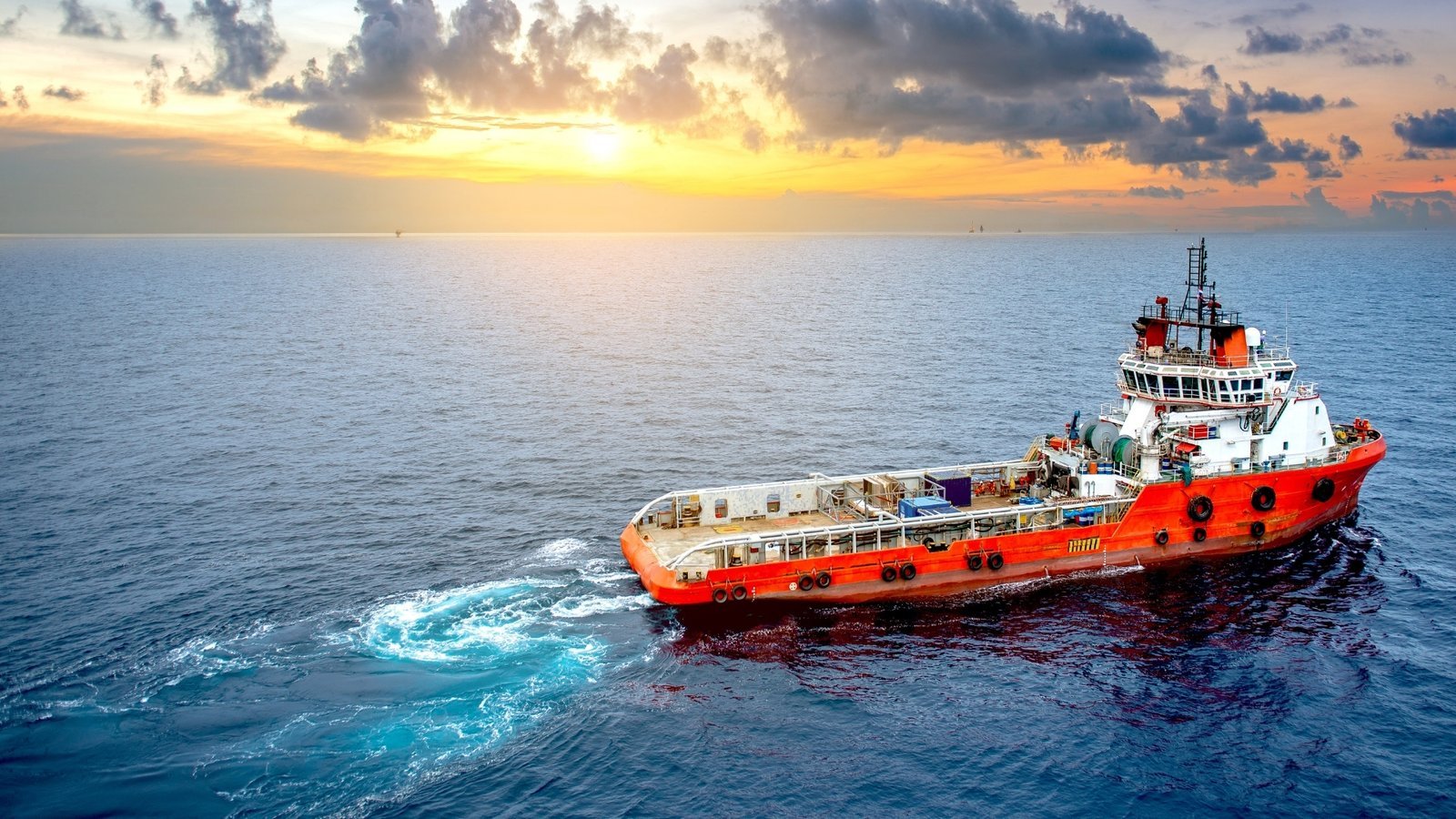 المشروع 54Offshore supply vessel under way on open water at sunset, representing seaborne energy cargo logistics
The contract book, and the doctrine that built it
The clearest way to see the first surplus is the contract book itself, because every line in it is a public, counterparty confirmed commitment and most of it starts after Japanese demand is expected to have fallen further.
Kani gave S&P Global Commodity Insights the portfolio arithmetic on 10 September 2025: about 35 million tonnes a year handled across FY2024 and FY2025, about 22 million tonnes burned in JERA's own thermal plants, about 5 million tonnes bought spot and 25 to 26 million tonnes a year under long-term contract. In the same interview he said JERA needs about 16 million tonnes a year of new long-term contracts in the 2030s to replace expiring deals. That last number is the largest single block of contestable long-term LNG demand in Asia, and it will be awarded over the next few years.
Two things follow from the doctrine. The first is that length is deliberate rather than accidental, so any pitch built on helping JERA unwind an embarrassing position misreads the company. Kani's framing is that the risk of being short is worse than the cost of being long, and he told S&P Global that "That kind of volatility is increasing in the long term, and within [a] year, the seasonality of LNG demand is greater than ever." The second is that if length is permanent, the surplus has to be commercialised rather than avoided.
It is also national policy rather than one company's choice. METI's 2020 New International Resource Strategy set a goal of Japanese companies handling 100 million tonnes of LNG a year by FY2030, explicitly including third country trade. Contracts carrying destination clauses fell from 75 per cent in FY2016 to 39 per cent in FY2023 and are projected at 34 per cent by FY2030, on figures compiled by Japan NRG from METI data. Destination freedom is the mechanical precondition for reselling, and Japan has been dismantling it for a decade.
The scale of the resale activity is already large, and the best available measurement comes from IEEFA, which should be read as an advocacy think tank that campaigns against fossil fuel expansion rather than as a neutral statistical agency. IEEFA's Sam Reynolds reported on 25 February 2026 that 40 per cent of all LNG volumes handled by Japanese companies were sold overseas in FY2024, up from 16 per cent in FY2018, that Japanese resales exceeded total Russian LNG production, and that resold volumes ran at about 1.7 times Japan's total direct imports from Australia and four times its purchases from Malaysia. IEEFA also reports that Japanese LNG consumption has fallen nearly 20 per cent since FY2018 and projects it at 53 million tonnes by 2040. In earlier work dated 11 March 2024 it estimated that JERA, Tokyo Gas, Osaka Gas and Kansai Electric were collectively over contracted by roughly 11 million tonnes a year through the decade, against projected Japanese domestic demand of 25.7 to 31.6 million tonnes a year by 2030. Those two demand figures are IEEFA projections and should be read as estimates.
The commercial reading for a supplier is that contract basis is now a strategy signal rather than a legal detail. The Qatar volumes are delivered ex ship, which limits resale flexibility. The US volumes are free on board with no destination restrictions, which does not. The ratio of free on board to delivered ex ship in JERA's book is the cleanest single metric for how serious the merchant pivot is, and it can be tracked from public announcements without access to the company.
| Counterparty | Volume | Term | Start year | FOB or DES |
|---|---|---|---|---|
| QatarEnergy, signed at LNG 2026 in Doha on 3 February 2026 | 3.0 million tonnes a year | 27 years | 2028 | DES |
| PETRONAS, announced 10 June 2026, primarily Malaysian supply | Up to 2.0 million tonnes a year | 20 عامًا | 2028 | غير مُفصح عنه |
| NextDecade, Rio Grande LNG, part of the package announced 12 June 2025 | 2.0 million tonnes a year | 20 years, as announced for the package | غير مُفصح عنه | FOB, no destination restrictions |
| Sempra Infrastructure, Port Arthur Phase 2, same package | 1.5 million tonnes a year | 20 years, as announced for the package | غير مُفصح عنه | FOB, no destination restrictions |
| Commonwealth LNG, same package | 1.0 million tonnes a year | 20 years, as announced for the package | غير مُفصح عنه | FOB, no destination restrictions |
| Cheniere Marketing, same package | Up to 1.0 million tonnes a year | 20 years, as announced for the package | غير مُفصح عنه | FOB, no destination restrictions |
| Torrent Power, India, announced 8 December 2025, JERA's first long-term LNG sale | About 270,000 tonnes a year, four cargoes a year | 10 years | 2027 | DES |
Singapore, Dunkerque, Houston and a listing study
Japanese utilities have resold spare cargoes for years. That is a trading activity, run opportunistically against a seasonal position. Selling on long-term terms is a different business, because the counterparty is buying a decade of reliability and will price JERA's credit, shipping control and operational depth before it prices the molecule. Four moves across 2025 and 2026 show JERA building exactly those capabilities, and that is what separates this from a bigger resale desk.
The first is organisational. JERA established JERA Global Energy Solutions on 1 July 2026, headquartered in Singapore, described in its own announcement as the group's exclusive long-term LNG origination platform covering LNG, upstream, lower carbon fuels and shipping. Irtiza H. Sayyed is chief executive, with strategic direction from Ryosuke Tsugaru, JERA's Chief Low Carbon Fuel Officer, and the company sits alongside the existing trading arm, JERA Global Markets. Kani's framing on the day was that "The establishment of JERA GES represents an important step in strengthening JERA's operating model for the next phase of its growth." The operative word for a vendor is exclusive. Long-term origination is no longer a Tokyo conversation.
The second is the first term sale. JERA announced on 8 December 2025 that it would supply India's Torrent Power with four cargoes a year, about 270,000 tonnes a year, for 10 years from 2027 on a delivered ex ship basis. JERA's stated rationale is seasonal complementarity, and Tsugaru put it as follows: "Expanding into high-growth markets such as India allows us to broaden our LNG capabilities in ways that complement regional demand patterns." That framing is coherent and should be taken on its own terms, because Indian demand peaks when Japanese demand troughs and fleet utilisation genuinely improves. Our analysis, offered as analysis and not as reported fact, is that the surplus explains the timing: a company with no length has no reason to build a term sales capability at all, and 270,000 tonnes a year is a pilot for a capability rather than a material revenue line.
The third is infrastructure on the selling side. On 19 March 2026 JERA booked 2 billion cubic metres a year of regasification capacity at the Dunkerque LNG terminal in France, about 1.5 million tonnes a year of LNG, for six years from 2031. It is JERA's first acquisition of overseas LNG terminal capacity, at a terminal operated by Fluxys, and the release restates JERA's existing 5.5 million tonnes a year of US LNG on flexible free on board terms. Tsugaru's language again framed it as security rather than trading: "Strengthening flexibility across our LNG supply chain is essential to ensuring stable energy supply in an increasingly uncertain environment." Both readings are true at once. Regasification capacity in northern Europe is how a seller reaches European utilities directly instead of selling to an intermediary, and it is also genuine optionality against a Japanese cold snap.
The fourth is upstream and people. In October 2025 JERA Americas bought the South Mansfield Haynesville and Mid-Bossier position from Williams for 1.5 billion dollars, about 210 square kilometres with over 500 million cubic feet a day of production and 200 undeveloped locations, with a stated ambition to double output to 1 billion cubic feet a day. It was JERA's first US upstream venture. On the equity side, JERA acquired a 25.7 per cent interest in Freeport LNG development in November 2021 for 2.5 billion dollars and sold part of that interest to JAPEX in 2024; no current percentage is confirmed against a JERA or Freeport primary source, so the safe description is a minority stake acquired in 2021 and subsequently reduced. The hiring tells the same story as the assets. Effective 1 April 2026 Steven Winn moved into an expanded Chief Global Strategist role, Sayyed, previously of ExxonMobil's LNG business, was elevated to chief operating officer of the low carbon fuel business before taking the JERA GES chief executive role three months later, Naoki Tsutsumi became Chief Strategy Officer of JERA Americas, and the Chief Optimization Officer title was renamed Chief Risk Officer. JERA is importing the commercial grammar of an international major.
The financing leg is the part most coverage gets wrong. Reuters reported exclusively on 17 July 2026, citing unnamed sources, that JERA has begun an early stage feasibility study on a US listing, assessing market conditions, investor demand and regulatory requirements, with no decision taken on timing, structure or valuation and the Tokyo Stock Exchange previously its primary listing option. That is a study, not a listing, and it should not be reported as one. It matters anyway, because term sales need term grade credit, and a balance sheet underwritten by two Japanese regional utilities is a constraint on how much length a merchant can sell. Bloomberg reported on 16 September 2026 that JERA is negotiating with multiple countries for further long-term sales, expects US Gulf Coast LNG to reach about 30 per cent of its long-term portfolio by 2030 from roughly 10 per cent now, and plans to charter additional LNG carriers later this decade, with Kani noting that a cool Tokyo summer had left the company with extra cargoes. Treat those three figures as reported by Bloomberg rather than as company disclosure.
Chiba: land, water, grid and firm output
On 1 October 2026 JERA signed a memorandum of understanding with Dell Technologies and RHAELM Holdings of the United Kingdom to build what the parties describe as a standardised national scale AI infrastructure framework in Japan, starting with a hyperscale data centre adjacent to JERA's Chiba Thermal Power Station. The headline numbers are up to 400 megawatts supported, total investment across phases exceeding 15 billion dollars, or 2.3 trillion yen, and operations in phases from around 2028 reaching full capacity in 2029. The announcement describes it as the largest single site AI infrastructure deployment in Japan.
The division of labour is the commercially interesting part. JERA supplies land and power under an agreement of 15 to 25 years. RHAELM develops, builds, operates and finances, with Apollo Global Management as its strategic investment and financing partner. Dell holds the compute scope. JERA is therefore not becoming a data centre operator, it is becoming a long-term landlord and power vendor to one, which is a utility earning a merchant margin on a contracted asset rather than a utility recovering costs from ratepayers. Note also what this is: a memorandum of understanding, with no final investment decision in the public record. Treat the 15 billion dollar figure as the announced programme ambition across phases, not as committed capital.
Replication is explicit. The parties state an intention to extend the model to other JERA sites, targeting multiple gigawatts across Japan in the 2030s and then other markets. For suppliers that is the sentence to underline, because it converts one project into a repeating tender pipeline at successive thermal stations: civils, cooling, power electronics, switchgear, substation and interconnection work, fire, security and long-term operations and maintenance, each with a JERA site as the anchor and an incumbent set of counterparties already in place at Chiba. Being qualified at Chiba is worth considerably more than the Chiba scope alone.
There is a US version of the same idea, and it needs careful handling. Nikkei reported on 22 June 2026 that JERA will build a large gas fired plant for a co-located US data centre for around 500 billion yen, about 3 billion dollars. That report is Nikkei sourced and not company confirmed. No location, capacity, customer or final investment decision is public, and it should not be described as a committed project. If it is confirmed, it is a turbine, balance of plant, EPC and long-term operations and maintenance opportunity bought through a Houston entity on US contracting terms.
The buying committee this creates is genuinely new, and it is the single most under served content niche in the sector. Chiba puts a power company, a server original equipment manufacturer, a UK infrastructure developer and a US private capital firm in the same room. Energy vendors arrive with uptime and reliability material written for a regulated utility. Data centre vendors arrive with density and cooling material written for a hyperscaler. Neither set lands on a mixed committee that is simultaneously underwriting a 25 year power agreement and a 2029 capacity ramp. The commercial opportunity is to be the supplier whose proof structure speaks to both sides of that table.
The financial context makes the appetite legible. JERA reported first quarter FY2026 results on 31 July 2026 showing revenue of 904.3 billion yen, up 73.5 billion yen or 8.9 per cent year on year, operating profit of 174.4 billion yen, up 36.8 per cent, and profit of 123.1 billion yen, up 30.6 billion yen or 33.1 per cent, with profit excluding time lag accounting effects at 128.0 billion yen against 48.3 billion yen a year earlier. The company's full year FY2026 forecast is 280.0 billion yen against an FY2025 actual of 193.5 billion yen on the profit line JERA itself reports. That sits inside the growth strategy announced on 16 May 2024, which commits 5 trillion yen of investment through 2035, split 1 to 2 trillion yen each across LNG, renewables and hydrogen or ammonia, and targets more than 35 million tonnes of LNG transaction volume, 20 gigawatts of renewables, about 7 million tonnes of hydrogen and ammonia handling, FY2035 consolidated net profit of 350 billion yen and EBITDA of 700 billion yen. The capital is budgeted and the mandate is published.
Analysis: four buying organisations in three jurisdictions
This section is our analysis built on the sourced facts above. No third party research compares how these entities buy, and none should be implied.
Account based marketing built on legal entity is now wrong, because JERA is at least four buying organisations across three jurisdictions. Long-term LNG, upstream, lower carbon fuels and shipping origination sits with JERA Global Energy Solutions in Singapore. US upstream, US LNG offtake and US power sit with JERA Americas in Houston. Offshore wind sits in JERA Nex bp, the 50:50 joint venture with bp launched on 1 August 2025 with 13 gigawatts of net potential capacity, comprising 1 gigawatt installed, a 7.5 gigawatt pipeline and 4.5 gigawatts of secured leases, under chief executive Nathalie Oosterlinck. Tokyo retains Japanese generation, Japanese market operations and the energy security relationship with METI. A vendor with a Tokyo only account team is now calling on the part of JERA with the least growth capital attached to it, and segmenting the account by entity and geography is the difference between a relevant campaign and a wasted one.
The commercial culture is converging on the majors rather than the utilities. With a former ExxonMobil LNG executive running the Singapore origination company and a Chief Global Strategist role expanded above it, the procurement vocabulary shifts from reliability and relationship toward netbacks, optionality, basis risk and portfolio return. A supplier whose pitch assumes a slow, consensus driven Japanese buying committee will be outpaced. A supplier who can price risk transfer will be heard. The title changes are the cheapest available signal of where budget authority is consolidating: Chief Low Carbon Fuel Officer, Chief Global Strategist, Chief Risk Officer renamed from Chief Optimization Officer, and a distinct Chief Japan Market Officer. That last title is the tell. Japan has been reclassified internally from the market to a market.
The demand pools now open, ranked by how near term and how under contested they are. Shipping and chartering comes first, because JERA has said it will charter additional LNG carriers later this decade and term sales cannot be served without hulls. Terminal and regasification services follow, Dunkerque from 2031 and the storage, reloading, cool down and berth services around it. Third is trading, risk and portfolio software, because a company running term supply, term sales, European regasification and a US upstream position needs energy trading and risk management, credit, logistics optimisation and emissions accounting systems at major oil company grade, and that is close to greenfield. Fourth is Haynesville oilfield services, since doubling South Mansfield from over 500 million cubic feet a day toward 1 billion means rigs, pressure pumping, water handling, gathering and compression bought on US terms through a Houston entity. Fifth is gas fired generation and grid scope at Chiba and its successor sites. Sixth is data centre adjacency work at those same sites. Ammonia and hydrogen is real but last, because the 1 to 2 trillion yen allocation is gated on cost, Kani has said JERA is temporarily prioritising LNG over green alternatives because of the cost gap, and IEEFA argues co-firing is constrained by cost, supply and timing. Sell the cost gap economics and the policy support case there, not the decarbonisation virtue.
Channel conflict is the sharpest second order effect, and it is the one that changes contract terms rather than just marketing. US LNG developers that sell to JERA now also meet JERA in India, Southeast Asia and Europe, competing for the same end buyers. For a US developer's commercial team JERA has become simultaneously its largest customer and a rival marketer. That changes what destination and resale terms are worth in an offtake negotiation, and whether the developer's own marketing should start targeting end users directly rather than routing volume through portfolio players. This is the logical consequence of the facts above rather than a claim any source makes, and it should be read that way.
For energy B2B marketers two further consequences follow. Content has to serve a merchant rather than a ratepayer funded utility, which means case studies leading with cycle time and risk transfer outcomes instead of uptime percentages alone. And the relevance window has moved further out than most attribution models reach: JERA is contracting into the 2050s and booking terminal capacity that starts in 2031, so vendors need to be inside consideration sets for 2029 to 2031 commissioning now. That argues for durable authority content over campaign bursts, and it makes JERA a clean worked example of the long cycle attribution problem rather than an exception to it. One last reclassification is overdue across the whole category: anyone producing Asian LNG buyer guides, panel programmes, awards categories or lead generation taxonomies built on an importer and exporter split now has a taxonomy that is becoming inaccurate, because Japanese utilities belong on the supply side of some of those conversations.
The ownership question at the end of the logic
Four things are worth watching over the next six months, and all four are publicly observable. Whether the US listing feasibility study converts into a mandate or a filing. Whether further term sales follow India, with Vietnam, the Philippines, Thailand and Bangladesh the obvious candidates, and whether JERA buys regasification or power equity downstream to manufacture its own buyers as it has done at Dunkerque on the European side. Whether the Nikkei reported US gas plant and data centre project is confirmed with a location, an offtaker and a final investment decision. And the FY2026 half year results, expected around late October 2026, measured against the 280.0 billion yen full year forecast, with the fuel segment the line to read, since IEEFA reports JERA's Fuel Business segment net earnings fell 46 per cent from 2022.
Over 12 to 36 months the structural markers are different. Follow on AI campuses at other JERA thermal sites, each one a tender, against a stated ambition of multiple gigawatts across Japan in the 2030s. More US upstream, where the Williams deal was the first move and Mitsubishi's roughly 7.5 billion dollar Aethon acquisition in July 2026 shows the Japanese appetite is broad rather than company specific. The ratio of free on board to delivered ex ship volumes in JERA's book, which is the cleanest single measure of merchant intent. Alaska LNG, which is a watch item only, since nothing about Japanese equity or offtake there is confirmed. And JERA Nex bp, where bp's own portfolio discipline is the variable JERA does not control and any change would land on the 20 gigawatt renewables target.
What would settle the strategic question is narrower than it sounds. If term sales scale beyond pilot volumes and the follow on AI campuses get built, then the surplus was indeed raw material and JERA has invented a second business out of a balance sheet problem. If the Torrent Power contract stays a single line and Chiba stays a single site, then this was sophisticated inventory management with a strong communications wrapper. Nothing in the public record settles that today, and the honest position is that the capability has been built and not yet proven at scale.
Our reading, offered as a view rather than a finding. JERA is majority exposed to a shrinking home market, owned by two domestic regional utilities, and building an international merchant business that needs global capital and global risk appetite. Those three conditions are not stable together indefinitely. Either the ownership changes or the ambition does, and everything announced between July and October 2026 is consistent with the first. The under discussed pressure is on the owners rather than on JERA: TEPCO carries Fukushima compensation obligations, which gives one of two shareholders a strong incentive to monetise its stake. That is analysis and not a reported fact, and no source states it as a motive for the listing study.
One thing the piece should not do is treat the energy security claim as cover. Every JERA statement says the over contracting exists because of security doctrine, and the evidence supports that reading rather than contradicting it. The merchant business is what you build when security policy has made you structurally long and the domestic market has stopped growing into it. That is a more interesting story than hypocrisy, and it is also a more useful one commercially, because it tells a supplier that the length is not going away and the selling capability will keep being funded.
For anyone selling into the sector the practical conclusion does not depend on which reading is right. A customer you have treated as one Japanese account is now four organisations in three jurisdictions with different vocabularies, decision speeds and risk appetites. The same customer is becoming a competitor to US and Qatari sellers in third markets. And the same customer is now a power vendor to AI developers, which puts it in buying rooms where no existing content library is calibrated. Treat JERA as four accounts, re-read your offtake and resale terms if you sell molecules, and get qualified at Chiba before the second site tenders.
استمع وخذها معك
هل تفضل الاستماع إلى التسجيل الصوتي، أم تحتاج إلى العرض التقديمي للمراجعة الداخلية؟ يتوفر العرض التقديمي الكامل كحلقة بودكاست وعرض شرائح قابل للتنزيل.
What is JERA's merchant pivot most likely to be remembered as in 2032?
الأسئلة المتكررة
No. Reuters reported exclusively on 17 July 2026, citing unnamed sources, that JERA has begun an early stage feasibility study on a US listing, assessing market conditions, investor demand and regulatory requirements. Reuters is explicit that no decision has been taken on timing, structure or valuation, and that the Tokyo Stock Exchange had previously been JERA's primary listing option. The accurate framing is that the study exists and that it is consistent with a company building a business that needs term grade credit, because selling LNG on long-term terms requires a balance sheet that two Japanese regional utilities, Tokyo Electric Power and Chubu Electric Power, may not comfortably underwrite indefinitely. Any report that JERA is listing in New York is ahead of the record.
Because Japanese energy security doctrine makes JERA structurally long while Japanese demand falls. Global CEO and Chair Yukio Kani told S&P Global Commodity Insights on 10 September 2025 that with no natural resources in Japan the worst case is underestimating demand growth and having to buy spot cargoes, so JERA deliberately over contracts. At the same time Japanese LNG imports fell from about 11 billion cubic feet a day in 2018 to about 9 billion in 2025, and the EIA estimates the restart of Kashiwazaki-Kariwa Unit 6 on 9 February 2026 alone could displace about 1.3 million tonnes of LNG a year. JERA's own framing of its first long-term sale, about 270,000 tonnes a year to India's Torrent Power for 10 years from 2027, is seasonal complementarity: supplying India in its high demand windows improves fleet utilisation during Japan's low demand months. Reading the sale as surplus placement is our analysis rather than JERA's position, and both readings can be true at once.
It is a memorandum of understanding signed on 1 October 2026 between JERA, Dell Technologies and RHAELM Holdings of the United Kingdom, covering a standardised national scale AI infrastructure framework in Japan and starting with a hyperscale data centre adjacent to JERA's Chiba Thermal Power Station. Up to 400 megawatts would be supported, total investment across phases is stated as exceeding 15 billion dollars, or 2.3 trillion yen, and operations would begin in phases from around 2028 reaching full capacity in 2029. JERA supplies land and power under an agreement of 15 to 25 years, RHAELM develops, builds, operates and finances with Apollo Global Management as its strategic investment and financing partner, and the announcement describes the project as the largest single site AI infrastructure deployment in Japan. It is a memorandum of understanding with no final investment decision in the public record, so the investment figure is programme ambition across phases rather than committed capital.
Nikkei reported on 22 June 2026 that JERA will build a large gas fired power plant for a co-located US data centre for around 500 billion yen, about 3 billion dollars. That report is Nikkei sourced and has not been confirmed by the company, and no location, capacity, customer or final investment decision is public, so it should not be described as a committed project. It is consistent with the direction of travel: JERA Americas in Houston already holds US upstream after buying the South Mansfield Haynesville and Mid-Bossier position from Williams for 1.5 billion dollars in October 2025, and the Chiba memorandum of understanding shows JERA is willing to sell land and firm power to data centre developers. If the US project is confirmed it becomes a turbine, balance of plant, EPC and long-term operations and maintenance opportunity contracted on US rather than Japanese terms.
JERA handles about 35 million tonnes of LNG a year, which is not the same as importing 35 million tonnes, and Chinese buyers are comparable in scale, so the superlative is best avoided. The defensible description is Japan's largest power generator and one of the world's largest LNG buyers. Kani gave the breakdown to S&P Global Commodity Insights on 10 September 2025: of roughly 35 million tonnes a year handled across FY2024 and FY2025, about 22 million tonnes were burned in JERA's own thermal plants, about 5 million tonnes were bought spot, and 25 to 26 million tonnes a year sat under long-term contract. He also said JERA needs about 16 million tonnes a year of new long-term contracts in the 2030s to replace expiring deals, which is the largest single block of contestable long-term LNG demand in Asia and the most commercially relevant number in the whole story.
احصل على التالي إسقاط معلومات استخباراتية
انضم إلى قادة الطاقة والصناعة واحصل على معلوماتنا التسويقية، ونمو الذكاء الاصطناعي، وهيكلة الإيرادات، مباشرة وبدون حشو.
اسمك مدرج في القائمة
أهلاً بكم في موجز نمو الطاقة، تابعوا بريدكم الوارد للاطلاع على النشرة القادمة.