



GE Vernova's 116 GW Is Not 116 GW
GE Vernova reported 116 GW of gas capacity under contract at the end of June 2026. Fifty four per cent of that is slot reservations, not firm orders. On firm equipment backlog alone, 53 GW, Siemens Energy is ahead at 69 GW. Meanwhile the company's own chief executive says the turbines are not the gating item. For anyone buying power equipment, or selling into the companies that do, the number that matters is in the Electrification segment, not the gas one.
- The headline is half reservations. 116 GW at 30 June 2026 is 53 GW of firm equipment backlog plus 63 GW of slot reservation agreements. GE Vernova guides to at least 125 GW by year end 2026. Jefferies reported on 17 September 2026 that slot to order conversion has accelerated since Q2, which is the single data point that most supports the bull case.
- On firm backlog GE Vernova is behind Siemens. Siemens Energy reported a 69 GW gas turbine backlog at 30 June 2026 against GE Vernova's 53 GW of firm gas equipment backlog. Mitsubishi Heavy reported 35 GW. The three may not define backlog identically, which is itself worth asking about, but the like for like comparison does not say what the 116 GW headline implies.
- Pricing power is real and quantified. Strazik said on 22 July 2026 that first half 2026 orders were priced more than 20 per cent above fourth quarter 2025 equipment orders. Group adjusted EBITDA margin expanded 340 basis points in the quarter. This is the strongest part of the story and it is management's own number, not an estimate.
- No OEM has a lead time advantage. GE Vernova quotes about three years on new heavy duty orders and books four to five years out. Siemens Energy's chief financial officer has said company lead times are at least three years. Mitsubishi's Q1 FY2026 orders deliver between 2028 and 2030. The constraint is industry wide, which supports pricing but undercuts any claim that one supplier is uniquely scarce.
- Electrification is the segment to watch. Orders up 66 per cent, equipment backlog up 69 per cent to 41 billion dollars, margin up 390 basis points to 18.4 per cent, and about 800 million dollars of US transformer orders in Q2 alone. GE Vernova has never disclosed its HVDC, transformer or switchgear lead times. That silence, on the part of the business its own chief executive points to as the constraint, is notable.
- Wind is improving but is not fixed. Segment EBITDA loss of 275 million dollars in Q2 and 657 million dollars in the first half, against full year guidance of roughly 400 million dollars of losses. The 2025 investor day cut the 2028 Wind margin target from 10 per cent to 6 per cent. The Vineyard Wind litigation settled on 16 September 2026 with confidential terms, so the financial outcome is not public.
- The demand forecasts carry a caveat from the forecaster. Grid Strategies, whose 166 GW five year US load growth figure is the one everyone cites, states in the same report that the data centre portion is likely overstated by roughly 25 GW, and that it is by no means assured the load forecasts are correct. Texas is auditing roughly 474 GW of interconnection requests, about 90 per cent of them data centres.
- Guidance is strong and the 2028 target now looks stale. FY2026 revenue guidance of 45.5 to 46.5 billion dollars and free cash flow of 11.5 to 12.5 billion dollars, raised from 6.5 to 7.5 billion. The December 2025 investor day set a 52 billion dollar 2028 revenue target excluding Prolec GE. On the current run rate that target looks conservative. That is our inference, not a company statement.
One quarter, three segments, and a backlog that has stopped being comparable
The most recent reported period is the second quarter of 2026, the three months to 30 June 2026, released on 22 July 2026. Third quarter results had not been reported as at 12 October 2026, so everything below is either Q2 2026, full year 2025 actuals, or management commentary given at the Morgan Stanley Laguna Conference on 16 September 2026, for which the company publishes its own transcript.
Group revenue was 11,104 million dollars, up 22 per cent reported and 12 per cent organic. Adjusted EBITDA was 1,250 million dollars at an 11.3 per cent margin, 340 basis points better organically. Orders were 24.2 billion dollars, up 88 per cent organically. Free cash flow was 5,107 million dollars in the quarter and 9,897 million across the first half, against 194 million in the comparable quarter a year earlier. That free cash flow swing is the reason the company raised full year free cash flow guidance from 6.5 to 7.5 billion dollars up to 11.5 to 12.5 billion.
Total backlog reached 176 billion dollars, from about 129 billion a year earlier, split 88 billion equipment and 88 billion services. Chief financial officer Ken Parks described the equipment side as up approximately 12 billion dollars sequentially, and the services side up about 10 billion, or 12 per cent year on year, led by Power.
Segment detail is where the story diverges from the headline. Power took 16,729 million dollars of orders, more than double the prior year quarter, on 5,477 million of revenue at an 18.8 per cent segment margin. Electrification took 6,347 million of orders, up 66 per cent, on 3,637 million of revenue at an 18.4 per cent margin, up 390 basis points. Wind took 1,249 million of orders, down 40 per cent, on 2,026 million of revenue at a negative 13.6 per cent margin.
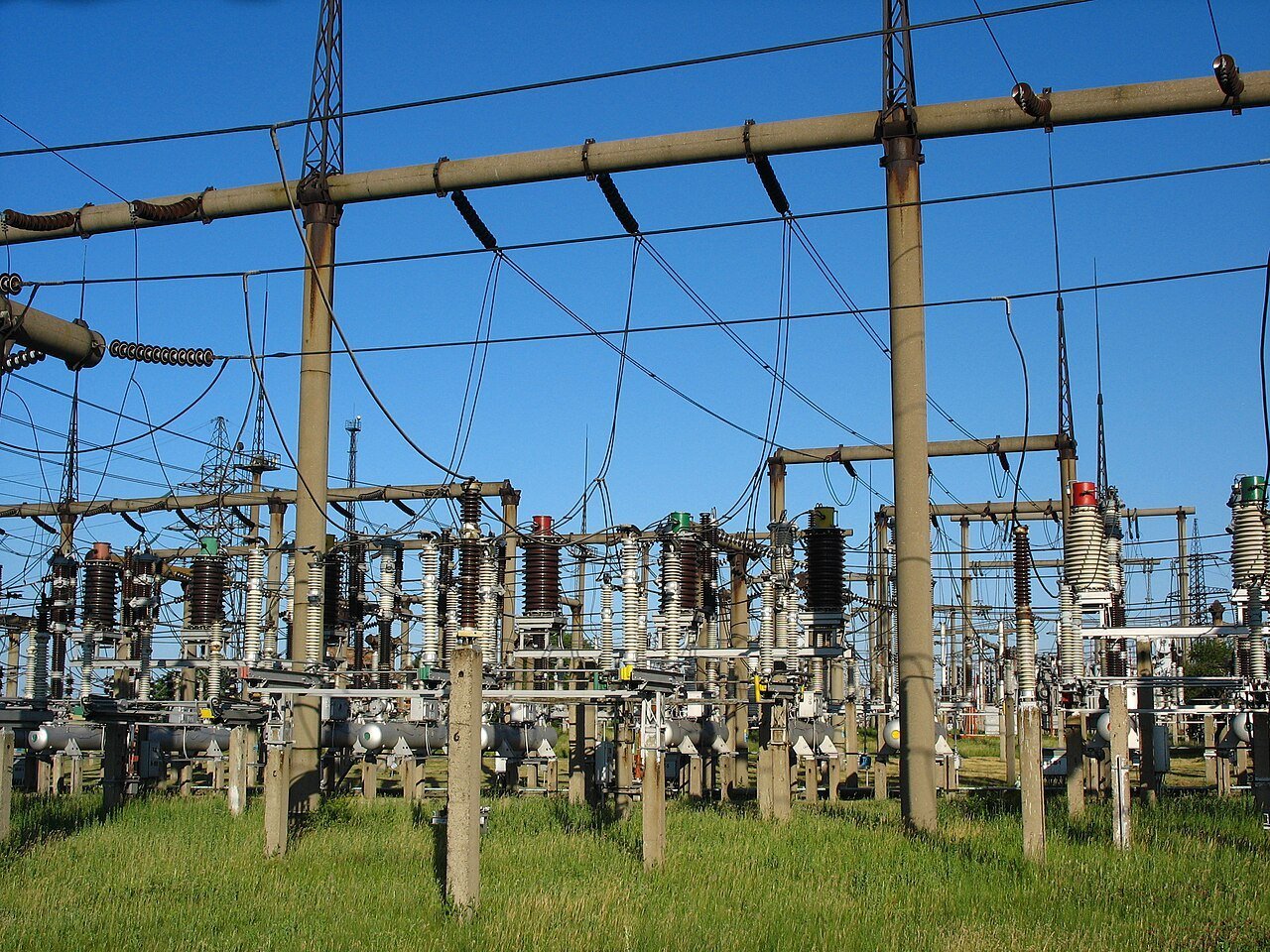 Projet 54An outdoor high voltage substation switchyard. GE Vernova's gas turbine backlog is the number that travels, but its own chief executive says the turbines are not the gating item. Equipment like this is.
| Mesure | Value | Période | Source |
|---|---|---|---|
| Gas capacity under contract | 116 GW: 53 GW firm equipment backlog plus 63 GW slot reservations | At 30 June 2026 | GE Vernova Q2 2026 |
| Siemens Energy gas turbine backlog | 69 GW | At 30 June 2026 | Siemens Energy Q3 FY2026 |
| Mitsubishi Heavy large frame backlog | 35 GW, from 23 GW a year earlier | Q1 FY2026 | MHI, via Utility Dive |
| Total backlog | 176 billion dollars, 88 equipment and 88 services | At 30 June 2026 | GE Vernova Q2 2026 |
| Group orders | 24.2 billion dollars, up 88 per cent organic | 2e trimestre 2026 | GE Vernova Q2 2026 |
| Electrification equipment backlog | 41 billion dollars, up 69 per cent | At 30 June 2026 | GE Vernova Q2 2026 |
| Wind segment EBITDA | Loss of 275 million dollars, negative 13.6 per cent margin | 2e trimestre 2026 | GE Vernova Q2 2026 |
| FY2026 free cash flow guidance | 11.5 to 12.5 billion dollars, raised from 6.5 to 7.5 billion | Issued 22 July 2026 | GE Vernova |
| Share of 116 GW that is non binding | About 54 per cent | Project 54 calculation | Projet 54 |
Fifty four per cent of the headline is a reservation nobody has seen the terms of
The distinction matters because the two things are accounted for differently and behave differently under stress. A firm equipment order sits in backlog with a contract, a price and a delivery slot. A slot reservation agreement reserves manufacturing capacity in a future year. GE Vernova discloses the two separately and then reports the sum, and it is the sum that travels.
The trajectory of the sum is genuinely striking. It was 62 GW at the end of 2024, 83 GW at the end of 2025, 100 GW at 31 March 2026 and 116 GW at 30 June 2026. The company booked 40 GW in the first half of 2026 alone against second half guidance of 20 GW, which Strazik said at the Morgan Stanley Laguna Conference on 16 September 2026 is likely to prove conservative. The year end guide is at least 125 GW.
What is not disclosed is what a reservation costs to walk away from. Nothing in the Q1 2026 ou Q2 2026 call transcripts sets out deposits, liquidated damages or cancellation terms for slot reservations. Management's reassurance is qualitative. Strazik told the Q2 call the company is not putting things in its order book without a firm pathway to the schedule, and said it expects to convert many of the reservations into orders in the second half.
There is one hard data point on the bull side. Jefferies reported on 17 September 2026 that the conversion rate from slots to orders has accelerated since the second quarter. That is the evidence to watch, and it is the right question to put to the company at the Q3 call. On the other side, BNP Paribas analyst Moses Sutton, quoted by Utility Dive on 23 July 2026, said of the capacity expansion that the jury's out, while also noting management's track record of under guiding and over delivering.
The practical reading for a supplier or a competitor is simple. Fund against 53 GW. Price optionality against the other 63 GW. And ask which calendar years the reservations sit in, because GE Vernova says it is mostly sold out through 2030, expects to be more than halfway contracted for 2031 by year end 2026, and Strazik said in July that the company needs more time before it can articulate the timing of contracting in 2032.
On firm backlog it is second, and no one has a lead time advantage
There is no credible published market share figure for heavy duty gas turbine orders in 2025 or 2026. Everything that looks like one comes from paid market research summaries with no disclosed method. We are not going to publish a share percentage we cannot source. The defensible comparison is on gigawatts, with the definitional caveat stated plainly.
At 30 June 2026 GE Vernova reported 53 GW of firm gas equipment backlog plus 63 GW of reservations. Siemens Energy reported a 69 GW gas turbine backlog at the same date, inside a Gas Services order book that grew 61.9 per cent on a comparable basis in its third fiscal quarter, with a book to bill of 2.65. Mitsubishi Heavy reported 35 GW of large frame backlog, up from 23 GW a year earlier. On firm backlog, Siemens is the larger book. Whether the three define backlog identically is not verifiable from public disclosure, and that is a fair question to ask all three.
On lead times the three converge. GE Vernova quotes roughly three years on new heavy duty orders and books four to five years out. Siemens Energy's chief financial officer Maria Ferraro has indicated company wide lead times of at least three years. Mitsubishi's first quarter FY2026 orders are scheduled for delivery between 2028 and 2030. No one is materially faster. That matters for how you read the pricing story: the rent is being earned by the industry, not won from rivals.
Capacity is expanding everywhere at once, which is the thing to model if you are projecting pricing into 2029 and beyond. GE Vernova is targeting a 20 GW annualised run rate by the third quarter of 2026, 24 GW by 2028 and 30 GW by 2030, with Strazik calling the capital expenditure modest and Parks flagging a roughly 30 per cent year on year combined increase in research and development plus capital expenditure. Siemens has added around 30 medium gas turbine units since 2025, has about 35 large gas turbine units with 15 more planned in 2027, and is expanding transformer and gas insulated switchgear capacity by around 50 per cent by 2030. Mitsubishi still plans to double production capacity against 2024 levels while being, in its own words, selective in the projects it contracts.
Siemens puts the addressable gas turbine market at up to 120 GW a year, about half of it in the United States. If all three hit their expansion targets, the industry adds supply into a market whose demand signal is itself contested. That is the shape of every capital goods cycle that has ever turned.
The chief executive points at the grid, and the grid numbers agree with him
The most useful sentence GE Vernova has said this year is not about gas. On the first quarter 2026 call Strazik said that at the end of the day, in many of the cases with these projects, the gas turbines are really not the gating item. At Laguna in September he added that many data centre projects do not have a guaranteed commitment on grid interconnection timing.
The Electrification numbers support him. Orders of 6,347 million dollars in the quarter, up 66 per cent and running at roughly 1.7 times revenue. Equipment backlog of 41 billion dollars, up 69 per cent. Segment margin of 18.4 per cent, up 390 basis points, which Strazik put at 700 basis points on an organic basis. About 800 million dollars of US transformer orders in the quarter alone. Unit throughput moving from roughly 9,000 units last year to a planned 10,500 this year. Three further US factories, in Shreveport, North Carolina and Wisconsin. The 2028 target is to take Electrification backlog from 30 billion to 60 billion dollars.
What GE Vernova does not publish is its lead times in that segment. Neither the Q1 nor the Q2 2026 call contains an HVDC, transformer or switchgear lead time. The independent evidence is blunt: PwC analysts put lead times for high capacity transformers at as long as four years, and Wood Mackenzie measured demand for generator step up transformers rising 274 per cent between 2019 and 2025, with substation transformers up 116 per cent.
For a buyer this inverts the procurement sequence. If the turbine is three years out and the transformer is four, the transformer is the critical path and should be ordered first, against a site that may not yet have planning consent. For a supplier it says the scarcity rent sits in grid equipment, and that is where capacity investment earns the better return. For an investor it says the Electrification margin line is the leading indicator and the gigawatt headline is the lagging one.
The forecaster who produced the famous number also published the haircut
The macro case is strong and comes from sources with no equipment to sell. The IEA's Electricity 2026 puts global demand growth at 3.6 per cent a year to 2030, against 2.8 per cent over the past decade, taking consumption from 28,200 TWh in 2025 to 33,600 TWh in 2030. It puts US growth close to 2 per cent a year, more than double the past decade's rate, with more than 420 TWh of total growth and data centres accounting for roughly half of it. The US Energy Information Administration expects record US generation of 4,368 billion kWh in 2026.
The widely cited US figure is Grid Strategies' National Load Growth Report of November 2025: 166 GW of five year peak demand growth, of which roughly 90 GW is data centres. The same report says the data centre portion is likely overstated by roughly 25 GW, warns that FERC does not appear to review load forecast data filed on Form 714 for accuracy, notes that including sub areas would effectively double count some loads, and writes that if the load forecasts are correct, and this is by no means assured. The caveat is in the primary source and is almost never quoted with the number.
Then there is Texas. On 3 August 2026 Governor Greg Abbott wrote to ERCOT and the Public Utility Commission ordering an audit of every data centre in the interconnection queue, roughly 474 GW of requests, more than five times ERCOT's record peak demand, of which he said approximately 90 per cent are data centres. Projects that fail the audit are to be denied. ERCOT aims to complete it by December 2026. BloombergNEF estimates the audit could delay 49.8 GW, almost 20 per cent of the 253 GW US data centre pipeline, at a cost of just over 8 billion dollars by the first quarter of 2027 and up to around 15 billion in a full delay case. New York paused new data centre approvals in July 2026 for up to a year.
GE Vernova's own exposure to this is smaller than the narrative suggests, and the company says so. Roughly 20 per cent of the gigawatts under contract are direct to data centres; about 80 per cent are utilities, independent power producers and industrials, across about 100 customer entities in 26 countries. Data centre orders in Electrification were about 5 billion dollars in the first half of 2026 against about 2 billion in all of 2025, and Strazik conceded at Laguna that those orders can be a little bit lumpy.
The honest position is that both things are true. Electricity demand growth is real and structural. The specific data centre queue is inflated, and at least two states are now acting as if it is. A supplier planning capacity should model the IEA's demand curve and discount the queue.
Losses narrowing, a target cut, and a settlement nobody can price
Wind lost 275 million dollars of segment EBITDA in the second quarter at a negative 13.6 per cent margin, which Parks described as in line with expectations, and 657 million dollars across the first half. Full year guidance is for roughly 400 million dollars of losses, which implies a second half close to break even, consistent with the guidance that the third quarter would be approximately break even. Orders fell 40 per cent, mainly in onshore equipment.
The driver is offshore. Parks attributed the loss to higher project costs and contract losses at Offshore Wind, partly offset by improved onshore services. Dogger Bank B and C are expected to take, in Strazik's words, the better part of 2027 to complete. The company has moved to trim the offshore unit, with secondary reporting putting the figure at around 900 jobs; we could not locate a primary GE Vernova release confirming that headcount.
The Vineyard Wind dispute is the part that cannot be priced. Vineyard Wind sued GE Renewables on 8 April 2026 to stop it exiting the turbine supply agreement on the 800 MW project. The filing cited 853 million dollars of costs incurred from defective blades against a 1.3 billion dollar contract price, and a GE root cause analysis reportedly finding 68 of 72 installed blades defective. The parties settled on 16 September 2026, GE Vernova withdrew its termination notice, all claims were dropped, and the terms of the settlement agreement are confidential. That means the financial outcome is simply not public.
Set against that, the December 2025 investor day cut the 2028 Wind segment margin target from 10 per cent to 6 per cent, and assumes onshore revenue declines below 2026 levels with both offshore backlog projects complete. Strazik said in September that the segment is reaching a profitability pivot point and that profitability will be drastically better going forward, while conceding on onshore orders that he would not say the company is close to that inflection point right now. Both statements are in the same transcript. Read them together.
Three different reads, one shared conclusion
If you supply GE Vernova, size your investment against the 53 GW of firm equipment backlog and the 88 billion dollar equipment book, not the 116 GW. Ask for the delivery year profile of any reservation driven forecast you are handed. Price long validity windows, because a reservation whose terms are undisclosed is optionality the customer holds and you fund. And look hard at Electrification: 69 per cent backlog growth with undisclosed lead times is where the shortage, and therefore the margin, currently lives.
If you buy power equipment, reorder your critical path. The transformer, the switchgear and the interconnection study are likely to bind before the turbine does. Strazik has said as much twice. Secure the grid scope first, then the generation scope, and treat the interconnection commitment as the genuine milestone rather than the equipment order.
If you compete with GE Vernova, the comparison to make publicly is firm backlog, not capacity under contract. Siemens Energy's 69 GW against GE Vernova's 53 GW is the honest like for like, and it is a better story than most of Siemens' own communications currently tell. The lead time parity across all three OEMs also means there is no scarcity story to differentiate on, only delivery reliability and total installed cost.
And everyone should watch two things at the third quarter print. First, whether slot reservations converted at the rate Jefferies observed. Second, whether Electrification margin held above 18 per cent. Those two numbers, not the gigawatt headline, will tell you whether this cycle is compounding or peaking. There is also an execution variable: chief financial officer Ken Parks retires in April 2027, with Claire McDonough joining from Rivian in November 2026 and taking over on 1 January 2027, which is a finance leadership change at the top of a capital expenditure and backlog conversion cycle.
Écoutez et emportez-le avec vous
Vous préférez le format audio ou vous avez besoin de la présentation pour une analyse interne ? Le compte rendu complet est disponible sous forme d’épisode de podcast et de diaporama téléchargeable.
You supply castings, controls or balance of plant and GE Vernova tells you it has 116 GW under contract through 2030. What do you do with that number?
Questions fréquemment posées
At 30 June 2026 GE Vernova reported 116 GW of gas capacity under contract, made up of 53 GW of firm equipment backlog and 63 GW of slot reservation agreements. The company has guided to at least 125 GW under contract by the end of 2026. Total company backlog across all segments was 176 billion dollars, split evenly between 88 billion dollars of equipment and 88 billion dollars of services.
It is an agreement that reserves gas turbine manufacturing capacity in a future delivery year without being a firm equipment order. GE Vernova reports reservations separately from equipment backlog and then presents the combined figure. As at the Q1 and Q2 2026 earnings calls the company had not disclosed deposits, liquidated damages or cancellation terms for reservations, so the amount at risk if they are not converted is not publicly quantifiable.
It depends which figure you use. On the combined 116 GW of equipment backlog plus reservations, yes. On firm equipment backlog alone, no: GE Vernova reported 53 GW at 30 June 2026 against Siemens Energy's 69 GW gas turbine backlog at the same date. Mitsubishi Heavy reported 35 GW of large frame backlog. The three companies may not define backlog identically and none of them publishes a reconciliation.
Scott Strazik said on the Q2 2026 call that the company is mostly sold out through 2030. It expects to be more than halfway contracted for 2031 by the end of 2026. On 2032 he said in July 2026 that the company needs more time before it can articulate the timing of contracting. Lead times on new heavy duty orders are around three years, and the company books reservations four to five years out.
GE Vernova's own chief executive says they usually are not. On the Q1 2026 call Scott Strazik said that in many of these projects the gas turbines are really not the gating item, and in September 2026 he noted that many data centre projects lack a guaranteed commitment on grid interconnection timing. Independent evidence points the same way: PwC analysts put lead times for high capacity transformers at as long as four years.
Partly, according to the forecaster most often cited for it. Grid Strategies' November 2025 report projects 166 GW of five year US peak demand growth with roughly 90 GW from data centres, and states in the same document that the data centre portion is likely overstated by roughly 25 GW. Texas is auditing roughly 474 GW of interconnection requests, around 90 per cent of them data centres, and BloombergNEF estimates the audit could delay 49.8 GW.
As at 12 October 2026 GE Vernova had not announced a third quarter 2026 earnings date, and Q3 results had not been reported. The most recent reported period is the second quarter of 2026, released on 22 July 2026, and the most recent management commentary is the Morgan Stanley Laguna Conference transcript of 16 September 2026, which the company publishes itself.
Obtenez la suite gouttelettes de renseignement
Rejoignez les leaders des secteurs de l'énergie et de l'industrie et recevez directement nos informations stratégiques en matière de marketing, de croissance par IA et d'architecture des revenus, sans superflu.
Vous êtes sur la liste
Bienvenue dans The Energy Growth Brief, consultez votre boîte de réception pour le prochain numéro.