
Who Owns XRG? ADNOC's Investment Arm Explained
XRG is wholly owned by ADNOC, which is itself wholly owned by the Emirate of Abu Dhabi. That single fact explains most of what counterparties need to know about it: where the capital comes from, who signs, why its board carries serving UAE ministers, and why its deals attract foreign investment review in Brussels, Berlin, Canberra and Washington. Here is the ownership chain in detail, and what it means commercially.
- ADNOC holds 100 percent of XRG P.J.S.C., a UAE public joint stock company headquartered in Abu Dhabi and launched on 27 November 2024. ADNOC is wholly owned by the Emirate of Abu Dhabi, so the ultimate owner is the Abu Dhabi government.
- XRG's board was endorsed by UAE President Sheikh Mohamed bin Zayed Al Nahyan in December 2024 and includes serving UAE ministers alongside Blackstone President Jon Gray, OCI Global's Nassef Sawiris and former bp chief executive Bernard Looney.
- Dr Sultan Ahmed Al Jaber is Executive Chairman of XRG and added the chief executive title in November 2025, while remaining ADNOC Managing Director and Group CEO and UAE Minister of Industry and Advanced Technology.
- In September 2025 ADNOC transferred its stakes in its ADX-listed companies into XRG, including roughly 86 percent of ADNOC Gas, 78.5 percent of ADNOC Drilling, 77 percent of ADNOC Distribution and 78 percent of ADNOC L&S, plus Fertiglobe and the 24.9 percent OMV holding.
- For counterparties the contracting entity is XRG or a named subsidiary, but the capital and ultimate recourse sit with ADNOC and behind it the Emirate. That is why XRG transactions have drawn EU Foreign Subsidies Regulation review, German FDI clearance and, on the Santos approach, Australian scrutiny.
Abu Dhabi, then ADNOC, then XRG
XRG is a UAE public joint stock company, XRG P.J.S.C., headquartered in Abu Dhabi. It was launched by ADNOC on 27 November 2024 with a stated enterprise value at the time of more than 80 billion dollars, around AED 290 billion, and with three declared platforms: international gas, global chemicals, and low-carbon energies and energy solutions. The announcement and the subsequent endorsement of its board by the UAE President on 12 December 2024 are the primary record of its formation.
The ownership question has a clean answer because ADNOC has stated it directly. In its 11 September 2025 announcement of internal shareholding transfers, ADNOC said it "will continue to retain control and ultimate ownership of the listed companies through its 100% shareholding of XRG". The April 2026 Borouge International completion release likewise describes XRG as a wholly-owned subsidiary of ADNOC.
One step further up, ADNOC is wholly owned by the Government of Abu Dhabi. So the chain is Emirate of Abu Dhabi, then ADNOC, then XRG, then XRG's subsidiaries and holdings. Nothing in the public record shows a direct equity stake in XRG held by the Abu Dhabi Investment Authority, Mubadala or ADQ.
The ADQ point is worth stating plainly because it is a common source of confusion. ADQ appeared alongside XRG and Carlyle in the consortium that approached Santos in 2025, and ADQ's chief executive sits on the XRG board. Neither of those facts makes ADQ a shareholder in XRG. Consortium partnership on a single transaction and board representation are different things from ownership.
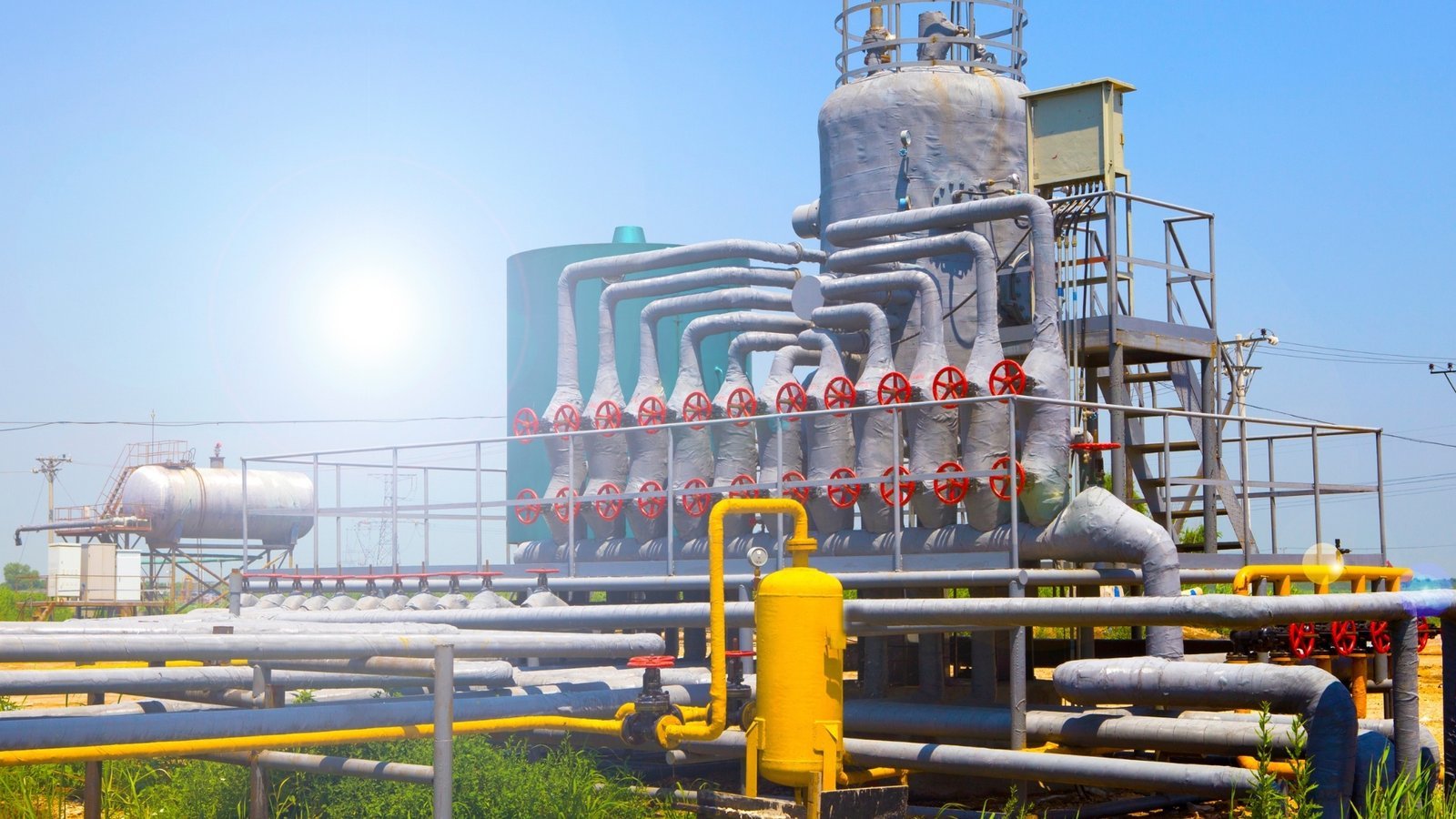 Projet 54Gas processing equipment and heat exchangers at an operating plant. XRG's largest declared platforms are international gas and global chemicals, the two businesses where ADNOC has concentrated its overseas capital since 2024.
| Couche | Entity | Holding | Source |
|---|---|---|---|
| Ultimate owner | Emirate of Abu Dhabi | 100 percent of ADNOC | ADNOC corporate disclosure |
| Parent | ADNOC | 100 percent of XRG P.J.S.C. | ADNOC statement, 11 September 2025 |
| Investment arm | XRG P.J.S.C., Abu Dhabi | Holds international and listed-company stakes | XRG launch release, 27 November 2024 |
| Listed stakes held | ADNOC Gas, ADNOC Drilling, ADNOC Distribution, ADNOC L&S, Fertiglobe, OMV 24.9 percent | Approximately 86, 78.5, 77 and 78 percent respectively | ADNOC transfer announcement, 11 September 2025 |
| Named deal subsidiary | ADNOC International Germany Holding AG | Indirect wholly-owned XRG subsidiary used for Covestro | Covestro completion release, 10 December 2025 |
A board endorsed at head of state level
XRG's board was endorsed by UAE President Sheikh Mohamed bin Zayed Al Nahyan on 12 December 2024. That matters for interpretation: this is not an ordinary corporate subsidiary board appointed by a parent company's nominations committee, it is a state-level appointment. The board endorsed XRG's 2025 to 2030 five year plan on 3 June 2025.
Dr Sultan Ahmed Al Jaber is Executive Chairman. In November 2025 he additionally took the chief executive role, while remaining ADNOC Managing Director and Group CEO and UAE Minister of Industry and Advanced Technology. The practical consequence is that ADNOC strategy and XRG strategy converge in one person, so a counterparty negotiating with XRG should not assume independent decision making from ADNOC.
The rest of the board mixes UAE state office with international commercial weight: Mohamed Hassan Alsuwaidi, UAE Minister of Investment and chief executive of ADQ; Dr Ahmed Mubarak Al Mazrouei, chairman of the President's Office for Strategic Affairs; Jassem Al Zaabi, chairman of the Abu Dhabi Department of Finance; Jon Gray, President and Chief Operating Officer of Blackstone; Nassef Sawiris, Executive Chair of OCI Global; and Bernard Looney, former chief executive of bp.
Al Jaber described the mandate at launch: "Under the guidance of the UAE's leadership, XRG is a transformative investment company, uniquely positioned to unlock value across high-growth sectors, geographies, and value chains that are underpinned by strong market fundamentals." When the board approved the five year plan in June 2025 he framed it more narrowly: "XRG is investing in the energy systems of the future – more integrated, more resilient, and responsive to global demand."
Gas, chemicals and a dividend engine
XRG's portfolio has been assembled in stages. In February 2025 ADNOC moved US hydrogen and LNG positions into it, including its stake in NextDecade's Rio Grande LNG and 35 percent of ExxonMobil's Baytown low-carbon hydrogen project in Texas. By the June 2025 board meeting the international gas platform also listed Area 4 in Mozambique's Rovuma Basin, Arcius Energy in Egypt, a joint venture with bp, Absheron in Azerbaijan and Offshore Block I in Turkmenistan. The board set a target of 20 to 25 million tonnes per annum of LNG and gas by 2035 and a top-five global position.
The September 2025 internal transfer changed the character of the entity. Moving ADNOC's listed-company stakes into XRG gave it a recurring dividend stream from ADNOC Gas, ADNOC Drilling, ADNOC Distribution and ADNOC L&S. That is a structural point for anyone assessing its capacity to fund large acquisitions: XRG is not only a deployment vehicle, it now sits on top of cash-generating listed assets.
On chemicals, the Covestro acquisition closed on 10 December 2025 through ADNOC International Germany Holding AG, an indirect wholly-owned XRG subsidiary, and included a capital increase of 1.17 billion euros. On 1 April 2026 XRG and OMV completed the creation of Borouge International, a 50/50 combination of Borouge, Borealis and NOVA Chemicals with around 13.6 million tonnes of capacity, headquartered and tax domiciled in Austria with a regional headquarters in the UAE. Al Jaber called it a milestone that "accelerates XRG's ambition to build a globally leading chemicals platform".
Not every approach has succeeded. The XRG, ADQ and Carlyle consortium made an indicative proposal for Santos valued at roughly 18.7 to 19 billion dollars in mid 2025 and withdrew it on 17 September 2025 without a binding offer. We looked at the strategic logic behind the gas and chemicals build in ADNOC's XRG, the gas, chemicals and AI bet.
State ownership changes the timetable, not usually the outcome
Three practical consequences follow from 100 percent state ownership. First, on credit and contracting: the signing entity is XRG P.J.S.C. or a named subsidiary such as ADNOC International Germany Holding AG, but the balance sheet behind it is ADNOC's and behind that the Emirate's. Counterparties should still read the actual contracting entity rather than assuming parent recourse, but the underlying capital position is not in doubt.
Second, on regulatory review: XRG deals are treated abroad as foreign state investment. The Covestro transaction required clearance under the EU Foreign Subsidies Regulation, granted with conditions in November 2025, plus German foreign direct investment clearance. Australia's Foreign Investment Review Board was the relevant gate on the Santos approach, and CFIUS is the relevant gate on the US gas, LNG and hydrogen positions. The pattern so far is longer timelines and behavioural remedies rather than outright prohibition.
Third, on how to sell to it. For suppliers, XRG is not a new procurement counterparty so much as a new capital allocator sitting above familiar ones. Work continues to be contracted by ADNOC operating companies, Borouge International, Covestro and the LNG project vehicles, each with their own vendor registration and, in the UAE, In-Country Value requirements. Understanding the ownership chain tells you where strategy is set; it does not exempt you from the registration and ICV work described in iktva and ICV, local content in the GCC.
The forward read is that XRG's ownership concentrates decision making rather than diffusing it. With one individual holding the chair, the chief executive role and the ADNOC group chief executive role, and a board carrying serving ministers under presidential endorsement, XRG can move quickly on strategy. The friction is external, in the review regimes of the jurisdictions it buys into, and that is where its timetable is genuinely uncertain.
Écoutez et emportez-le avec vous
Vous préférez le format audio ou vous avez besoin de la présentation pour une analyse interne ? Le compte rendu complet est disponible sous forme d’épisode de podcast et de diaporama téléchargeable.
When you assess a state-owned counterparty like XRG, what do you check first?
Questions fréquemment posées
Indirectly, yes. XRG P.J.S.C. is 100 percent owned by ADNOC, and ADNOC is wholly owned by the Emirate of Abu Dhabi. So the ultimate beneficial owner is the Abu Dhabi government, but the direct and sole shareholder of record is ADNOC. ADNOC stated the 100 percent shareholding explicitly in its 11 September 2025 announcement of internal shareholding transfers.
No shareholding by ADIA, Mubadala or ADQ in XRG appears in any public source. ADQ has partnered with XRG at transaction level, including in the consortium with Carlyle that made and then withdrew an indicative proposal for Santos in 2025, and ADQ's chief executive Mohamed Hassan Alsuwaidi sits on the XRG board. Consortium participation and board membership are not ownership.
XRG was launched by ADNOC on 27 November 2024 with a stated enterprise value of more than 80 billion dollars, around AED 290 billion. XRG's own corporate boilerplate, as used in the April 2026 Borouge International completion release, now describes its value as exceeding 150 billion dollars. Those are company-stated figures rather than independently audited valuations, and the increase reflects the transfer of ADNOC's listed-company stakes into XRG in September 2025 as well as acquisitions.
Dr Sultan Ahmed Al Jaber is Executive Chairman and, since November 2025, also chief executive. He simultaneously serves as ADNOC Managing Director and Group CEO and as UAE Minister of Industry and Advanced Technology. The board, endorsed by the UAE President in December 2024, includes UAE Minister of Investment and ADQ chief executive Mohamed Hassan Alsuwaidi, Dr Ahmed Mubarak Al Mazrouei, Jassem Al Zaabi, Blackstone President Jon Gray, OCI Global Executive Chair Nassef Sawiris and former bp chief executive Bernard Looney.
Practically, it means you are dealing with a state-owned investor rather than a listed company with dispersed shareholders. Contracts are signed by XRG or a named subsidiary, and you should read that entity rather than assume parent recourse. Cross-border transactions attract foreign investment review, so expect longer timetables and possible conditions. And for suppliers, procurement itself still runs through the operating companies, Borouge International, Covestro and the project vehicles, each with its own vendor registration and, in the UAE, In-Country Value requirements.
Obtenez la suite gouttelettes de renseignement
Rejoignez les leaders des secteurs de l'énergie et de l'industrie et recevez directement nos informations stratégiques en matière de marketing, de croissance par IA et d'architecture des revenus, sans superflu.
Vous êtes sur la liste
Bienvenue dans The Energy Growth Brief, consultez votre boîte de réception pour le prochain numéro.