



Why Are Data Centers Driving Demand for Gas Turbines?
Artificial intelligence is turning electricity into the binding constraint on computing. Data center power demand is set to roughly double by 2030, and grids cannot connect that load fast enough. Gas turbines sited next to the data center have become one of the few ways to add firm power quickly, which is why equipment makers like Baker Hughes are booking record orders. Here is why the demand is real, why gas is winning a share of it, and where the bottleneck now sits.
- The International Energy Agency projects data center electricity demand will roughly double to about 945 terawatt hours by 2030, with AI focused data centers growing fastest.
- Grid connection queues run for years, so on site or near site generation is often the fastest way to power a new data center.
- Natural gas is expected to supply a large share of the new load, expanding by around 175 terawatt hours to meet data center demand, notably in the United States.
- Gas turbines deliver firm, dispatchable power that matches the constant, high load profile of AI computing, unlike weather dependent renewables on their own.
- The bottleneck has shifted to the turbines themselves: lead times now stretch several years, which is why equipment makers are booking record order books and expanding capacity.
A demand curve that doubles
The scale of the demand is what makes this a strategic issue rather than a niche one. The International Energy Agency, in its 2025 Energy and AI analysis, projects that global electricity consumption from data centers will roughly double to around 945 terawatt hours by 2030, just under 3 percent of world electricity, and rise toward 1,200 terawatt hours by 2035 (IEA, Energy and AI). Electricity use from AI focused data centers grows fastest of all, roughly tripling over the period.
That load is not just large, it is concentrated and constant. AI training and inference run around the clock at high utilisation, which is a very different profile from ordinary commercial demand. Meeting it requires firm power that is available every hour, not just when the wind blows or the sun shines.
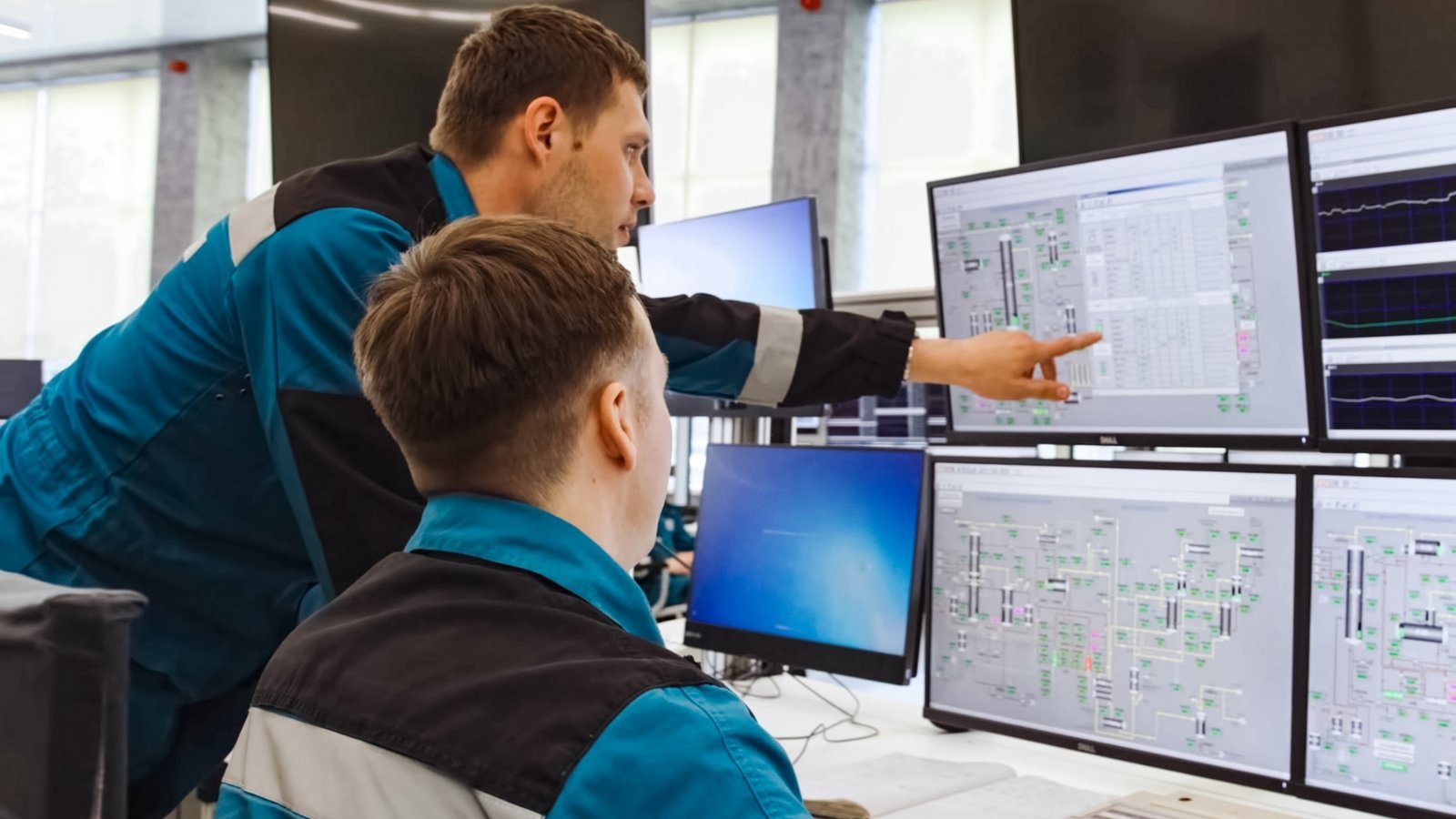 Project 54Engineers reviewing live data on an operations wall, the kind of always on computing load that is driving data center power demand.
The queue is the problem
The obvious answer, connect the data center to the grid, runs into a hard constraint: time. In many markets the queue to secure a large new grid connection stretches for several years, and new transmission takes even longer to build. For a hyperscale operator racing to deploy AI capacity, a multi year wait for power is a multi year wait for revenue.
That timing gap is what pushes developers toward on site or near site generation. Building your own power next to the building, behind the meter, can be faster than waiting in the interconnection queue. Speed to power, not just cost of power, is now the deciding factor for where and how fast a data center can be built.
Firm power on a shorter timeline
Gas turbines fit the data center problem on three dimensions. They are dispatchable, meaning they run on demand and provide the firm, constant power AI computing needs. They can be sited next to the load, avoiding the transmission bottleneck. And at scale they can be deployed faster than most alternatives that deliver the same firm capacity. The IEA expects natural gas to expand by around 175 terawatt hours to help meet data center demand, notably in the United States (IEA, Energy demand from AI).
This is not a story of gas versus renewables. Renewables are expected to supply the largest single share of new data center demand, helped by short build times and low cost. But renewables need firming, and gas turbines are one of the technologies filling that role today. The result is a surge in turbine orders. Baker Hughes booked 2.7 gigawatts of gas turbines for data centers and mobile power in a single quarter of 2026, part of a record 7.1 billion dollars of Industrial and Energy Technology orders (Rigzone).
The turbines themselves
As demand has shifted to turbines, the constraint has moved with it. The IEA notes that lead times for new gas turbines now stretch several years, a supply crunch that could delay commissioning of some gas fired capacity beyond 2030. In other words, ordering a turbine today does not guarantee power tomorrow.
For equipment makers, that scarcity is the opportunity. It is why Baker Hughes, GE Vernova, Siemens Energy and Mitsubishi Power are expanding manufacturing capacity and why their order books now reach years into the future. Baker Hughes is targeting roughly 5 billion dollars of annual power systems revenue by 2029 and doubling its gas turbine capacity from 2026 levels by the end of 2028. Whoever can build turbines fastest captures the demand.
Sell speed to power
For anyone selling into this market, the lesson is that the scarce resource is firm power delivered quickly, not energy in the abstract. Buyers will pay a premium for capacity that shortens their time to power, and they will lock in supply years ahead to secure it. That reshapes how equipment, gas supply and power services should be positioned and priced.
It also explains why an oilfield services name like Baker Hughes now talks about the digital economy. To understand how a major energy company is repositioning around exactly this demand, read our analysis of Baker Hughes and the power pivot, and how Chevron is building power for data centers with Project Kilby.
Listen & take it with you
Prefer audio, or need the deck for an internal review? The full briefing is available as a podcast episode and a downloadable slide presentation.
What will be the biggest constraint on data center growth to 2030?
Frequently asked
AI is pushing data center electricity demand up faster than grids can supply it, with the IEA projecting a roughly doubling to around 945 terawatt hours by 2030. Grid connection queues stretch for years, so operators use gas turbines sited next to the data center to add firm power on a shorter timeline. Baker Hughes booked 2.7 gigawatts of such turbines in a single quarter of 2026.
The International Energy Agency projects that global data center electricity consumption will roughly double to around 945 terawatt hours by 2030, just under 3 percent of world electricity, and rise toward 1,200 terawatt hours by 2035. AI focused data centers grow fastest, tripling over the period.
Renewables are expected to supply the largest single share of new data center demand because they are cheap and quick to build. But AI computing needs firm, around the clock power, and renewables on their own are weather dependent. Gas turbines provide the firming capacity that keeps the load supplied at all hours, so the two are used together rather than as alternatives.
Lead times have lengthened significantly. The IEA notes that turbine deliveries for new gas fired plants now face lead times of several years, which could delay some commissioning beyond 2030. That scarcity is why equipment makers are expanding manufacturing capacity and booking multi year order backlogs.
The main suppliers include Baker Hughes, GE Vernova, Siemens Energy and Mitsubishi Power. Baker Hughes booked a record 7.1 billion dollars of Industrial and Energy Technology orders in the second quarter of 2026, including 2.7 gigawatts of gas turbines for data centers and mobile power, and is targeting roughly 5 billion dollars of annual power systems revenue by 2029.
Get the next intelligence drop
Join energy and industrial leaders getting our marketing, AI-growth and revenue-architecture intelligence, direct, no filler.
You're on the list
Welcome to The Energy Growth Brief, watch your inbox for the next dispatch.