








Procurement-Ready Marketing: Bridging the $500k Vendor Valuation Gap

Procurement-Ready Marketing: Bridging the $500k Vendor Valuation Gap

The enterprise B2B sales cycle has decoupled from the traditional “discovery call” model. This shift creates a high-stakes friction point that threatens vendor balance sheets. When a contract collapses at the final hurdle due to compliance gaps, the vendor—not the buyer—absorbs the permanent loss of sunk costs and a catastrophic spike in Customer Acquisition Cost (CAC).

A Procurement-Ready Marketing Vendor Package is the strategic alignment of marketing collateral with enterprise security, legal, and technical audit requirements. It ensures that a vendor can clear independent procurement hurdles without human intervention, protecting the cash conversion cycle and preventing valuation compression. Data confirms that 61% of enterprise buyers now complete their evaluation independently before engaging with a sales representative (Gartner).

The “9:1 Valuation Trap” illustrates the cost of administrative friction: for every month a deal sits in procurement due to missing documentation, a vendor’s risk profile increases. This operational inefficiency raises the Weighted Average Cost of Capital (WACC), making growth capital more expensive to secure.

The Strategic Shift Toward Independent Evaluation

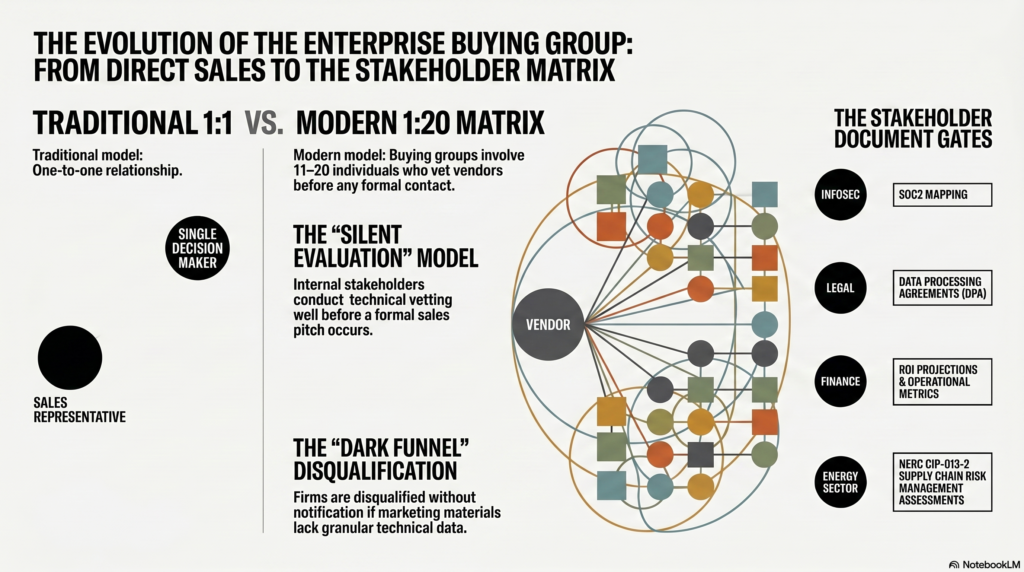
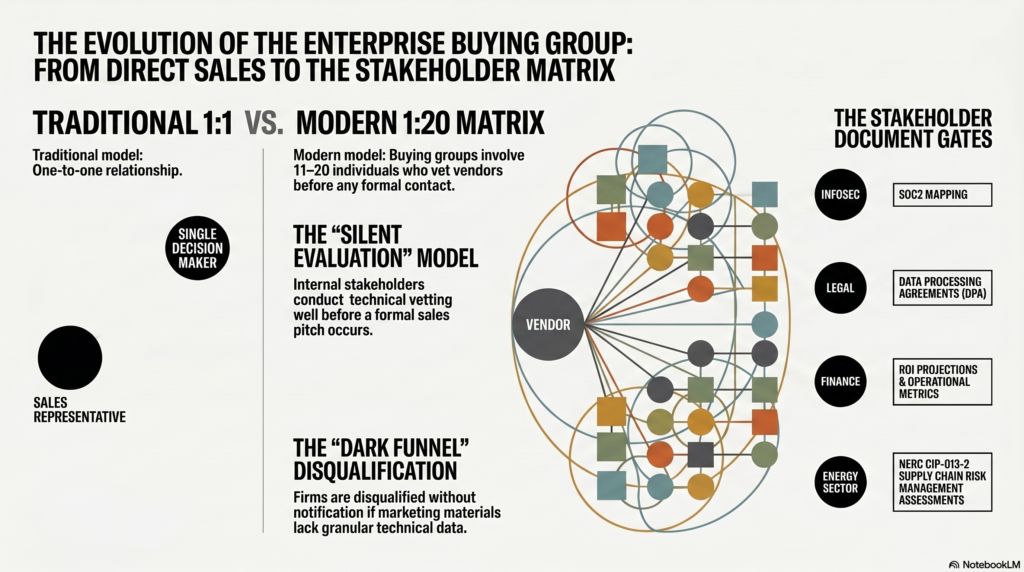
Enterprise procurement now operates on a “silent evaluation” model. Internal stakeholders—including InfoSec, Legal, and Finance—vet vendors well before a formal pitch occurs. If marketing materials lack granular technical data, firms are disqualified in the “dark funnel” without notification.

Modern buying groups involve 11 to 20 individuals. Each requires specific documentation: InfoSec requires SOC2 mapping, Legal requires Data Processing Agreements (DPA), and Finance requires ROI projections tied to operational metrics. In the energy sector, this frequently extends to supply chain risk management standards, such as NERC CIP-013-2, which mandates rigorous vendor risk assessments to protect critical infrastructure. Marketing materials that focus on vision while neglecting these technical requirements fail to meet the needs of the modern procurement process. 


Financial Consequences of Incomplete Procurement Documentation

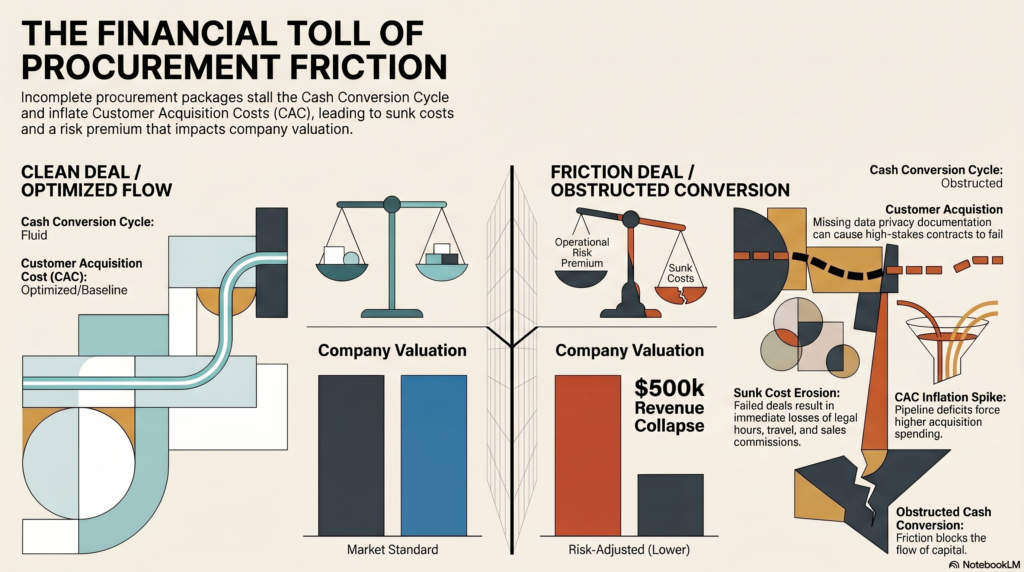
Incomplete procurement packages directly inflate CAC and obstruct the Cash Conversion Cycle (CCC). The financial damage extends beyond lost revenue; it increases the systemic cost of operation. Global investment in the energy transition reached record levels in 2025, but capital efficiency remains the primary metric for vendor sustainability (BloombergNEF)

In high-stakes sectors, such as healthcare, a $500k annual contract can collapse at the final stage if a vendor cannot provide standardized data privacy documentation. The resulting fallout for the vendor includes:

  • Sunk Cost: Immediate loss of sales commissions, travel expenses, and legal hours.
  • CAC Inflation: A $500k pipeline deficit forces a spike in acquisition costs, impacting investor reporting.
  • Opportunity Cost: Time misallocated to non-compliant prospects cannot be recovered.

This friction signals operational immaturity, leading to a risk premium on company valuation.

Metric

Impact of Procurement Friction

Strategic Consequence

CAC

15–25% Increase

Reduced ROI on marketing expenditure

CCC

60+ Day Delay

Restricted liquidity and cash flow

WACC

Increased Rate

More expensive capital and equity dilution

Valuation

Multiple Compression

Lower exit or funding valuation


Technical Documentation as a Primary Sales Asset

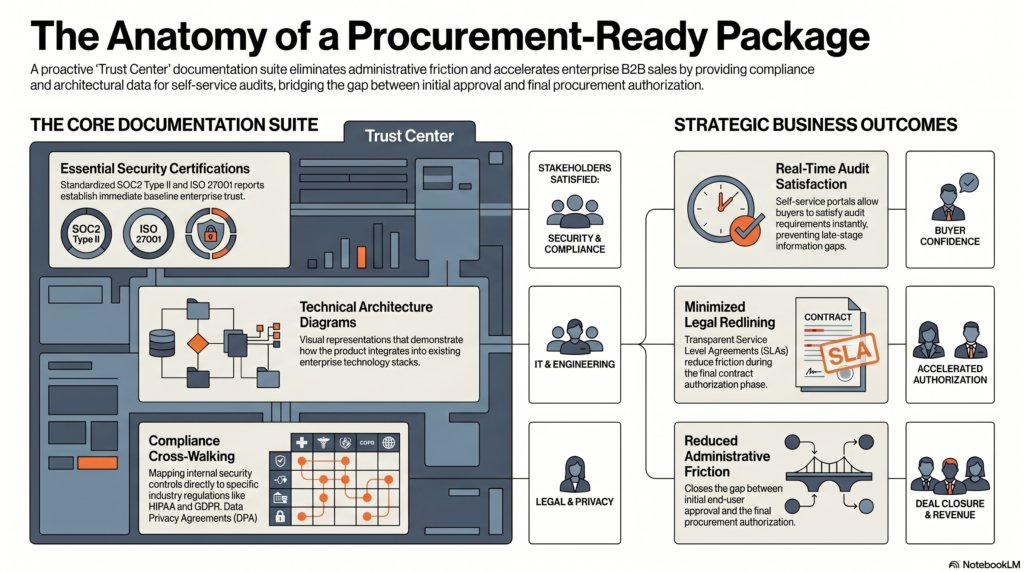
In a procurement-ready model, technical documentation is a front-line marketing asset. Providing a “Trust Center”—a self-service portal for security certifications and compliance data—allows buyers to satisfy audit requirements in real-time.

Standardized SOC2 Type II reports, ISO 27001 certifications, and detailed Data Mapping (identifying encryption standards and data residency) are essential for enterprise trust. Including these in the initial marketing suite removes the information gaps that trigger late-stage audits.

A procurement-ready package must include:

  1. Architecture Diagrams: Visualizing integration with existing enterprise stacks.
  2. Compliance Cross-Walking: Mapping security controls to specific industry regulations (e.g., HIPAA, GDPR).
  3. SLA Transparency: Defined uptime and support commitments to minimize legal redlining.

This proactive approach reduces the administrative friction that occurs between end-user approval and final procurement authorization.

Case Study: Compliance Audits in Regulated Sectors

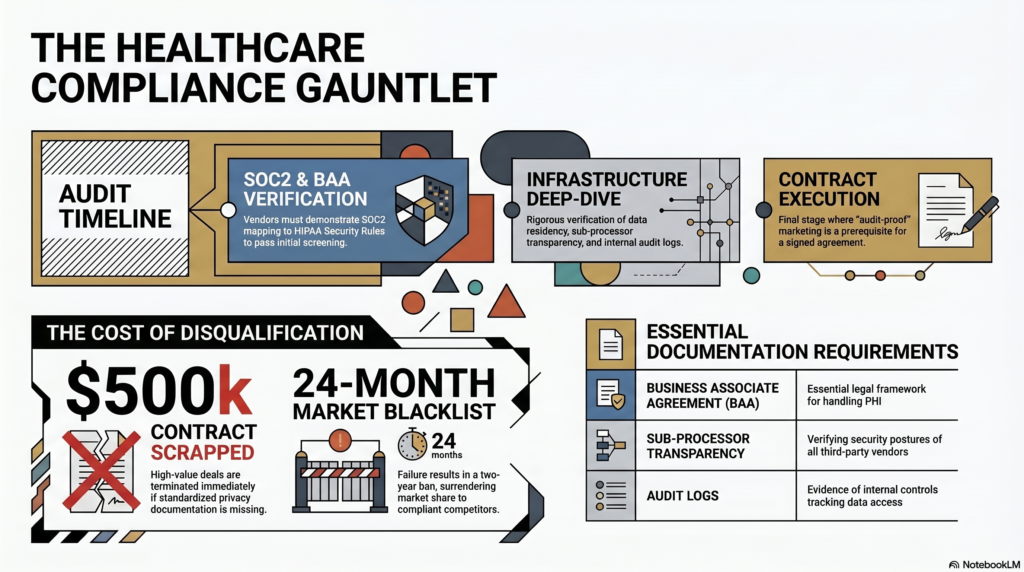
The healthcare sector serves as a benchmark for procurement rigor. Failure to provide standardized data privacy documentation results in immediate disqualification. “Audit-proof” marketing is a prerequisite for contract execution in this environment.

Consider a $500k contract scrapped because a vendor could not produce a Business Associate Agreement (BAA) or demonstrate SOC2 mapping to HIPAA Security Rules. This was an infrastructure failure rather than a product failure.

To meet these standards, vendors must document:

  • Data Residency: Confirmation of PHI storage locations.
  • Sub-processor Transparency: Security postures of all third-party vendors.
  • Audit Logs: Evidence of internal controls tracking data access.

In this scenario, the vendor was blacklisted for 24 months, surrendering market share to a competitor with compliant documentation.


Operationalizing Procurement Readiness

Bridging the gap between marketing collateral and procurement requirements requires a shift from persuasion to verification. Leadership must audit sales materials to replace vague claims with verifiable evidence.

Implementation occurs in three phases:

  1. Content Audit: Identifying documents that fail to answer technical or legal queries.
  2. The Technical Bridge: Establishing a pipeline where engineering specifications are translated into professional documentation.
  3. Self-Service Portal: Implementing a secure portal for independent evaluation by buyers.

Treating technical assets with the same rigor as brand campaigns reduces “Procurement Limbo,” protects WACC, and secures enterprise valuation.

要点

  • Valuation Integrity: Procurement readiness is a financial strategy to maintain valuation by lowering CAC and WACC.
  • The 61% Benchmark: Documentation must facilitate independent evaluation, as the majority of buyers vet vendors before initial contact.
  • Compliance as a Differentiator: In regulated sectors, audit-ready documentation provides a greater competitive advantage than product features.
  • Administrative Efficiency: Standardizing SOC2 and DPA documentation prevents late-stage deal collapse and protects sunk costs.
  • Self-Service Infrastructure: Utilize Trust Centers to satisfy the requirements of complex buying groups efficiently.
  •  


Frequently Asked Questions

What constitutes a Procurement-Ready Marketing Package?

It is a suite of technical and legal documentation (SOC2, GDPR/HIPAA compliance, DPAs) designed to clear enterprise audit requirements without sales intervention.

Why do contracts fail at the final authorization stage?

Failures typically occur when vendors cannot provide specific regulatory documentation required by InfoSec or Legal departments, leading to deal fatigue and disqualification.

How does procurement friction impact company valuation?

Lengthy sales cycles and high CAC signal operational risk to investors. This increases WACC and results in lower valuation multiples.

What is the “9:1 Valuation Trap”?

It describes the lopsided risk in B2B transactions: while a buyer simply selects an alternative, the vendor loses revenue, absorbs high sunk costs, and faces investor scrutiny.

Which documents are critical for enterprise vendors?

Essential documents include SOC2 Type II reports, Data Processing Agreements (DPA), architecture diagrams, and sub-processor lists.

Can smaller vendors implement these standards?

Yes. Investing in professional compliance documentation allows smaller firms to demonstrate the operational maturity required for enterprise-scale contracts.

About the Author

Project 54 Analysis Team is a senior strategic collective at Project 54 with 20+ years of experience in B2B enterprise sales and capital markets, focusing on operational efficiency in the energy and SaaS sectors. [Link to author profile].

Explore This Topic Further

[PODCAST PLAYER: The Invisible Deal Killer — Procurement Friction]

Listen to the companion discussion on this topic. 18 minutes.

Download Episode

[SLIDE DECK: Scaling Your Procurement Readiness]

Download the presentation summarizing the key insights from this article.

Download Slides (PDF) | Download Slides (PPTX)

External Links:

项目 54