


Kazakhstan's OPEC+ Overproduction: The Compliance Reckoning Testing the Cartel
Kazakhstan is the alliance's most visible overproducer, pumping steadily above its OPEC+ crude quota because most of its output comes from three foreign operated mega projects governed by contracts that predate the quotas. This dossier explains why Astana cannot simply turn the taps down, how one Chevron project broke the ceiling, and what the coming baseline reckoning means for oil markets and for suppliers.
- Kazakhstan is OPEC+'s largest and most persistent overproducer. In March 2025 it produced about 1.79 million barrels a day of crude against a quota near 1.468 million, more than 300,000 barrels a day over target, and total liquids reached roughly 2.08 million barrels a day (Argus, 8 April 2025).
- The cause is structural. More than two thirds of output comes from three foreign operated fields, Tengiz, Kashagan and Karachaganak, under 1990s production sharing contracts that predate OPEC+ quotas. Astana has publicly stated it cannot compel the international operators to cut.
- One project broke the ceiling. The Tengiz Future Growth Project, a roughly 48 to 50 billion dollar expansion led by Chevron, added about 260,000 barrels a day from first oil in January 2025. Tengiz alone now runs near 0.9 to 1.0 million barrels a day, larger than Kazakhstan's entire crude quota.
- The compliance mechanism is under strain. Kazakhstan carries the alliance's largest cumulative compensation burden, and analysts widely doubt the make up schedules are deliverable while the mega projects keep ramping. OPEC+ has responded through 2026 not by policing barrels but by unwinding its voluntary cuts in monthly increments.
- The real reckoning is the 2027 baseline. Rather than force Kazakh compliance, OPEC+ is more likely to renegotiate reference levels, a move that would accommodate capacity leaders like Kazakhstan and the UAE while quietly confirming that quota discipline now bends to physical capacity, not the reverse.
The alliance's largest and most persistent overshoot
Kazakhstan has become the clearest stress test of whether OPEC+ discipline still binds its members. The verifiable benchmark comes from Argus Media, which reported that in March 2025 Kazakhstan produced about 1.79 million barrels a day of crude against an OPEC+ target near 1.468 million, an overshoot of more than 300,000 barrels a day, while total liquids reached roughly 2.08 million barrels a day. That was not a one month spike. Kazakh output has continued at or above record levels through 2026, with total liquids reported near 2.1 million barrels a day, keeping the country consistently above whatever monthly crude ceiling the alliance sets.
One accounting detail matters before the politics. OPEC+ quotas apply to crude oil, and a large slice of Kazakhstan's headline production is condensate, a light liquid drawn from its gas rich fields that sits outside the quota. So part of the gap between the two million barrel headline and the roughly 1.5 million barrel quota is a definitional artefact, not defiance. Even after stripping condensate out, however, Kazakh crude has run several hundred thousand barrels a day above target, which is what makes it the single largest overproducer in the group.
The pattern echoes the wider erosion of quota discipline we traced in our analysis of the OPEC+ monthly barrel era and the UAE's baseline exit. Kazakhstan is not an outlier acting alone, it is the most extreme example of a structural problem the alliance has been managing rather than solving.
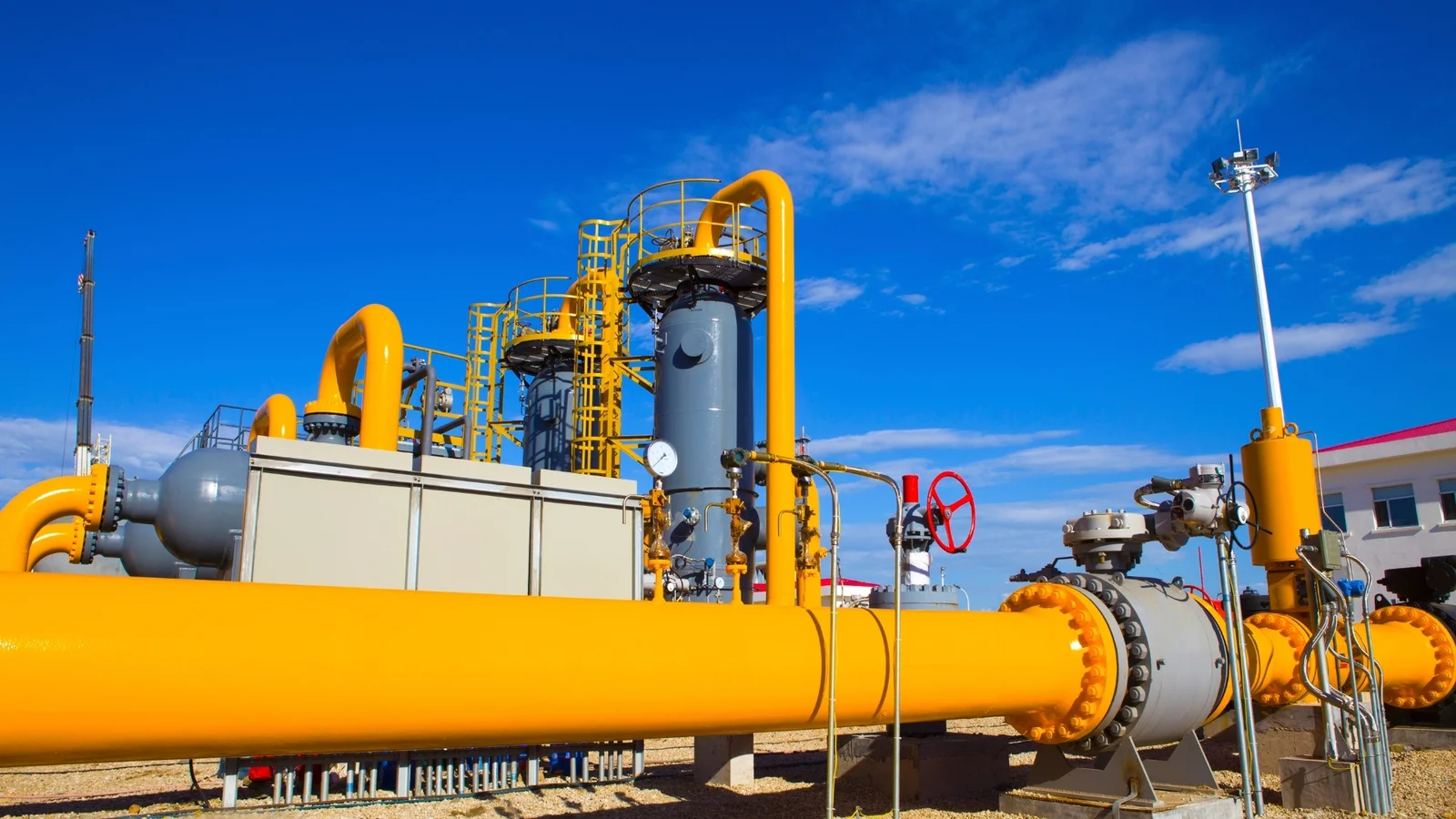 Project 54Crude oil processing infrastructure of the kind that dominates Kazakhstan's output, where three foreign operated mega fields, not the ministry, set the production ceiling.
| Metric | Figure | Source |
|---|---|---|
| Crude quota (target), March 2025 | about 1.468 million b/d | OPEC+ / Argus |
| Crude output (actual), March 2025 | about 1.79 million b/d | Argus, 8 Apr 2025 |
| Overshoot above target | more than 300,000 b/d | Argus, 8 Apr 2025 |
| Total liquids (incl. condensate) | about 2.08 million b/d | Argus, 8 Apr 2025 |
| Tengiz field output | about 0.9 to 1.0 million b/d | Argus / BOE Report |
| Tengiz FGP added capacity | about 260,000 b/d | Chevron, Q1 2025 |
The barrels belong to contracts, not to the ministry
The reason Kazakhstan overproduces is not political will, it is who owns the oil. More than two thirds of the country's output comes from three giant fields developed by international consortia under production sharing agreements signed in the 1990s, years before OPEC+ quotas existed. Tengiz is operated by Tengizchevroil, led by Chevron with ExxonMobil, KazMunayGas and Lukoil as partners. Kashagan is run by the North Caspian Operating Company, a consortium of majors. Karachaganak is operated by a group led by Shell and Eni. These contracts guarantee the operators' economics and give the state limited power to order production cuts.
That leaves Astana with a narrow lever. It can trim output at the smaller fields operated by the national company KazMunayGas, but those volumes are far too small to offset the mega projects, and cutting them means the state absorbs the entire burden while foreign operators keep pumping. Kazakhstan's own ministers have said publicly that the country will prioritise its national interest and cannot force the international operators to reduce output. The quota, in other words, is a commitment the government made on behalf of barrels it does not fully control.
This is the root cause that compensation schedules and stern communiques cannot touch. When the overproduction is written into decades long contracts with the world's largest oil companies, no monthly OPEC+ statement changes the physical reality on the ground. It is the same lesson that runs through modern energy dealmaking, that the structure of a contract signed years ago quietly governs the options available today.
The Future Growth Project changed the arithmetic
The single event that turned a chronic overshoot into a structural crisis was the completion of the Tengiz Future Growth Project. This roughly 48 to 50 billion dollar expansion, one of the largest oil investments on earth, added about 260,000 barrels a day of capacity, with first oil achieved in January 2025. It lifted Tengiz from around 600,000 barrels a day to roughly 0.9 to 1.0 million, meaning a single field now produces more than Kazakhstan's entire assigned crude quota.
The economics of that project make a cut almost unthinkable for the operator. Deputy Energy Minister Alibek Zhamauov told Argus Media in April 2025 that reducing Tengiz output was, in his words, a very challenging action, especially for Chevron, which spent 50 billion dollars on the project and told Kazakhstan it was not possible for them to reduce output. When a company has sunk fifty billion dollars into new capacity, its incentive is to run that capacity flat out to recover the investment, not to idle it to satisfy a quota it never signed.
Kashagan compounds the pressure. The second largest field produced around 387,000 barrels a day in early 2025 and has been running higher since, with further gas processing capacity expected to lift it further. Between them, Tengiz and Kashagan are expanding assets with their own investment logic and their own operators, pulling national output up regardless of what the ministry commits to in Vienna.
Sunk capital sets the incentive
A roughly 50 billion dollar expansion is built to run at capacity to recover its cost. Chevron told Astana that cutting Tengiz was not possible, which is the rational response to that much sunk investment.
One field, larger than the quota
Tengiz alone now runs near 0.9 to 1.0 million barrels a day, more than Kazakhstan's whole crude ceiling. No amount of trimming smaller state fields can offset a single asset that big.
The ramp is not finished
Kashagan's gas processing expansion is expected to lift its output further, so the structural overshoot grows over time rather than fading, unless the quota itself is renegotiated.
The largest make up burden in the alliance
OPEC+ manages overproduction through compensation, a schedule under which a member that pumped too much is meant to make up the excess with deeper cuts in later months. Kazakhstan carries the largest cumulative compensation obligation in the group, a make up total reported in the millions of barrels a day when summed across months, with the required monthly cuts scheduled to climb steeply through 2026. On paper, that would eventually bring Kazakh output back into line.
In practice, analysts widely treat the schedule as aspirational. Kazakhstan has repeatedly pledged to compensate since early 2024 and repeatedly missed, for the simple reason set out above, that the barrels it would need to cut belong to expanding foreign operated projects it cannot command. A compensation plan that requires idling Tengiz or Kashagan is not a plan the government can execute, which is why each new schedule tends to be revised rather than met. The compensation figures here are as reported by OPEC secondary sources and trade press, and the deliverability is the open question.
This is the quiet tension inside OPEC+. The alliance's credibility rests on members honouring their commitments, yet its largest overproducer is structurally unable to comply, and everyone at the table knows it. That gap between the rulebook and the reality is what forces the strategic response examined next.
Unwind, don't police
Faced with an overproducer it cannot discipline barrel by barrel, OPEC+ has chosen a different route. Through 2025 and 2026 the group, led by Saudi Arabia, shifted from defending price with deep cuts to unwinding its voluntary reductions in a series of monthly increments, adding supply back to the market in measured steps. We analysed the mechanics of this pivot in our piece on the monthly barrel era, and its market logic in Aramco's biggest price cut in decades.
One reading of that strategy is that it competes serial overproducers' advantage away rather than policing it. If quota cheating is going to happen anyway, allowing more official supply and accepting softer prices removes the premium that disciplined members were effectively handing to the undisciplined ones. It is a blunt instrument, and it pressures every producer's revenue, but it restores a measure of fairness that compensation schedules failed to deliver.
The cost is price. As the alliance adds barrels and non OPEC supply from the United States, Brazil and Guyana keeps growing, most forecasters expect a softening oil price into 2027, though the exact path is uncertain and sensitive to geopolitics. For a group whose members depend on oil revenue, choosing volume over price is a defensive move, a recognition that defending a high price while members cheat simply cedes market share for no lasting gain.
Accommodation is more likely than compliance
The pressure now converges on the reference baselines that determine each member's quota. OPEC+ has signalled a mechanism to reassess those baselines, and capacity rich members, Kazakhstan and the UAE among them, will argue for higher reference levels that reflect the capacity they have actually built. The likeliest outcome is therefore not Kazakh compliance but Kazakh accommodation, a renegotiated, higher baseline that legitimises the barrels already flowing. That relieves the immediate flashpoint while confirming a deeper shift, that inside OPEC+ physical capacity increasingly sets the quota, rather than the quota constraining capacity.
For oil markets, the implication is a structurally better supplied world than the alliance's headline discipline suggests, with more real barrels reaching the market than the quota table implies and a bias toward softer prices unless demand or geopolitics intervenes. The forward view here is analytical inference, not a stated OPEC+ decision, and should be read as such.
For energy suppliers and B2B sellers, the lesson is about where the spending is. Kazakhstan's overshoot is a symptom of enormous, committed capital in Tengiz and Kashagan that must be operated, maintained and serviced for decades, which is exactly the kind of long lived, contract governed demand that rewards suppliers who understand the operators' economics. Selling into this market means reading the same signals the majors read, that a project built to run flat out will keep buying the goods and services that keep it running, whatever the quota says. Revenue architecture, engineered, not assumed.
Listen & take it with you
Prefer audio, or need the deck for an internal review? The full briefing is available as a podcast episode and a downloadable slide presentation.
What resolves Kazakhstan's OPEC+ overproduction first?
Frequently asked
In March 2025 Kazakhstan produced about 1.79 million barrels a day of crude against an OPEC+ target near 1.468 million, an overshoot of more than 300,000 barrels a day, with total liquids around 2.08 million (Argus, 8 April 2025). Output has stayed at or above record levels through 2026, keeping Kazakhstan the alliance's largest overproducer. Part of the headline gap is condensate, which is exempt from the quota.
Because more than two thirds of its output comes from three foreign operated fields, Tengiz, Kashagan and Karachaganak, that run under 1990s production sharing contracts predating OPEC+ quotas. Kazakhstan has said it has no legal right to force those international operators to cut, and the smaller state operated fields it can control are too small to offset the overshoot.
It is a roughly 48 to 50 billion dollar Chevron led expansion of the Tengiz field that added about 260,000 barrels a day of capacity, with first oil in January 2025. It lifted Tengiz to near 0.9 to 1.0 million barrels a day, larger than Kazakhstan's entire crude quota, and its Deputy Energy Minister said Chevron told Astana that cutting Tengiz output was not possible after such spending.
Rather than police barrels it cannot control, OPEC+ led by Saudi Arabia has unwound its voluntary cuts in monthly increments through 2025 and 2026, adding supply back to the market. One reading is that this competes serial overproducers' advantage away and accepts softer prices instead of ceding market share while defending a price others undercut.
The most likely outcome is accommodation rather than compliance. OPEC+ has signalled a mechanism to reassess reference baselines, and capacity rich members like Kazakhstan and the UAE will push for higher levels that legitimise the barrels already flowing. That would ease the flashpoint while confirming that inside OPEC+, physical capacity increasingly sets the quota.
Get the next intelligence drop
Join energy and industrial leaders getting our marketing, AI-growth and revenue-architecture intelligence, direct, no filler.
You're on the list
Welcome to The Energy Growth Brief, watch your inbox for the next dispatch.