


Aramco's Biggest Price Cut in Decades: Why the Market Leader Chose Share Over Margin
On 6 July 2026 Saudi Aramco cut its flagship Arab Light price for Asia by 11 dollars a barrel, taking it to a discount against the benchmark for the first time since the 2020 price war. With Hormuz reopening, discounted Iranian barrels flooding back and OPEC+ unwinding its cuts, the world's lowest-cost producer has switched from defending margin to defending share. This is the logic behind the move, what it signals, and the commercial lesson for anyone selling into the energy sector. All figures are attributed; forecasts are labelled as their publishers' views.
- The cut is historic: 11 dollars off Arab Light for Asia, to 1.50 dollars below the Oman/Dubai benchmark, the largest monthly reduction since at least 2000 and the first discount since the 2015 and 2020 price wars, per Bloomberg.
- Three forces converged: the Hormuz war premium unwinding, more than 40 million barrels of discounted Iranian crude returning in a fortnight per CNBC, and OPEC+ approving its fifth straight monthly quota rise, about 800,000 barrels a day restored April through July.
- Aramco can afford the fight: first quarter 2026 adjusted net income of 33.6 billion dollars, free cash flow of 18.6 billion, and the East-West Pipeline proven at its 7.0 million barrel a day maximum during the crisis, per Aramco's results.
- Aramco also broke its own commercial orthodoxy, making rare spot sales of at least 6 million barrels to South Korea, Japan and China outside its term-contract system, per Bloomberg, a visible signal of commercial agility in a share fight.
- For energy B2B sellers the lesson is direct: buyers' 2026 and 2027 budgets are being written under lower-price assumptions, so messaging must pivot to cost efficiency, throughput and margin protection.
An 11 Dollar Cut That Rewrites the Asian Price Board
Every month Aramco publishes official selling prices, OSPs, that set what its term customers pay relative to regional benchmarks. They are the reference grid for the largest oil trade route in the world, Gulf crude into Asia. On 6 July 2026 the company cut its August OSP for flagship Arab Light into Asia by 11 dollars a barrel, taking it to 1.50 dollars below the Oman/Dubai benchmark, per Bloomberg, which called it the largest monthly cut since at least 2000. Arab Light last sold at a discount to the benchmark during the 2015 and 2020 price wars. The July OSP had stood at 9.50 dollars above the benchmark, a war-inflated premium set in early June while the Strait of Hormuz crisis still constrained shipping, per Argaam; the arithmetic of the two published numbers reconciles exactly.
The OSP cut did not arrive alone. In the same week, Aramco made rare spot sales of at least 6 million barrels on three supertankers to buyers in South Korea, Japan and China, outside its normal term-contract system, per Bloomberg. For a company whose commercial identity is built on disciplined term relationships, selling spot cargoes is a loud signal: Aramco is competing for every marginal barrel of Asian demand, on price and on availability.
Context matters for scale. Brent traded near 76 dollars a barrel in the second week of July, per Trading Economics, down from a crisis peak above 120 dollars in March, and the direction of the OSP move tracks that unwind. An OSP is a relative price, not an absolute one, but an 11 dollar swing in the relative is a strategy change, not an adjustment.
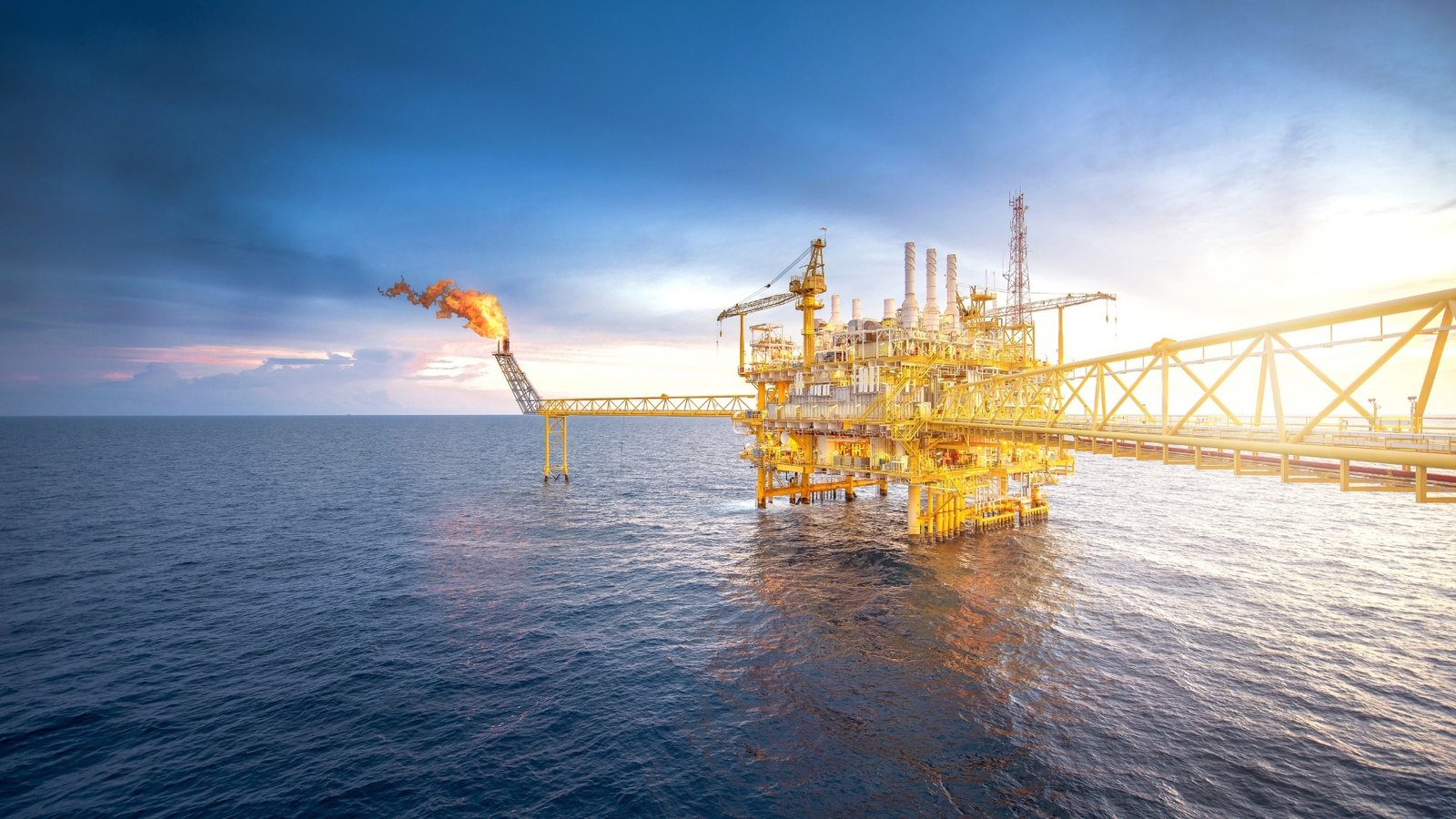 Project 54Gulf production at dusk: an offshore platform flaring as supply returns to a contested Asian market
Three Converging Forces: Premium Unwind, Iranian Barrels, OPEC+ Supply
The first force is the end of the war premium. The Strait of Hormuz crisis that began in late February 2026 shut in the region's normal export routes and pushed prices to levels the IEA described as the largest supply disruption in the history of the oil market. In mid June, the US and Iran signed a memorandum of understanding that reopened the strait, with a 60 day partial waiver on Iranian oil sanctions while talks continue, per Al Jazeera. Trapped barrels released, freight normalised, and the premiums Gulf producers had been charging began collapsing back through pre-war levels.
The second force is Iranian competition. Iran exported more than 40 million barrels in the first fortnight after the blockade lifted, selling at roughly 20 percent above its own pre-war prices but still at a discount to Saudi grades, per CNBC. Every discounted Iranian cargo lands in exactly the refining system Aramco considers its core market. The third force is OPEC+ itself: on 5 July the group approved its fifth consecutive monthly quota increase, 188,000 barrels a day for August across Saudi Arabia, Russia, Iraq, Kuwait, Kazakhstan, Algeria and Oman, taking the April to July restorations to roughly 800,000 barrels a day as the 1.65 million barrel a day cut from 2023 unwinds, per CNBC. More supply chasing the same Asian slots compresses everyone's realised price; the question is only who blinks first.
Aramco's answer is that it will not be the one to blink, because it does not have to be. First quarter 2026 adjusted net income came in at 33.6 billion dollars, up from 26.6 billion a year earlier on war-elevated prices, with free cash flow of 18.6 billion dollars, capex of 12.1 billion and gearing under 5 percent, per Aramco's results announcement. The company also demonstrated logistical resilience under fire: its East-West Pipeline ran at its maximum 7.0 million barrels a day during the crisis, rerouting exports to the Red Sea around the blocked strait. As CEO Amin Nasser put it in the results release, "Our East-West Pipeline, which reached its maximum capacity of 7.0 million barrels of oil per day, has proven itself to be a critical supply artery, helping to mitigate the impact of a global energy shock and providing relief to customers affected by shipping constraints in the Strait of Hormuz." Lowest production cost in the industry, proven alternative routes, fortress balance sheet: that is the hand you play a share war with.
| Date (2026) | Event | Source |
|---|---|---|
| Late Feb to Jun | Strait of Hormuz crisis constrains Gulf exports; prices spike | IEA via Brookings, Al Jazeera |
| 10 May | Q1 results: 33.6 billion dollars adjusted net income; East-West Pipeline at 7.0 mb/d max | Aramco |
| 8 Jun | July OSP set at +9.50 dollars over Oman/Dubai, a war premium | Argaam |
| Mid to late Jun | US-Iran MOU reopens Hormuz; 60 day partial sanctions waiver | Al Jazeera |
| 1 Jul | Iran exports 40+ million barrels in a fortnight; Aramco makes rare spot sales of 6+ million barrels | CNBC, Bloomberg |
| 5 Jul | OPEC+ approves fifth straight monthly quota rise, +188,000 b/d for August | CNBC |
| 6 Jul | August OSP cut 11 dollars to -1.50 vs benchmark, biggest cut since at least 2000 | Bloomberg |
A Buyer's Market in Asia, a Squeeze Everywhere Else
The forward picture assembled from published forecasts is consistent in direction and disputed in degree. The IEA has flagged that the 2026 global surplus could reach roughly 4 million barrels a day, a record, as post-crisis supply returns while demand growth stays modest. The EIA's Short-Term Energy Outlook has Brent averaging in the mid 70s through the third quarter of 2026, while J.P. Morgan's global research desk holds a mid 80s third quarter view easing toward the high 70s by year end; both houses published before the full OSP news landed, so treat each as its publisher's view at its date. Macquarie analysts have gone further, suggesting OPEC+ may be forced back into production cuts in the second half of 2026 to steady prices. Directionally, every published view points the same way: more supply, contested demand, softer realised prices for Asia-bound grades.
For Asian refiners this is the best procurement environment in three years: discounted Saudi term barrels, cheaper Iranian spot cargoes while the waiver holds, and returning OPEC+ volume all competing for their slates. For higher-cost producers, US shale at the margin, mature North Sea barrels, high-breakeven national budgets, the squeeze arrives from both directions, softer prices and a market leader publicly signalling it will defend share. And for the oilfield services and supply chain that sells into upstream, the read-through is capex caution: operators whose 2026 and 2027 budgets were drafted during a 100 dollar crisis will rewrite them under 75 to 85 dollar assumptions.
The strategic subtext is the one Nasser has been building for a year. At the Energy Intelligence Forum in London in October 2025 he said, "We are determined to remain dominant in oil thanks to a massive resource base, low costs, and one of the lowest upstream carbon intensities across the industry," per International Finance. Dominance, in that framing, is not a margin target. It is a structural position: the producer that sets the price board, absorbs the downcycle, and is still standing at full scale when weaker supply exits. The 6 July cut is that sentence translated into a price.
The Commercial Lesson: Price Is a Signal, Resilience Is a Story
First, price is communication. Aramco's OSP is a public, monthly, strategic broadcast to customers and competitors, and the company just used it to announce a share war without holding a press conference. Most B2B firms treat pricing as a spreadsheet output and then wonder why the market misses the message. If you change price, change it as a narrative act with a stated logic, because your customers will construct a story around it either way, a discipline we unpack in our energy procurement framework.
Second, resilience is a sales asset, not an operations footnote. Nasser marketed the East-West Pipeline by name in a results release, turning contingency infrastructure into proof that Aramco delivers when rivals cannot. Every industrial supplier has an equivalent, redundant capacity, dual sourcing, delivery performance under disruption, and almost none of them sell it explicitly. Third, visible rule-breaking signals seriousness: the term-contract giant selling spot cargoes told the market more about its intent than the OSP itself. When the market turns, demonstrated commercial agility beats process orthodoxy.
Fourth, sell to the squeeze. The 2026 to 2027 budget cycle across energy operators is being written under materially lower price assumptions than the ones in place when the crisis peaked. Vendors and services firms that pivot messaging now, toward cost per barrel, throughput, utilisation and margin protection, will match the conversation their buyers are actually having, the same demand-side logic that runs through our analysis of OPEC+'s monthly-barrel era and our BP strategic reset deep-dive. The sellers who keep pitching growth capex into a share war will be talking to a budget that no longer exists.
The demand side of the same story is being rebuilt in Delhi: India builds its oil buffer.
Listen & take it with you
Prefer audio, or need the deck for an internal review? The full briefing is available as a podcast episode and a downloadable slide presentation.
What is the most important signal in Aramco's July move?
Frequently asked
An OSP is the monthly price differential a producer such as Saudi Aramco sets for its crude grades against a regional benchmark, for Asia usually the Oman/Dubai average. Term customers pay the benchmark plus or minus the OSP. Because Aramco is the largest exporter into Asia, its OSPs function as the reference price board for the whole Gulf-to-Asia trade, and other Gulf producers typically price in its shadow.
Aramco cut its August official selling price for Arab Light to Asia by 11 dollars a barrel, taking it to 1.50 dollars below the Oman/Dubai benchmark, per Bloomberg. It is the largest monthly cut since at least 2000, and the first time the grade has priced at a discount to the benchmark since the 2020 price war. The July OSP had been a war-inflated 9.50 dollars above the benchmark, per Argaam.
Three converging forces. The Strait of Hormuz reopened after the mid-June US-Iran memorandum of understanding, unwinding the war premium in Gulf crude prices. Iran exported more than 40 million barrels in the first fortnight after the blockade lifted under a partial sanctions waiver, competing directly for Asian buyers, per CNBC. And OPEC+ approved its fifth consecutive monthly quota increase, restoring roughly 800,000 barrels a day between April and July. Aramco chose to defend its Asian market share rather than its per-barrel margin.
Better than any competitor. First quarter 2026 adjusted net income was 33.6 billion dollars with 18.6 billion in free cash flow and gearing under 5 percent, per Aramco's results. It has the industry's lowest production costs, and its East-West Pipeline proved it could move 7.0 million barrels a day around a blocked Hormuz. Low cost plus proven logistics plus balance-sheet strength is precisely the position from which share wars are launched.
Published forecasts point softer. The IEA has flagged a possible record surplus of roughly 4 million barrels a day in 2026; the EIA's outlook has Brent averaging in the mid 70s in the third quarter, and J.P. Morgan sees the mid 80s easing to the high 70s by year end, each reflecting its publication date. Macquarie analysts suggest OPEC+ may even need to cut again in the second half. These are their publishers' views, not certainties: renewed disruption around Hormuz remains the standing upside risk.
Get the next intelligence drop
Join energy and industrial leaders getting our marketing, AI-growth and revenue-architecture intelligence, direct, no filler.
You're on the list
Welcome to The Energy Growth Brief, watch your inbox for the next dispatch.