



Baker Hughes Bought Chart. Now It Buys Differently.
Baker Hughes closed its USD 13.6 billion acquisition of Chart Industries on 16 July 2026 and reset its guidance, segments and backlog definitions on 9 September. Buried in that reset is a dated, quantified warning to its own supply base: about USD 325 million of annual cost has to come out within three years, roughly three quarters of it from inside Chart, and only USD 35 million had been actioned. The re tendering has barely started, and the counterparty on a liquefaction package is no longer the developer or the EPC.
- The buying entity is changing, not just the owner. Baker Hughes is now selling the liquefaction block rather than the components inside it. For a vendor of instrumentation, valves, coolers, structural steel, skids or electrical gear, the counterparty on a liquefaction train moves from the developer or EPC onto Baker Hughes' own supplier quality regime, with a different qualification file, different terms and no end user relationship to protect price.
- The supplier rationalisation is quantified and barely begun. About USD 325 million of annualised synergies are targeted within three years, roughly three quarters of it inside Chart, delivered through procurement efficiency, SG and A optimisation and facility optimisation. Only USD 35 million of actions had been executed as at 9 September 2026.
- That implies roughly USD 240 million of Chart side cost coming out of a supply chain and plant footprint of about 65 manufacturing locations and more than 50 service centres over roughly 2026 to 2028. The window to defend or win a position on the combined approved vendor list is about the next eighteen months.
- Long tenure with Chart is not a defence, because the buyer is new. Baker Hughes is running the Baker Hughes Business System through Chart under a segment leader appointed for that purpose. Incumbency built on a relationship with Chart procurement is being re evaluated by people who did not make the original decision.
- The capex clock rotated from LNG to power. Management flagged near term Chart margin pressure from LNG equipment volume timing and unfavourable LNG mix, with order recovery visible in 2027, while Industrial and Energy Technology has booked USD 4.2 billion of data centre orders since 2025, about USD 3.2 billion in the first half of 2026.
- The backlog number changed definition under suppliers' feet. Chart's reported backlog is being restated to about USD 3.6 billion at the end of the third quarter under Baker Hughes' backlog definitions. Management called it a methodology change to align with the integration, not an end market view. A supplier sizing its own capacity off Chart's legacy disclosure will mis time 2027.
- Procurement is moving to multi year frameworks. The Kodiak Gas Services agreement of 8 July 2026 is a rolling multi year arrangement of about one gigawatt initially against a ceiling of up to 1.8 gigawatts, explicitly intended to shorten lead times. Frameworks flow down. Suppliers able to sign capacity reservations will beat suppliers who bid job by job.
- There is a dated news peg. Third quarter results are released on 27 October 2026 with the call on 28 October, the first quarter with a full Chart contribution and the first print of the restated Chart backlog. Several of the figures in this dossier will be superseded that week.
A third segment, USD 4.3 billion of revenue, and about 65 plants
Baker Hughes completed its acquisition of Chart Industries on 16 July 2026, making Chart a third operating and reporting segment alongside Oilfield Services and Equipment and Industrial and Energy Technology. The Chart segment spans air and gas handling, thermal management and lifecycle services.
The deal was announced on 29 July 2025 at USD 210 per share in cash, an enterprise value of about USD 13.6 billion. Chart had terminated a USD 19 billion merger of equals with Flowserve two days earlier, triggering a USD 266 million termination payment. Chart brought about USD 4.3 billion of 2025 revenue and customers in more than 50 countries across gas infrastructure, nuclear, data centres, carbon capture and storage, space and geothermal. At announcement its footprint was described as about 65 manufacturing locations and more than 50 service centres, on 2024 revenue of USD 4.2 billion and roughly USD 1 billion of adjusted EBITDA.
The strategic framing from the top is unambiguous about scale rather than oil. Lorenzo Simonelli, Chairman and Chief Executive, told the Barclays energy and power conference on 9 September 2026 that Baker Hughes sits at the center of a fundamental shift in the global economy. The company said about 60 per cent of its revenue now comes from infrastructure and industrial markets, and that its high growth end market opportunity should rise about 60 per cent, from roughly USD 36 billion today to about USD 57 billion by 2030, within a combined addressable market of more than USD 400 billion.
The same day it filed an 8-K resetting full year 2026 guidance to include Chart: total revenue of USD 28.5 to 30.3 billion and adjusted EBITDA of USD 4.875 to 5.475 billion, with the Chart stub period from the July close contributing USD 1.85 to 2.25 billion of revenue and USD 300 to 400 million of EBITDA, about 17 per cent at the midpoint, and 55 to 65 per cent of Chart segment EBITDA expected in the fourth quarter. Free cash flow conversion for 2026 was lowered to 40 to 45 per cent on acquisition related items.
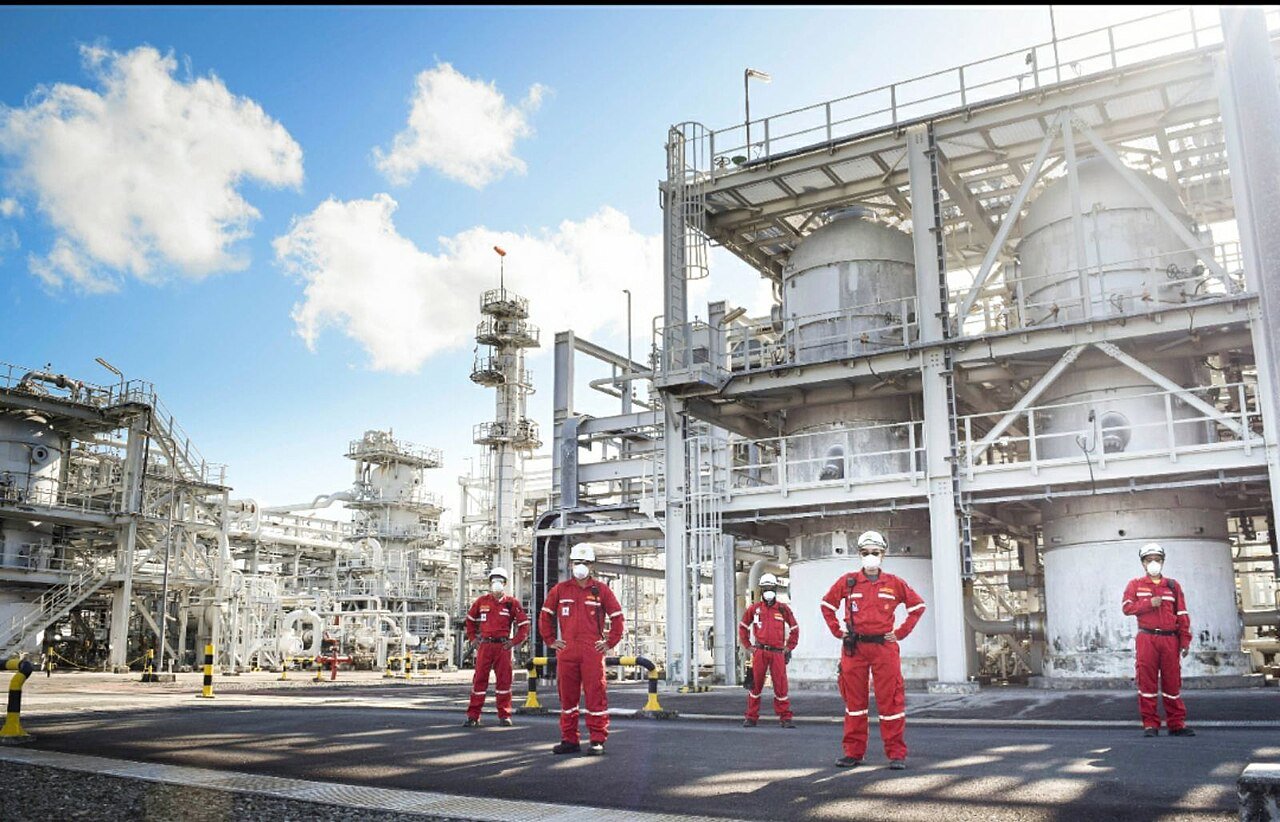 Project 54An onshore gas processing plant. Baker Hughes is increasingly selling the whole liquefaction block rather than the equipment inside it, which changes who the supplier of a cold box or an air cooler is actually selling to.
| Measure | Figure | As at | Source |
|---|---|---|---|
| Cost synergies, target against executed | About USD 325 million target by year three, roughly three quarters inside Chart, against USD 35 million executed | 9 September 2026 | Baker Hughes, Barclays conference remarks |
| Chart segment backlog, restated to Baker Hughes definitions | About USD 3.6 billion expected | End of third quarter 2026 | Baker Hughes, Barclays conference remarks |
| Industrial and Energy Technology remaining performance obligations | USD 37.1 billion, a record; total USD 40.1 billion | Second quarter 2026 | Baker Hughes Q2 2026 results |
| Industrial and Energy Technology quarterly orders | USD 7.09 billion, up 101 per cent year on year | Second quarter 2026 | Baker Hughes Q2 2026 results |
| Data centre orders booked | USD 4.2 billion since 2025, including about USD 3.2 billion in the first half of 2026 | 9 September 2026 | Baker Hughes, Barclays conference remarks |
| Chart footprint acquired | About 65 manufacturing locations and more than 50 service centres | At announcement, 29 July 2025 | Baker Hughes, via JPT |
| Full year 2026 guidance including Chart | Revenue USD 28.5 to 30.3 billion; adjusted EBITDA USD 4.875 to 5.475 billion | 8-K, 9 September 2026 | Baker Hughes Form 8-K |
Venture Global, 13 September 2026, and the sentence that matters
On 13 September 2026 Baker Hughes announced that it will supply Venture Global with 13 gas compression systems driven by Frame 5 and 2E gas turbines for the Cloud Connector Pipeline in Louisiana, feeding gas to Plaquemines LNG and taking the Plaquemines compression fleet to 23 systems. In the same announcement it said it will supply four liquefaction blocks comprising a total of eight electric motor driven single mixed refrigerant liquefaction modules.
One sentence in that release does more work than the headline. The liquefaction blocks include Chart cold boxes. The scope per block is described as centrifugal compressor trains, cold boxes, air coolers and integrated controls, similar to a recent award for the CP2 project. Baker Hughes said the work supports more than 100 million tonnes a year of existing and planned LNG capacity. Contract values were not disclosed, and no figure should be attached to them.
Historically, the cold box, the compressor train, the air coolers and the controls were separate tenders, often placed by the EPC contractor or the developer. Baker Hughes is now selling the block. The commercial consequence for a vendor sitting inside that scope is a change of counterparty, and it is worth being precise that this is Project 54's inference from what has been disclosed rather than something Baker Hughes has announced. The company has named no suppliers, no plant closures and no approved vendor list changes. What it has disclosed is segment bundling, a named synergy programme and a 65 plant footprint, and those three facts point in one direction.
That direction is a demotion in the value chain. If the developer tenders the cold box, you are selling to the developer and the end user relationship protects your price. If Baker Hughes sells the block, you are selling to Baker Hughes, qualified under its supplier regime, with its terms and its margin objectives sitting between you and the project. Mike Sabel, Venture Global's Chief Executive, said that Baker Hughes has been a trusted partner across our LNG developments, which is precisely the relationship that makes repeat block awards likely and that leaves less room for a package by package tender.
If you supply into a liquefaction train today, the practical test is simple. Ask who issued your last purchase order and who is likely to issue the next one. If the answer is changing, your qualification file, your commercial terms and the person you call need to change with it, and the time to find that out is before the next block award rather than after.
USD 325 million targeted, USD 35 million done, about eighteen months of window
Baker Hughes set out a target of about USD 325 million of annualised cost synergies within three years of closing, with early priorities named as supply chain, functional support and manufacturing, and a net leverage target of 1.0 to 1.5 times within 24 months from 2.25 times at close. Commercial synergies were treated as upside rather than as part of the number.
The 9 September update is the one suppliers should read. As at that date only USD 35 million of synergy actions had been executed, roughly three quarters of the USD 325 million target sits inside the Chart segment, and the delivery buckets were named as procurement efficiency, SG and A optimisation and facility optimisation. Two of those three are things that happen to suppliers.
Do the arithmetic the company has invited. Roughly USD 240 million of Chart side annualised cost has to be removed from a supply chain and a plant footprint of about 65 manufacturing locations and more than 50 service centres, over roughly 2026 to 2028, and about 89 per cent of it is still to be actioned. That is not a rumour of consolidation. It is a disclosed, quantified programme that has barely started, which means the re tendering wave is ahead rather than behind.
Simonelli's language about the segment has been notably direct. We are taking decisive actions to improve execution at Chart, he said on 9 September, adding that these factors do not change our confidence in the strategic value of the acquisition. On appointing Jim Apostolides to lead the Chart segment at the July close, he said the appointee's background makes him well suited to lead implementation of the Baker Hughes Business System within Chart. A named operating system being pushed through an acquired company is how procurement standardisation actually arrives.
The implication for a long standing Chart supplier is uncomfortable and worth saying plainly. Fifteen years of good service to Chart is not a defence, because the person making the next decision did not make the last one, is working to a published synergy number, and is being measured on procurement efficiency. The defensible positions are the usual ones and they have to be re established with a new buyer: qualification under the acquirer's own supplier regime, documented quality and delivery performance, and a cost position that survives a clean sheet comparison.
On margins, the company has said Chart EBITDA margin should rise from about 17 per cent in the second half of 2026 to 22 to 23 per cent by the second half of 2028, with a separate Baker Hughes target of 20 per cent adjusted EBITDA margin by 2028 excluding Chart, and cost synergies named as a key contributor to 500 to 600 basis points of margin expansion over two years. Five to six hundred basis points does not come out of overhead alone.
Not LNG, not this year
Baker Hughes told investors on 9 September that near term Chart margins are hurt by LNG equipment volume timing and an unfavourable LNG mix, and that LNG order recovery becomes visible in 2027. At the same time the Industrial and Energy Technology segment has booked USD 4.2 billion of data centre orders since 2025, about USD 3.2 billion of that in the first half of 2026 alone, with Chart separately booking about USD 600 million over the past two years.
Second quarter 2026 showed the shape. Total orders were USD 10.5 billion. Industrial and Energy Technology orders were USD 7.088 billion, up 101 per cent year on year, with remaining performance obligations at a record USD 37.1 billion and total remaining performance obligations of USD 40.1 billion. Segment revenue was USD 3,291 million at 20.6 per cent EBITDA margin, against Oilfield Services and Equipment at USD 3,451 million and 17.5 per cent. Baker Hughes raised its full year Industrial and Energy Technology order guidance and lifted its 2026 to 2028 orders outlook to more than USD 45 billion.
So the honest advice to a vendor planning 2027 content is that LNG cycle positioning in 2026 is positioning into the trough, and the live money this year is turbine, generator and balance of plant content for behind the meter power. That is not a permanent rotation and the LNG work returns, but the order timing matters for where a limited business development budget goes between now and the middle of next year.
The Kodiak Gas Services agreement of 8 July 2026 shows how that power work is being contracted. It is a rolling multi year arrangement for behind the meter United States data centre power, about one gigawatt initially against a framework ceiling of up to 1.8 gigawatts, using NovaLT16 and Frame 5 gas turbines with BRUSH generators, with the initial gigawatt to be delivered by 2030. The agreement explicitly aims to streamline execution and shorten lead times and includes Baker Hughes commitments on technical training and spare parts. Financial terms were not disclosed. Mickey McKee, Kodiak's President and Chief Executive, said that our customers require dependable, efficient and rapidly deployable power solutions.
Frameworks of that shape flow down. An original equipment manufacturer that has committed to a 1.8 gigawatt ceiling and to shorter lead times cannot serve it with job by job purchasing. It needs capacity reserved. A supplier that can sign a multi year capacity reservation, hold slots and accept the associated take or pay exposure is a structurally better fit than one that quotes each enquiry on its merits, and that is a commercial posture decision rather than a pricing one.
Two further datapoints show capacity being added rather than merely reshuffled. On 9 October 2026 Baker Hughes unveiled an expansion of its Integrated Compressor Line testing and production facility at Le Creusot in France, operated through its Thermodyn subsidiary, adding variable speed drive systems, upgraded test positions, a new low speed balancing machine, a new furnace and a machining centre, aiming to double Integrated Compressor Line production capacity. Investment value was not disclosed. Separately, on the Oilfield Services side the surface pressure control joint venture with Cactus closed on 2 January 2026, Cactus taking 65 per cent and Baker Hughes retaining 35 per cent for about USD 344.5 million in cash before adjustments. Capacity is being added where the orders are and equity released where they are not.
Three things that are not disclosed, and one date that will reset the numbers
First, no contract value has been disclosed for the Venture Global, Kodiak or Venezuela awards. Any dollar figure circulating against them is invented. Size the opportunity from the equipment counts and the gigawatts, not from a number someone has attributed to the award.
Second, Baker Hughes has not named a single supplier, plant closure or approved vendor list change arising from the Chart integration. The argument in this dossier that direct suppliers face demotion to a second tier is an inference from disclosed facts: segment bundling in the Venture Global scope, the named synergy buckets, and the 65 plant footprint. It should be treated as a planning assumption worth acting on, not as an announcement.
Third, the Venezuela agreements announced on 5 October 2026 are a framework rather than a contract. Baker Hughes signed an alliance agreement with PDVSA, Lindsayca and Fulcrum LNG, plus a memorandum with New Stratus Energy, covering upstream, midstream, gas monetisation and LNG, and named an installed base of more than 1,200 oil production systems and about 240 turbomachinery units across 23 sites after more than 60 years in the country. Individual projects require separate definitive agreements and OFAC authorisations. Nothing is contracted, and a supplier building a Venezuela plan on it is building on a sanctions permission that does not yet exist.
Fourth, and most practically, the numbers in this dossier have a shelf life measured in days. Baker Hughes releases third quarter results by press release at 5pm Eastern on 27 October 2026, with the webcast on 28 October. That is the first quarter with a full Chart contribution and the first print of the restated Chart backlog. Full year guidance, the synergy execution figure and the backlog will all move. Anyone building a 2027 account plan should treat this as the pre read and revisit it the week of 27 October.
Four, and three of them are qualification work rather than selling
Re qualify under the acquirer, not the acquired. If your approval sits with Chart, assume it will be reviewed against Baker Hughes' own supplier quality regime and start that process now rather than when a re tender lands. Qualification takes months and the synergy programme has about eighteen months of runway left on its three year clock. The worst outcome is discovering the requirement at the point you are being compared on cost.
Find out who issues your next purchase order. The Venture Global award is the evidence that packages which used to be tendered separately by developers and EPC contractors are now being sold as blocks by Baker Hughes. Map your current order sources across liquefaction, compression and cryogenic scope and identify which of them are likely to be absorbed. Where the counterparty is changing, your route to market has to change ahead of it.
Move the 2026 pitch from LNG to power. The disclosed order flow says data centre and behind the meter power content is where decisions are being taken this year, and that LNG order recovery is a 2027 story. That is a business development allocation decision, and the company has effectively published the answer.
Offer capacity, not quotes. The Kodiak framework is a signal about contracting shape, not just about volume. If you can reserve slots, hold inventory against a rolling forecast and accept the exposure that comes with it, say so explicitly in your commercial proposition, because the stated objective of these frameworks is shortened lead times and that is bought with commitment rather than with price.
One honest note on where this dossier sits relative to our earlier work. We covered Baker Hughes in July 2026 on the power pivot, when record second quarter orders and 2.7 gigawatts of gas turbines sold into data centres showed an oilfield name becoming an industrial energy technology company. This is the sequel, and it is the less comfortable half. The same strategy that makes Baker Hughes a bigger buyer of power equipment makes it a more consolidated, more standardised and more demanding buyer of everything else.
Listen & take it with you
Prefer audio, or need the deck for an internal review? The full briefing is available as a podcast episode and a downloadable slide presentation.
You have supplied cold boxes and coolers into LNG trains for a decade, mostly on orders placed by the EPC contractor. Baker Hughes has just sold a customer four complete liquefaction blocks. What is the first thing you do?
Frequently asked
Baker Hughes completed the acquisition on 16 July 2026. The deal was announced on 29 July 2025 at USD 210 per share in cash, an enterprise value of about USD 13.6 billion. Chart had terminated a USD 19 billion merger of equals with Flowserve two days before the Baker Hughes announcement, triggering a USD 266 million termination payment to Flowserve. Chart became a third operating and reporting segment covering air and gas handling, thermal management and lifecycle services, bringing about USD 4.3 billion of 2025 revenue and customers in more than 50 countries.
Baker Hughes has not announced supplier consolidation, named any supplier or confirmed any plant closure. What it has disclosed is a target of about USD 325 million of annualised cost synergies within three years, that roughly three quarters of that sits inside the Chart segment, that the delivery buckets are procurement efficiency, SG and A optimisation and facility optimisation, and that only USD 35 million of actions had been executed as at 9 September 2026. Chart was acquired with about 65 manufacturing locations and more than 50 service centres. Taken together those disclosures imply significant supply chain and footprint rationalisation over roughly 2026 to 2028, but the inference is ours rather than the company's.
Increasingly Baker Hughes, where the scope is sold as a liquefaction block. In its 13 September 2026 Venture Global announcement Baker Hughes described supplying four liquefaction blocks comprising eight electric motor driven liquefaction modules, with each block covering centrifugal compressor trains, cold boxes, air coolers and integrated controls, and stated that the blocks include Chart cold boxes. Where a block is sold whole, the components inside it are not separately tendered by the developer or the engineering, procurement and construction contractor. This does not apply to every project, so the practical step is to check, project by project, who is issuing the purchase order.
Management indicated on 9 September 2026 that near term Chart margins were affected by LNG equipment volume timing and an unfavourable LNG mix, and that LNG order recovery becomes visible in 2027. In the meantime the growth is in power: the Industrial and Energy Technology segment has booked USD 4.2 billion of data centre orders since 2025, about USD 3.2 billion of it in the first half of 2026, with Chart booking about USD 600 million over the past two years. Note that Chart's reported backlog is separately being restated to about USD 3.6 billion at the end of the third quarter under Baker Hughes' backlog definitions, which management described as a methodology change rather than an end market signal.
It is Baker Hughes' internal operating system for standardising processes across the company, and it is being implemented inside the Chart segment under a segment leader appointed at the July 2026 close specifically for that purpose. For a supplier it matters because standardised operating systems are how acquired companies' procurement practices, approved vendor lists, quality requirements and commercial terms get replaced by the acquirer's. Incumbency established with Chart procurement is therefore being re evaluated by a different buyer working to a published cost reduction target.
Get the next intelligence drop
Join energy and industrial leaders getting our marketing, AI-growth and revenue-architecture intelligence, direct, no filler.
You're on the list
Welcome to The Energy Growth Brief, watch your inbox for the next dispatch.