


QatarEnergy's Order Book Doctrine: Why 20-Year LNG Contracts Beat the Spot Market
QatarEnergy is nearly doubling LNG capacity to 142 million tonnes a year and has already sold most of it on 20 to 27 year contracts. In 2026 a supply shock tested that model in public. Here is what the order book strategy is, why it held, and what it teaches energy B2B sellers.
- QatarEnergy is lifting LNG capacity from about 77 to 142 million tonnes a year by 2030, funded by roughly 29 billion dollars, the largest single LNG build-out in the world.
- The strategy is demand first: more than 70 percent of the new volume is already sold on 20 to 27 year deals, so multi-decade offtake is signed before the plant is finished. Certainty, not spot price, is the product.
- In February 2026 at LNG2026 in Doha, QatarEnergy signed a 20 year, up to 2 million tonne a year sale with PETRONAS, alongside a 15 year supply to Germany with ConocoPhillips, extending a contract book that already spans China, Europe and Asia.
- The model was tested in public: strikes on 18 and 19 March 2026 damaged Trains 4 and 6, about 12.8 million tonnes a year or roughly 17 percent of exports, and force majeure ran into a fourth month. The long contract base plus a portfolio of shipping and third party volumes cushioned the blow.
- The commercial lesson for energy B2B is direct: sell the multi-decade relationship, make contract certainty and resilience the offer, and capture the margin others leave on the table.
The biggest build-out in the industry met its biggest shock in the same year
Two things collided for QatarEnergy in 2026. The first is scale. The state producer is in the middle of the single largest LNG expansion anywhere, raising liquefaction capacity from about 77 million tonnes a year toward 142 million tonnes a year by 2030, drawing on the North Field, the offshore extension of the world's largest gas reservoir shared with Iran. Reuters and QatarEnergy put the upstream and liquefaction bill at roughly 29 billion dollars.
The second is fragility. On 18 and 19 March 2026, missile strikes during the wider regional conflict damaged Trains 4 and 6 at Ras Laffan, removing about 12.8 million tonnes a year of capacity, close to 17 percent of Qatar's exports, according to reporting by Al Jazeera and industry trackers. QatarEnergy declared force majeure on long term contracts, and by late July the disruption had run into a fourth month, with deliveries to European buyers cancelled through the end of September per Bloomberg and AGBI.
That collision is why the company is worth studying now. A business built on selling certainty had to prove, in real time and in public, that its certainty was real. The answer sits in how it sells LNG in the first place.
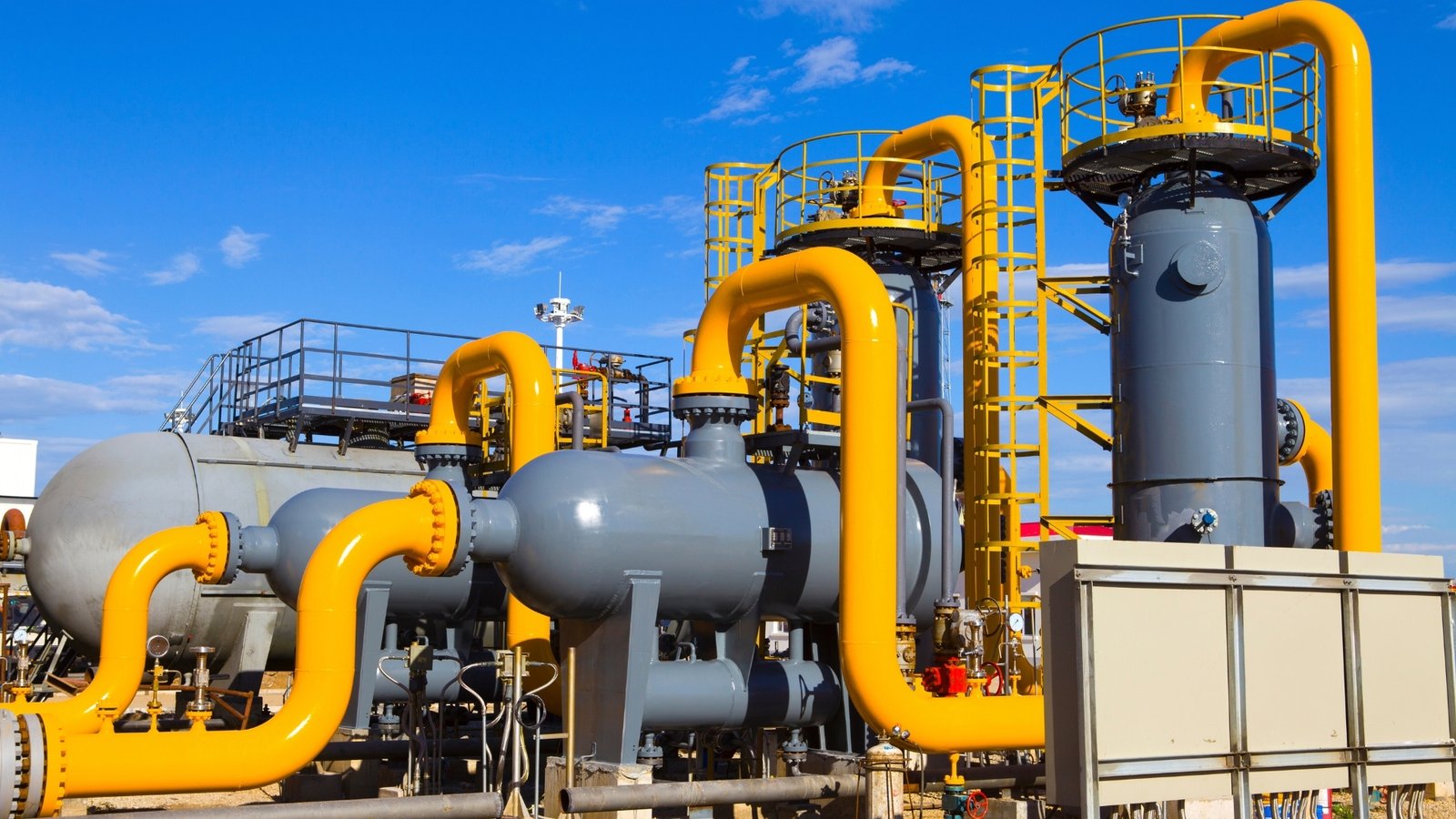 Project 54Gas liquefaction and processing infrastructure. QatarEnergy is building the world's largest LNG expansion and selling most of it decades in advance.
Sell the decade, build the plant, keep the balance sheet patient
QatarEnergy does not sell LNG the way a merchant sells a commodity. It sells multi-decade supply relationships, and it signs most of them before the capacity exists. Three principles hold the model together.
Demand before capacity
More than 70 percent of the new North Field volume is contracted on 20 to 27 year deals before the trains are commissioned. In November 2022 Qatar signed a 27 year agreement with China's Sinopec, at the time the longest LNG deal on record. Buyers get security of supply across the whole cycle of a power fleet or an industrial base; QatarEnergy gets a signed order book that de-risks a 29 billion dollar build long before first gas.
Patient, low cost capital
Qatar's production cost is among the lowest in the world and the state can wait. That lets the company favour price stability and duration over chasing every spike in the spot market. When European and Asian spot prices swung violently after 2022, Qatar kept selling on formula linked, long dated contracts, accepting less upside in return for cash flow it can plan a sovereign budget around.
A portfolio, not a single pipe
The franchise is deliberately diversified: a fleet of about 70 owned and chartered vessels with roughly 128 more on order, destination flexible cargoes, and a trading arm that moves third party volumes. Spread across buyers, regions and ships, no single disruption breaks the whole system, which is exactly what 2026 tested.
From 77 to 142 million tonnes, most of it already spoken for
The build-out comes in phases off the North Field. North Field East adds about 32 million tonnes a year across four mega trains, North Field South adds about 16 million tonnes across two, and a further expansion announced in 2024, including North Field West, adds roughly another 16 million tonnes. Baker Hughes won a major award for North Field West covering six gas turbines, twelve centrifugal compressors and integrated power systems for two mega trains, the core machinery of liquefaction.
The table sets out the scale and the contracting behind it. Figures are drawn from QatarEnergy statements and reporting by Reuters, Al Jazeera and specialist LNG trade press; where a number is a target or expectation rather than a booked result, it is marked as such.
| Metric | Figure | Source and note |
|---|---|---|
| LNG capacity today | about 77 million tonnes a year | QatarEnergy; pre-expansion baseline |
| Target capacity by 2030 | about 142 million tonnes a year | QatarEnergy target, Reuters; an expansion goal, not yet built |
| Headline investment | roughly 29 billion dollars | Reuters and QatarEnergy; upstream plus liquefaction |
| New volume pre-sold | more than 70 percent on 20 to 27 year deals | Industry reporting; estimate of the contracted share |
| 2026 supply hit | about 12.8 million tonnes a year, near 17 percent of exports | Al Jazeera; Trains 4 and 6 damage from March strikes |
| Non-Qatari LNG traded by 2030 | target 30 to 40 million tonnes a year | Al-Kaabi, cited by Reuters; a stated ambition |
Force majeure is the clause a long contract seller hopes never to use
When Trains 4 and 6 went down in March 2026, QatarEnergy did what a long contract seller can do and a spot merchant cannot: it invoked force majeure on affected deliveries while keeping the rest of the book intact. Shell, holding Qatari offtake, declared its own force majeure downstream, and cargoes to Italy's Edison and other European buyers were curtailed. Bloomberg and AGBI reported the disruption stretching into a fourth month, with European deliveries cancelled through the end of September.
The damage was not trivial and the recovery is slow. Reporting by Splash247 and OilPrice indicated the restart of operable trains was likely to slip into late in the year, with repairs to the damaged facilities expected to take a long period, an estimate some reports put at up to five years for full restoration. Yet the franchise did not unravel. Because the order book is long and diversified, buyers stayed contracted through the outage rather than walking to a competitor, and QatarEnergy could lean on portfolio and third party volumes to soften the gap.
That is the quiet argument for the doctrine. A merchant fully exposed to spot would have taken the price hit and, worse, the relationship risk. A seller of decades has contractual and commercial shock absorbers. The event was painful, and it exposed real physical and geopolitical vulnerability at Ras Laffan, but it did not cost Qatar its market position.
Capturing the margin that others were making on Qatari cargoes
The order book doctrine has a second act. QatarEnergy, historically the purest long contract seller in the industry, has built a trading unit that already handles around 10 million tonnes of physical LNG a year, more than half of it non-Qatari volume. Chief Executive Saad Sherida Al-Kaabi has been blunt about why. Traders elsewhere, he said, would buy Qatari cargoes and make money reselling them, so, in his words, there was money left on the table. The company decided to capture that margin itself.
The ambition is large. Al-Kaabi has said the goal is to trade 30 to 40 million tonnes a year of non-Qatari LNG by 2030, supported by a fleet expanding from about 70 ships toward roughly 128 more on order. This is not a retreat from long contracts, it is a hedge and a margin play layered on top of them. The base of the business stays contracted and predictable; the trading arm adds optionality, market intelligence and a slice of the spot economics Qatar used to hand to others.
For a commercial audience the sequencing matters. QatarEnergy secured the durable, low risk revenue first, then added the higher variance, higher touch business once the foundation was locked. It expanded into complexity from a position of certainty, not instead of it.
Sell the relationship and the resilience, not the transaction
QatarEnergy is a state producer, not a B2B vendor, but the commercial logic transfers cleanly to anyone selling into the energy and industrial economy. Three lessons stand out.
First, contract certainty is itself the product. Qatar wins because buyers will pay for two decades of assured supply, not because it is cheapest on any given day. If your offer is a service, a technology or a supply agreement, the durable version of it, priced for the relationship rather than the transaction, is usually the more defensible sale. This is the same logic behind selling to a long energy buying committee, where the decision is about decades, not quarters.
Second, demand should be secured before capacity is fully built. Qatar signs offtake ahead of first gas. The equivalent for a growth business is a pipeline and a book of committed demand that de-risks the investment in delivery, rather than building capacity and hoping to fill it. It is the same discipline as engineering revenue rather than assuming it, and it is why a beachhead of committed accounts beats a broad, uncommitted market.
Third, resilience is a selling point, not just an operations concern. The 2026 shock showed that a diversified portfolio and a long book absorbed a 17 percent supply loss without breaking the franchise. Buyers notice which suppliers can take a hit and keep serving them. In a volatile energy market, the seller who can credibly promise continuity, and prove it under stress, earns a premium that pure price competition never will.
Listen & take it with you
Prefer audio, or need the deck for an internal review? The full briefing is available as a podcast episode and a downloadable slide presentation.
In your own commercial model, where does durable, contracted demand sit today?
Frequently asked
QatarEnergy is expanding liquefaction capacity from about 77 million tonnes a year to about 142 million tonnes a year by 2030 through the North Field East, South and West projects, backed by roughly 29 billion dollars of investment. It is the largest single LNG expansion in the world.
Industry reporting indicates more than 70 percent of the new North Field volume is contracted on 20 to 27 year deals, signed before the capacity is built. Recent agreements include a 20 year sale to PETRONAS and a 15 year supply to Germany via ConocoPhillips, both tied to 2026.
On 18 and 19 March 2026, strikes damaged Trains 4 and 6 at Ras Laffan, removing about 12.8 million tonnes a year, close to 17 percent of exports. QatarEnergy declared force majeure on affected long term contracts, and the disruption extended into a fourth month, with European deliveries cancelled through the end of September.
Chief Executive Saad Sherida Al-Kaabi said traders elsewhere were buying Qatari cargoes and reselling them at a profit, so there was money left on the table. QatarEnergy's trading unit now moves around 10 million tonnes a year, over half non-Qatari, with an ambition to reach 30 to 40 million tonnes of non-Qatari LNG by 2030.
Sell multi-decade relationships rather than transactions, secure committed demand before building delivery capacity, and treat resilience as a selling point. Qatar's long, diversified contract book absorbed a major 2026 supply shock without losing its market position, which is the commercial value of certainty.
Get the next intelligence drop
Join energy and industrial leaders getting our marketing, AI-growth and revenue-architecture intelligence, direct, no filler.
You're on the list
Welcome to The Energy Growth Brief, watch your inbox for the next dispatch.