


Aramco's Real Product Is Not Oil. It Is Redundancy.
On 5 October 2026, in his first in-person speech since the Iran war began in late February, Aramco chief executive Amin Nasser told the Energy Intelligence Forum in London that Brent would have reached 200 US dollars a barrel without Saudi Arabia's East-West pipeline. It is the most commercially revealing sentence any energy executive has said this year. It prices a piece of infrastructure that moves no incremental barrel, earns no premium and exists only to be unnecessary most of the time. The barrels were never the scarce thing. The route was.
- Amin Nasser told the Energy Intelligence Forum in London on 5 October 2026 that Brent would have reached 200 US dollars a barrel without the East-West pipeline. Brent traded near 102 US dollars that day and near 110 US dollars on 20 October.
- The pipeline's value is entirely conditional. It earns nothing extra when Hormuz is open, and it is worth roughly half the oil price when Hormuz is not. Redundancy is priced at zero until the day it is priced at everything.
- Nasser said Aramco can make its maximum sustainable capacity of 12 million barrels a day available within days, and that the system is intact. Capacity that can be delivered within days is a different commercial instrument from capacity that exists on paper.
- The more serious number is not the price, it is the inventory. Nasser described global stocks as scarily thin and said replenishing them while meeting demand could take up to two years.
- Of roughly 6 billion barrels nominally in storage, Nasser said much is not practically available, with up to 90 per cent sitting in pipelines or representing minimum tank volume that cannot be drawn without stopping the system.
- Restocking is itself demand. Nasser put the refill at about 2 million extra barrels a day over 18 months, which lands on top of global demand already just over 100 million barrels a day.
- Aramco is working on fourth and fifth export routes. That is the strategic tell: the company is buying more optionality at exactly the moment the market has demonstrated what optionality is worth.
- For suppliers, the budget has moved. Spending is shifting from unit-cost efficiency toward route redundancy, storage integrity, security hardening and anything that shortens the distance between capacity on paper and barrels on water.
A price put on an absence
On Monday 5 October 2026, Amin Nasser gave his first in-person speech since the Iran war began in late February. The venue was the Energy Intelligence Forum in London. The headline claim, reported by The National, was that Brent crude could have reached up to 200 US dollars a barrel if Saudi Arabia's East-West pipeline did not exist.
Set that against the market. Brent traded around 102 US dollars on the day he spoke, after peaking at about 126 US dollars at the end of April. By 20 October it was back above 110 US dollars, and Fortune put it at 110.74 US dollars on the morning of 21 October, up 79 per cent on the 61.75 US dollars of a year earlier.
Read the claim precisely. Nasser is not saying the pipeline added supply. He is saying that without it, the same barrels would have been stranded behind a chokepoint, and that the price difference between a barrel that can reach a buyer and a barrel that cannot is roughly 100 US dollars. That is a valuation of access, not of oil.
He was careful about the company's own position. On capacity he said: "Our system is intact." He described Aramco as holding "the strategic reserves and flexibility" to "isolate or shift output as required." Those are the words of a producer whose constraint is not in the reservoir.
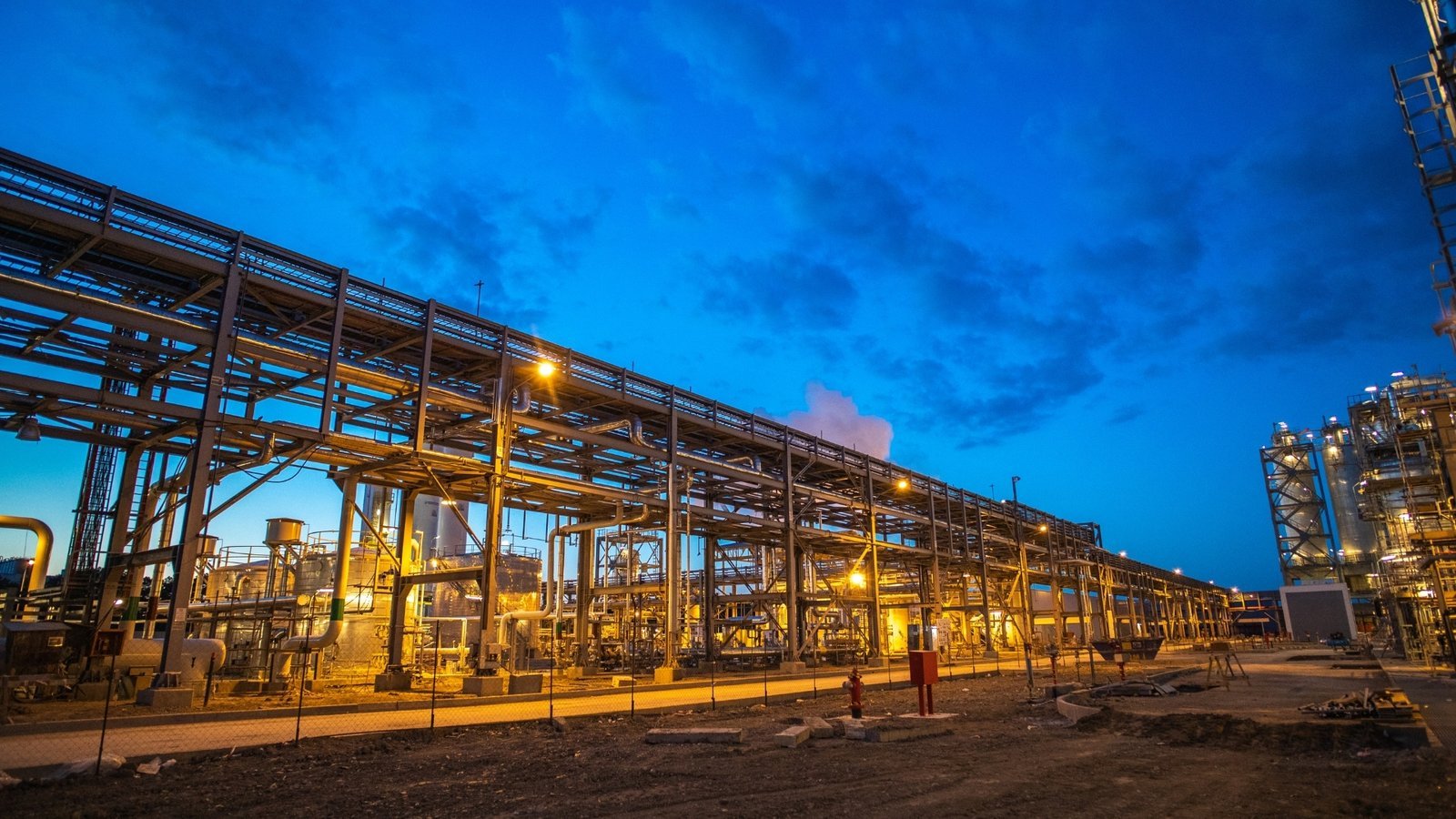 Project 54A lit industrial process plant and pipe rack at dusk. The barrels were never the scarce thing in 2026. The route that could still carry them was.
Chokepoints convert volume into optionality
Saudi Arabia's crude is concentrated in the Eastern Province, on the Gulf coast. The default export path loads at Gulf terminals and leaves through the Strait of Hormuz. The East-West pipeline runs the other way, across the peninsula to Red Sea loading at Yanbu, which puts barrels into the market without a Hormuz transit.
In an open market that line is close to commercially pointless. It costs money to build, maintain, power and protect, and the barrels it moves sell for the same price as the barrels that take the shorter route. Every efficiency metric a normal industrial business runs would mark it down. Utilisation, return on capital employed and cost per barrel moved all argue against it.
Then the primary route closes, and every one of those metrics inverts in a single step. Nasser said the line had been restored to about 80 per cent of capacity after a temporary halt that followed an attack the previous month. The halt is the important detail: the bypass is not invulnerable either, and an 80 per cent restoration is a statement about repair capability as much as about throughput.
This is the structural lesson, and it generalises well beyond Saudi Arabia. Infrastructure whose entire value is conditional cannot be justified by the metrics that justify ordinary assets. It has to be justified as an option, and options are priced on volatility, not on utilisation. Project 54 has made a version of this argument before in energy procurement automation and strategic moats: the durable advantage is usually the thing competitors cannot assemble quickly under pressure.
Deliverable capacity and paper capacity are different products
Nasser said Saudi Arabia's maximum sustainable production of 12 million barrels a day could be available within days. The phrase doing the work is "within days".
Spare capacity is usually quoted as a volume, which makes it look like a single number. It is really two numbers: how much, and how fast. Capacity that takes months to bring up is useful for a structural shortage and useless for a shock. Capacity deliverable within days is a different instrument entirely, because it can arrive inside the window in which a disruption is still repricing the market.
That distinction is the reason spare capacity moves prices even when it is never used. A credible fast reserve caps the upside that traders are willing to pay for, which is why the market can hold a large risk premium and still not run away. We set out the underlying mechanism in what OPEC spare capacity is in 2026, and the question of why it transmits to price at all is worth its own answer, which we give in why spare capacity affects oil prices.
Note also what fast capacity requires. It is not only wells. It is gas-oil separation trains, water handling, power, storage, berths and the pipeline capacity to move the result. A producer can only promise days if the entire chain behind the promise is already built and maintained in a state of readiness that, on an ordinary balance sheet, looks like overinvestment.
Six billion barrels, most of which cannot be moved
The most alarming part of the speech was not the 200 US dollar counterfactual. It was the inventory position. Nasser described global oil stockpiles as "scarily thin", and the arithmetic he gave, reported by Hydrocarbon Processing, explains why.
Close to 3 billion barrels of supply have been lost since the conflict began. About 1 billion barrels have been released from global stocks to cover the gap. Roughly 6 billion barrels remain in storage on paper, but Nasser said much of that is not practically available, with up to 90 per cent of it sitting inside pipelines or representing the minimum tank volume below which a system cannot operate.
That last point is the one most often missed by headline inventory coverage. Tank bottoms and line fill are not inventory in any usable sense. They are the working fluid of the system. Counting them as cover is like counting the oil in an engine's sump as fuel.
Then comes the part that sets the duration of the problem. Nasser said replenishing inventories while meeting demand could take up to two years, and that restocking would add about 2 million extra barrels a day of demand over 18 months. Against global demand just over 100 million barrels a day, that is a persistent additional call on supply that begins the moment the crisis is judged to be over.
Governments have been buying time rather than supply. The G7 agreed on Friday 2 October to release 100 million barrels of diesel and crude from emergency reserves. Nasser's assessment was that stock releases buy time but do not fix the supply and demand imbalance. The mechanics of those reserves, and their limits, are set out in IEA emergency oil reserves in 2026.
| Measure | Figure as stated | Why it matters |
|---|---|---|
| Supply lost since the conflict began | About 3 billion barrels | The size of the hole the system has been covering from stock |
| Released from global stocks | About 1 billion barrels | Cover already spent, and not yet replaced |
| Nominally in storage | About 6 billion barrels | The reassuring headline number |
| Of that, not practically available | Up to 90 per cent | Line fill and minimum tank volume are working fluid, not cover |
| Time to replenish while meeting demand | Up to two years | Sets the duration, not just the depth, of the squeeze |
| Extra demand created by restocking | About 2 million barrels a day over 18 months | Lands on top of demand just over 100 million barrels a day |
| Saudi maximum sustainable capacity | 12 million barrels a day, available within days | Fast reserve, which is what caps a shock premium |
| East-West pipeline flows | Restored to about 80 per cent of capacity | The bypass is working but is not itself invulnerable |
Pressure at both ends of the barrel
Nasser drew a distinction that matters commercially more than the crude headline. "While the squeeze on crude is serious, refined fuel prices have risen even more sharply," he said, and he framed the outlook as "pressure at both ends of the barrel" until Hormuz fully reopens and confidence returns.
The reason is that a crude disruption is a volume problem with a single substitution path, while a products disruption is a volume problem plus a specification problem plus a logistics problem. A refinery configured for one crude slate does not simply accept another. Diesel cannot be made by relabelling gasoline. The G7 release included diesel specifically, which tells you where the authorities judged the binding constraint to be.
US Energy Secretary Chris Wright told Fox News, as reported by Euronews, that Gulf crude flows had recovered to about 80 per cent of pre-war levels while refined products faced greater constraints. Two independent readings, from a producer and from a consuming government, put the crude recovery at about the same place and both say products are worse.
The gas market is carrying the same stress. Asian LNG spot prices reached 30.4 US dollars per million British thermal units, the highest since December 2022 according to Bloomberg, and Dutch TTF futures for next-month delivery traded just below 88 euros per megawatt hour on ICE data. Energy is repricing as a system, not as a commodity.
Buying optionality after its value has been demonstrated
Nasser said Aramco is working on "fourth and fifth" export routes. That single phrase is the most forward-looking thing in the speech, and it is a straightforward reading of what the year has taught.
The company has just run a live experiment in the value of a second route and measured the answer at roughly 100 US dollars a barrel. The rational response is to buy more of the thing that worked. Note that this is a decision taken while the option is expensive, which is the opposite of how redundancy is normally bought. Most organisations buy resilience when it is cheap and uninteresting, which is to say almost never, and then discover the price of not having it during the one week it matters.
There is a second-order effect worth tracking. If Saudi Arabia succeeds in making a material share of its exports Hormuz-independent, the strategic value of the chokepoint itself falls, and so does the leverage of anyone who can threaten it. Redundancy is not only insurance. Deployed at scale, it is deterrence, because it removes the payoff from the threat.
That reframes a decade of Gulf infrastructure spending that has often been read as prestige or diversification. Pipelines to the Red Sea, storage positions held in consuming markets and long-term offtake relationships are all purchases of the same underlying good, which is the ability to keep selling when the ordinary path is closed. The same logic sits behind the regional investment platforms we examined in XRG and comparable NOC investment platforms.
The budget has moved, and the buying criteria moved with it
The commercial consequence is a change in what operators are buying, not merely how much. For most of the past two years the dominant procurement narrative in the sector was unit cost. At 52 US dollars a barrel, the buyer's question was what can come out of the budget. At 110 US dollars, with inventories thin and a route under attack, the question becomes what cannot be allowed to fail.
Those two questions select different suppliers. The first rewards the lowest compliant bid. The second rewards demonstrable reliability, spare parts depth, response time, security of the supply chain behind the product, and the ability to prove all of it before the order is placed. A vendor who has spent two years competing on price has been optimising for a buying criterion that is currently out of favour.
Practically, expect weight to shift toward route redundancy and storage integrity work, security hardening, inspection and integrity management on assets that cannot be taken offline, rapid-response maintenance contracts, and anything that shortens the distance between capacity on paper and barrels on water. Readiness is the product being bought.
There is a sales-motion implication too, which we treat separately in what a supply shock changes for energy suppliers. The short version is that availability and proof now outrank price in the buying committee, and messaging built for a cost-cutting market will read as tone deaf to a buyer whose plant is a target.
Finally, a note of caution against over-reading any of this. A price driven by a risk premium is not the same as a price driven by structural demand. ING's commodities strategists said the level of prices despite relatively strong flows suggests the market is pricing in a significant risk premium given the volatility of the situation. Premiums can unwind faster than they build. Capacity decisions taken as though 110 US dollars is the new baseline are decisions taken on a number that is explicitly conditional on a war.
Four indicators, in order of information value
First, East-West pipeline throughput. The move from about 80 per cent back toward full capacity is the single cleanest read on whether the bypass is being contested or consolidated.
Second, the crude to products spread. Nasser and Chris Wright both say products are tighter than crude. If that gap widens further it points to refining and logistics as the binding constraint, which has very different supplier implications than a crude shortage.
Third, the pace of inventory rebuild once it begins. The 2 million barrels a day over 18 months figure is the thing that keeps the market tight after the headlines stop, and it is the part most likely to be underestimated.
Fourth, announcements on the fourth and fifth routes. Those will show whether redundancy is being treated as a permanent change in how the system is built or as a temporary response to be quietly deprioritised once the premium fades. Our working estimate, and it is an estimate, is that at least one of the two is announced as a firm project within 12 months, because the demonstrated value is now too large and too public to ignore.
Listen & take it with you
Prefer audio, or need the deck for an internal review? The full briefing is available as a podcast episode and a downloadable slide presentation.
Your operations depend on a single export or logistics route. A second route would cost real money, carry no volume in normal conditions and show a poor return on capital in every year it is not needed. What do you do?
Frequently asked
It is the crude pipeline that runs across Saudi Arabia from the Eastern Province producing area to Red Sea loading at Yanbu. Its strategic significance is that crude moved through it reaches export markets without transiting the Strait of Hormuz, which makes it the main physical bypass of that chokepoint for Saudi barrels.
Yes. Aramco chief executive Amin Nasser told the Energy Intelligence Forum in London on 5 October 2026 that Brent crude futures could have reached up to 200 US dollars a barrel if the East-West pipeline did not exist. Brent traded near 102 US dollars that day. The claim is a counterfactual about export access rather than a price forecast.
Nasser said Saudi Arabia's maximum sustainable production capacity of 12 million barrels a day could be made available within days and that the system is intact. Maximum sustainable capacity is not the same as spare capacity: spare capacity is the gap between that ceiling and what is actually being produced, so the usable figure depends on the current production rate at the time of measurement.
Nasser said roughly 3 billion barrels of supply have been lost since the Iran war began in late February 2026 and about 1 billion barrels have been released from global stocks to cover it. Around 6 billion barrels remain in storage nominally, but he said much of it is not practically available because up to 90 per cent is inside pipelines or represents minimum tank volume that cannot be drawn down without halting the system.
Nasser said replenishing inventories while meeting demand could take up to two years once the Strait of Hormuz fully reopens, and that the rebuild would add about 2 million extra barrels a day of demand over roughly 18 months. That additional call on supply arrives on top of global demand already just over 100 million barrels a day, which is why the market can stay tight after the immediate disruption ends.
Get the next intelligence drop
Join energy and industrial leaders getting our marketing, AI-growth and revenue-architecture intelligence, direct, no filler.
You're on the list
Welcome to The Energy Growth Brief, watch your inbox for the next dispatch.