


Why Does Spare Capacity Affect Oil Prices?
Spare capacity changes the oil price mostly without ever being produced. It works as insurance: a credible, fast reserve caps what buyers will pay to protect themselves against a disruption, and when that cap thins the same physical barrel starts trading with a fear premium attached. 2026 has been an unusually clean demonstration of the mechanism, with Brent at 110 US dollars rather than the 200 US dollars Aramco says it could have reached.
- Spare capacity is production that could be brought on quickly but is deliberately not being produced. It is not the same as reserves, which are oil in the ground that may take years and heavy capital to develop.
- It affects price mainly as insurance. A credible fast reserve removes the need for buyers to bid up physical barrels or hold costly precautionary inventory.
- Speed is as important as volume. Capacity deliverable within days caps a shock premium. Capacity that takes months to arrive only addresses a structural shortage.
- The barrels usually never move. Spare capacity does most of its price work by existing, which is why it is consistently underestimated by anyone looking only at production data.
- When spare capacity thins, price becomes the only mechanism left to balance risk, so volatility rises sharply even if physical supply has not yet fallen.
- 2026 is a live demonstration. Aramco chief executive Amin Nasser said on 5 October that Brent could have reached 200 US dollars without Saudi Arabia's East-West pipeline, against the roughly 102 US dollars it traded at that day.
- Spare capacity figures should be read critically. They are estimates, they are rarely independently verified, and deliverability matters more than the headline number.
It is priced as insurance, not as supply
Start from what a buyer of oil is actually managing. A refiner, an airline or a government is not only buying barrels, it is buying the assurance of receiving barrels on a schedule. Those are two different goods and they can be priced separately.
When a large, fast and credible spare reserve exists, the second good is cheap. A buyer who believes a shortfall can be covered within days does not need to bid aggressively for physical cargoes, does not need to hold large precautionary stock, and does not need to pay up for forward cover. The existence of the reserve substitutes for all three.
Remove the reserve and each of those costs reappears at once. Buyers compete for physical barrels, build inventory as protection, and pay more for forward cover. None of that requires actual supply to have fallen. The price rises because the cost of being unprotected has risen.
This is why spare capacity can move the market without a single incremental barrel being produced. It is also why the relationship is non-linear. Going from very ample to merely adequate spare capacity changes price modestly. Going from adequate to thin changes it violently, because the insurance function fails rather than degrades.
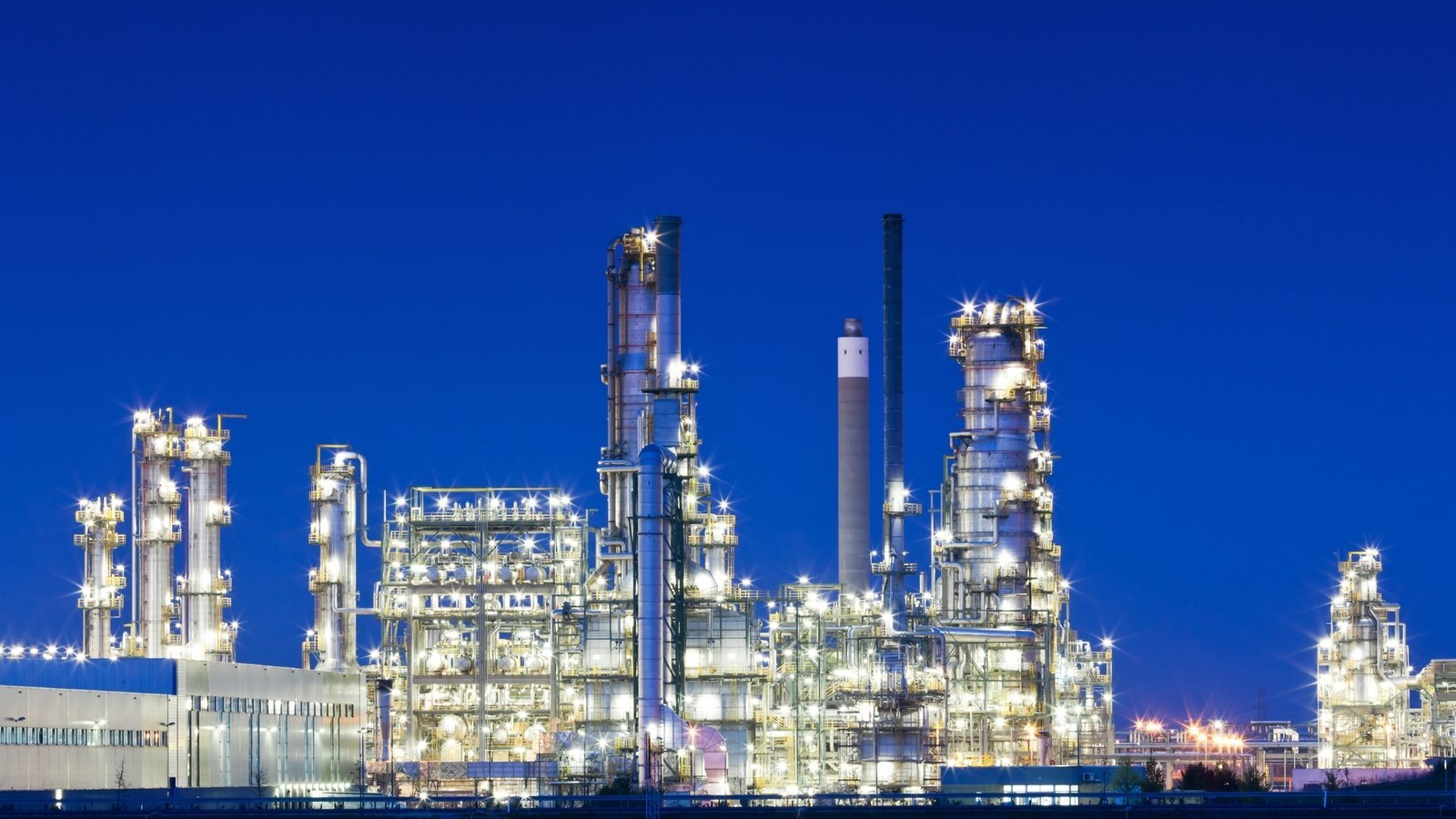 Project 54An illuminated refinery and petrochemical complex at twilight. Spare capacity does most of its work on price without ever producing a barrel.
One is available this week, the other this decade
Reserves are oil in the ground that is considered commercially recoverable. Converting reserves into production requires appraisal, capital, construction and time, usually measured in years. Reserves tell you about long-run supply potential and tell you almost nothing about next month's price.
Spare capacity is production capability that already exists, is maintained, and is deliberately held back. The wells, processing, power, storage and export capacity are all in place. It can be brought on in weeks or, in the Saudi case as described by Aramco, within days.
The distinction matters because a country can be enormously rich in reserves and contribute nothing to short-run price stability. Only developed, maintained, rapidly deliverable capacity performs the insurance function.
There is a third category worth separating out, which is emergency stocks held by governments. Those are already-produced barrels in storage. They can be released quickly, but they are finite and have to be bought back later, which creates future demand. We cover that mechanism and its limits in IEA emergency oil reserves in 2026. Our fuller definition of spare capacity itself sits in what is OPEC spare capacity in 2026.
| Spare capacity | Reserves | Emergency stocks | |
|---|---|---|---|
| What it is | Built capability deliberately not produced | Oil in the ground judged recoverable | Already-produced oil in storage |
| Time to deliver | Days to weeks | Years | Days to weeks |
| Can it be repeated | Yes, while held back | Yes, once developed | No, finite and must be rebought |
| Effect on price | Caps the risk premium continuously | Shapes long-run expectations only | Buys time, creates later demand |
| Who holds it | Mostly Saudi Arabia, with some others | Widely distributed | IEA members and large consumers |
A concentrated and therefore fragile arrangement
In practice, meaningful fast spare capacity has long been concentrated in a small number of Gulf producers, with Saudi Arabia holding most of it and the United Arab Emirates holding a material share. Most other producers run close to their effective ceiling most of the time.
That concentration is the system's quiet structural weakness. Global price stability depends on a small number of operators maintaining expensive idle capability, and on the physical infrastructure behind that capability remaining available. Both assumptions were tested in 2026.
Aramco's position, as stated by chief executive Amin Nasser at the Energy Intelligence Forum in London on 5 October 2026, is that Saudi maximum sustainable capacity of 12 million barrels a day can be made available within days and that, in his words, "Our system is intact." He said Aramco holds "the strategic reserves and flexibility" to "isolate or shift output as required."
Note the careful wording of maximum sustainable capacity. Spare capacity is the gap between that ceiling and what is actually being produced at the time, so the usable figure changes with the production rate and cannot be read off the ceiling alone. Published spare capacity numbers are estimates, are rarely independently verified, and deserve the same scepticism we applied to reserve estimates in why oil reserve estimates vary by source.
The gap between 110 dollars and 200 dollars
The Iran war that began in late February 2026 produced an unusually clean natural experiment, because it stressed both halves of the insurance function at once: the capacity itself, and the ability to deliver it.
On capacity, Aramco's message was continuity. 12 million barrels a day, available within days, system intact. On delivery, the story was the East-West pipeline, which carries Saudi crude to Red Sea loading at Yanbu and therefore avoids the Strait of Hormuz. Nasser said Brent could have reached up to 200 US dollars a barrel without that line, as reported by The National. Flows through it had been restored to about 80 per cent of capacity after a temporary halt following an attack the previous month.
Brent traded around 102 US dollars that day and 110.74 US dollars on 21 October, up 79 per cent from 61.75 US dollars a year earlier. The roughly 90 to 100 US dollar gap between the actual price and the stated counterfactual is, in effect, the market value of a functioning delivery route attached to credible spare capacity.
The experiment also showed what happens when the other buffer fails. Nasser described global stocks as "scarily thin", with close to 3 billion barrels of supply lost since the conflict began and about 1 billion barrels drawn from storage to cover it. When inventory cover erodes, spare capacity has to carry the entire insurance burden alone, which is precisely when its speed matters most. The producer-side reading of all this is in Aramco's real product is redundancy.
Price stops absorbing shocks and starts amplifying them
With ample spare capacity, a disruption is an inconvenience to be covered. With none, a disruption has to be rationed, and in a market the rationing instrument is price. The same loss of barrels therefore produces a far larger price move, and the market becomes more sensitive to news that has no physical effect at all, because expectations are doing the balancing.
Two second-order effects follow. Volatility rises faster than the price level, which raises hedging costs across the entire chain, from airlines to petrochemical buyers. And the premium becomes reflexive: high prices encourage precautionary stockpiling, which tightens the physical market further.
There is also a timing trap for anyone making investment decisions. A thin-capacity price is a conditional price. It depends on a situation persisting. ING's commodities strategists, reported by Euronews, said prices at this level despite relatively strong flows suggest the market is pricing a significant risk premium given volatility. Premiums can unwind considerably faster than the capacity built in response to them can be recovered.
For suppliers and commercial teams, the practical consequence is to separate what is structural from what is conditional before committing capital. We set out how to do that in selling into a supply shock.
Listen & take it with you
Prefer audio, or need the deck for an internal review? The full briefing is available as a podcast episode and a downloadable slide presentation.
Two producers each advertise 1 million barrels a day of spare capacity. One can deliver it in five days, the other in four months. How should the market treat them?
Frequently asked
No, and it usually is not used. Spare capacity works primarily as insurance. Its existence removes the need for buyers to bid up physical barrels, hold expensive precautionary inventory or pay up for forward cover, which caps the premium the market pays for security of supply. The barrels typically stay in the ground while the price effect is continuous, which is why analysts who track only production data consistently underestimate its influence.
Spare capacity is built, maintained production capability that is deliberately being held back and can be brought on in days or weeks. Reserves are oil in the ground judged commercially recoverable, which typically requires years of appraisal, capital and construction before it produces anything. A country can hold very large reserves and contribute nothing to short-run price stability, because only developed and rapidly deliverable capacity performs the insurance function.
Usable fast spare capacity has long been concentrated in a small number of Gulf producers, with Saudi Arabia holding the largest share and the United Arab Emirates holding a material amount. Most other producers operate close to their effective ceiling most of the time. That concentration is a structural fragility in the system, because global price stability depends on a few operators maintaining expensive idle capability and on the export infrastructure behind it staying available.
Aramco chief executive Amin Nasser argued on 5 October 2026 that it would have, if not for Saudi Arabia's East-West pipeline, which moves crude to Red Sea loading at Yanbu and so avoids the Strait of Hormuz. With Hormuz transit disrupted, that bypass kept a large volume of Saudi crude reaching buyers, and it was running at about 80 per cent of capacity. Brent traded near 102 US dollars that day, so the gap between the actual price and the counterfactual represents the value the market placed on a working delivery route attached to credible spare capacity.
Treat it as an estimate rather than a measurement. Spare capacity figures are generally produced by agencies and analysts from imperfect data, are rarely independently audited, and depend on assumptions about what a producer could sustain rather than what it has demonstrated. Maximum sustainable capacity is also not the same as spare capacity, since spare capacity is the gap between that ceiling and current production. The most useful questions to ask of any published figure are how fast the capacity can be delivered and whether there is an open export route for it.
Get the next intelligence drop
Join energy and industrial leaders getting our marketing, AI-growth and revenue-architecture intelligence, direct, no filler.
You're on the list
Welcome to The Energy Growth Brief, watch your inbox for the next dispatch.