



Siemens Energy: A Grid Backlog Sold Out to 2030
Siemens Energy's grid order backlog reached a record EUR 51 billion on 30 June 2026, with a book to bill of 1.48 and transformer capacity that does not arrive until 2030. The scarce thing in the electricity build out is no longer capital. It is a factory slot.
- The backlog is a queue, not a demand signal. Grid Technologies backlog reached a record EUR 51 billion at 30 June 2026 on quarterly orders of EUR 5.4 billion, up 28 per cent, a book to bill of 1.48. A book to bill near 1.5 sustained over a year means the order book is growing roughly half as fast again as the business can build. That is the definition of a queue, and queues ration by date, not by price.
- Pricing power has already shown up in the margin. Siemens Energy raised Grid Technologies full year margin guidance to 18 to 20 per cent and comparable revenue growth guidance to 25 to 27 per cent. In the first quarter of financial year 2026, reported 11 February 2026, the segment's profit margin before special items was 17.6 per cent. Scarce capacity is being repriced, and the repricing is flowing to the equipment makers rather than to the firms that install and integrate.
- The relief date is 2030, not 2027. Siemens Energy's planned expansion of transformer and gas insulated switchgear capacity is about 50 per cent, and it does not arrive until 2030. Any supplier plan built on the assumption that the shortage eases in the next two years is planning against the manufacturer's own stated schedule.
- The bottleneck is upstream of the OEM. The IEA's transmission grid work puts cable procurement at two to three years, large power transformers at up to four years and direct current cables at more than five, with average lead times for cables and large transformers close to double their 2021 level. Cable prices have nearly doubled since 2019 and power transformer prices have risen about 75 per cent, driven by copper, aluminium and grain oriented electrical steel. The binding constraint sits in materials and components, which is where a mid sized supplier can still get in.
- Data centre demand is now an identified, disclosed line item. Siemens Energy flagged a high triple digit million euro volume of United States data centre related orders in the first quarter of financial year 2026. Chief Executive Christian Bruch has told investors the addressable turbine market could reach about 120 GW a year, with roughly half of that demand from the United States. This is no longer an adjacent story for energy suppliers. It is the demand curve.
- The competitive set is expanding capacity in the same window, which caps the pricing window. GE Vernova reported Electrification orders of USD 6.3 billion in the second quarter of 2026, up 66 per cent organically for a book to bill of about 1.7, and segment EBITDA margin of 18.4 per cent. Two of the largest players guiding to the same margin band at the same time is a signal that the current spread is structural for about three to four years and then compresses as capacity lands.
A record order book, a raised margin, and a capacity date four years out
Siemens Energy reported its third quarter of financial year 2026 on 5 August 2026, covering the quarter ended 30 June 2026. Grid Technologies booked EUR 5.4 billion of orders, up 28 per cent year on year, taking segment order backlog to a record EUR 51 billion, about USD 59 billion. The implied book to bill for the quarter was 1.48. The company raised Grid Technologies full year guidance twice over: comparable revenue growth to 25 to 27 per cent and profit margin to 18 to 20 per cent. Large power transformers, not the more visible high voltage direct current projects, drove most of the segment's order gain.
At group level the same quarter produced record orders of EUR 17.9 billion, revenue of EUR 11.4 billion, up 18.5 per cent on a comparable basis, net income of EUR 1.188 billion and total backlog of EUR 162 billion. The gas turbine backlog stood at 69 GW after the company shipped 6 GW and booked 15 GW of new orders in the quarter. Two quarters earlier, in the first quarter of financial year 2026 reported on 11 February 2026, group backlog was EUR 146 billion and Grid Technologies profit margin before special items was 17.6 per cent. Chief Executive Christian Bruch's comment on that quarter was brief and accurate: the company had made a very strong start to the financial year. Group guidance for financial year 2026 was confirmed at 11 to 13 per cent revenue growth, 9 to 11 per cent profit margin before special items, EUR 3 to 4 billion net income and EUR 4 to 5 billion free cash flow before tax.
The number that matters most to anyone selling into this chain is not in the results headline. Siemens Energy's planned expansion of transformer and gas insulated switchgear capacity is roughly 50 per cent, and that capacity does not arrive until 2030. Reported alongside it is a USD 300 million high voltage switchgear plant at Pearl, Mississippi, a figure carried in trade coverage rather than confirmed in the quarterly release, so treat it as reported rather than audited. Either way, the direction is the same. The company has sold more than it can build, it has told the market the relief date, and the relief date is four years from the order.
Read the backlog correctly and it stops being a demand statistic. A book to bill of 1.48 means that for every euro of revenue recognised, almost one and a half euros of new commitment arrived. Sustained, that is not growth. It is accumulation. The order book lengthens, the delivery date recedes, and the firm's scarce asset shifts from its sales force to its factory calendar.
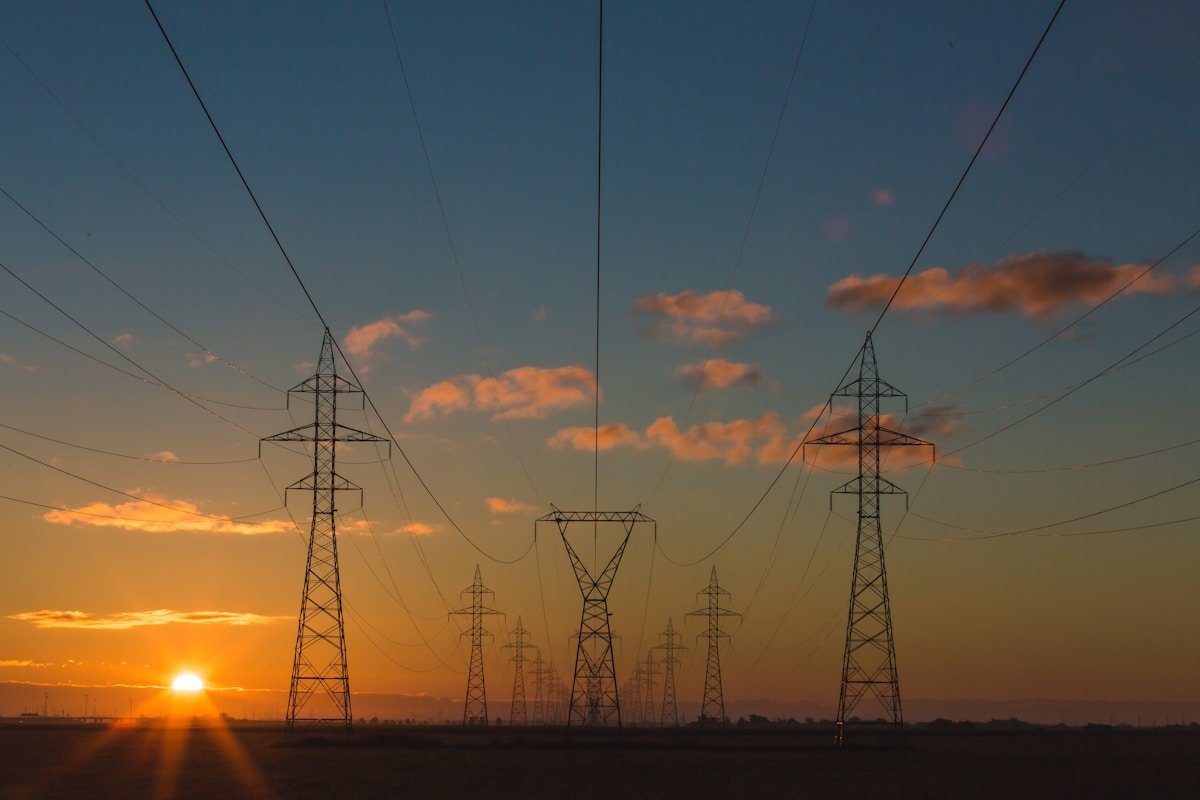 المشروع 54High voltage transmission towers at sunrise. The lines are built. The transformers and switchgear that connect new load to them are the part with a four year queue.
| متري | Value | Period or date | مصدر |
|---|---|---|---|
| Grid Technologies order backlog | EUR 51 billion, about USD 59 billion, a record | 30 يونيو 2026 | Q3 FY2026 results, 5 August 2026 |
| Grid Technologies quarterly orders | EUR 5.4 billion, up 28 per cent year on year | Quarter to 30 June 2026 | Q3 FY2026 results, 5 August 2026 |
| Grid Technologies book to bill | 1.48 | Quarter to 30 June 2026 | Q3 FY2026 results, 5 August 2026 |
| Grid Technologies FY margin guidance | Raised to 18 to 20 per cent | FY2026 | Q3 FY2026 results, 5 August 2026 |
| Grid Technologies margin before special items | 17.6 per cent | Q1 FY2026 | Earnings release Q1 FY2026, 11 February 2026 |
| Group total backlog | EUR 162 billion | 30 يونيو 2026 | Q3 FY2026 results, 5 August 2026 |
| Group orders, quarter | EUR 17.9 billion, a record | Quarter to 30 June 2026 | Q3 FY2026 results, 5 August 2026 |
| Gas turbine backlog | 69 GW, after shipping 6 GW and booking 15 GW | 30 يونيو 2026 | Q3 FY2026 results, 5 August 2026 |
| Transformer and GIS capacity expansion | About 50 per cent, arriving 2030 | Announced FY2026 | Q3 FY2026 results coverage, 5 August 2026 |
| US data centre related orders | High triple digit million euro volume | Q1 FY2026 | Earnings release Q1 FY2026, 11 February 2026 |
Not at the OEM. One tier above it, in cable, steel and copper
It is tempting to read a record OEM backlog as an OEM problem. The evidence says otherwise. The International Energy Agency's work on building the future transmission grid, drawing on an industry survey, puts cable procurement at two to three years, large power transformers at up to four years, and direct current cables at more than five years. Average lead times for cables and large power transformers have almost doubled since 2021. Prices moved with them: cable prices have nearly doubled since 2019 and power transformer prices have risen by roughly 75 per cent, with copper, aluminium and grain oriented electrical steel all contributing.
Grain oriented electrical steel is the clearest single chokepoint. It is the core material in a power transformer, it is made by a small number of mills, and a new line is a multi year capital project with its own permitting. A transformer OEM that doubles its winding and tanking capacity but cannot buy more core steel has not doubled its output. That is why the manufacturers' capacity announcements carry 2030 dates rather than 2027 dates, and it is why the shortage is better understood as a materials shortage wearing an equipment shortage's clothing.
The scale of what is queued behind the constraint is worth stating plainly. The IEA tracked about 1,650 GW of solar and wind projects in advanced development awaiting grid connection in 2024. Global transmission investment grew 10 per cent in 2023 to about USD 140 billion, and under current policy settings needs to exceed USD 200 billion a year by the mid 2030s, reaching USD 250 to 300 billion a year in scenarios that meet stated emissions goals. Meanwhile the IEA finds permitting remains the primary cause of transmission project delay in advanced economies, with component supply a growing second constraint. Two constraints, both long dated, acting on the same projects.
There is a workforce dimension that rarely reaches the commercial conversation. The IEA counts roughly 8 million people building, maintaining and operating grids, and estimates that number must grow by about 1.5 million by 2030 under current policy settings. A supplier whose differentiator is that it can supply competent commissioning and field engineering labour on schedule is selling into the same scarcity as the transformer maker, with none of the capital expenditure.
GE Vernova's numbers say sector, and they set the ceiling on the pricing window
GE Vernova reported its second quarter of 2026 on 22 July 2026 with a total backlog of USD 176 billion, up USD 13.0 billion sequentially from both equipment and services. Chief Executive Scott Strazik led on the figure. Electrification, the segment that competes most directly with Siemens Energy Grid Technologies, booked USD 6.3 billion of orders, up 66 per cent organically for a book to bill of about 1.7, on revenue of USD 3.6 billion. Segment EBITDA was USD 671 million at an 18.4 per cent margin, up 390 basis points reported and 700 basis points organically. Electrification equipment backlog reached USD 40.6 billion, up USD 16.6 billion or 69 per cent year on year, including USD 5 billion from Prolec GE.
The Power segment tells the same story in turbines. Orders of USD 16.7 billion were up 134 per cent organically. Gas equipment backlog rose from 44 to 53 GW and slot reservation agreements from 56 to 63 GW, a combined move from 100 to 116 GW. GE Vernova raised full year 2026 guidance to USD 45.5 to 46.5 billion of revenue and USD 11.5 to 12.5 billion of free cash flow, with Electrification guided to an 18 to 20 per cent segment EBITDA margin.
Put the two side by side and the inference is firm. Two of the largest grid equipment businesses in the world are simultaneously reporting book to bill well above 1.4, guiding to the same 18 to 20 per cent margin band, and announcing capacity that lands at the end of the decade. That is not a company specific advantage being competed away. It is a sector wide supply condition with a known expiry date.
The expiry date is the part most supplier strategies get wrong. The slot reservation agreement is the tell. When a buyer pays to hold a manufacturing slot years ahead of a firm order, the market has stopped clearing on price and started clearing on queue position. That mechanism persists only while demand exceeds capacity. When the 2030 capacity lands against a demand curve that has by then been partly satisfied, queue position stops being worth paying for and price competition returns. Suppliers who have built a cost base assuming today's spread will be bidding into a different market in 2031.
Sell the slot, document the schedule, and qualify one tier up
The first move is to stop selling capability and start selling delivery certainty. In a market rationed by date, the buyer's decisive question is not whether you can do the work but when you can start and whether you will hold the date. That changes what belongs in a proposal. Named manufacturing or crew capacity reserved against the client's window, with the reservation evidenced, outranks a capability statement. A credible schedule with its assumptions written down outranks a shorter promised duration that nobody believes.
The second move is to qualify one tier above where you sell today. If the binding constraint is core steel, cable, bushings, tap changers and gas insulated switchgear components, then the growth is in the component chain, not in the integration layer that is waiting on it. For a firm already supplying the integrators, the component chain is an adjacent qualification rather than a new business. The entry points are the OEM capacity expansions themselves, which are live projects with their own procurement, including the switchgear plant reported at Pearl, Mississippi.
The third move is timing the qualification against the capacity date rather than the order date. Qualification with a grid OEM is a multi quarter process, and the orders that will be placed against the 2030 capacity are being positioned now. A supplier that starts qualification when the capacity is announced as live has missed the window by roughly the length of its own qualification cycle. The practical test is simple: count the months in your own qualification process, subtract that from the date the capacity comes online, and if the answer is in the past, you are already late.
The fourth move concerns pricing discipline, and it runs against instinct. In a queue market the temptation is to price to the current spread. The capacity schedule says that spread has about four years to run. Contracts written now that extend past 2030 at today's economics will look very different on the other side of the capacity wave. Index what you can, keep the term shorter than the capacity date where the client will accept it, and treat the current margin as a window rather than a new baseline.
The last point is about where this demand actually comes from, because it changes who the buyer is. Siemens Energy's disclosure of a high triple digit million euro volume of United States data centre related orders, and Bruch's framing of a potential 120 GW a year addressable turbine market with about half from the United States, mean the counterparty increasingly is not a utility with a regulated capital plan but a hyperscaler with a construction deadline. Those buyers procure differently: faster, with less tolerance for schedule risk, and with a willingness to pay for certainty that a rate regulated utility does not share. A supplier organised entirely around utility procurement rhythms is organised for the smaller half of the market.
استمع وخذها معك
هل تفضل الاستماع إلى التسجيل الصوتي، أم تحتاج إلى العرض التقديمي للمراجعة الداخلية؟ يتوفر العرض التقديمي الكامل كحلقة بودكاست وعرض شرائح قابل للتنزيل.
Your grid OEM quotes a delivery date four years out. What do you change first?
الأسئلة المتكررة
Grid Technologies order backlog was a record EUR 51 billion, about USD 59 billion, at 30 June 2026, reported with third quarter financial year 2026 results on 5 August 2026. Segment orders in the quarter were EUR 5.4 billion, up 28 per cent year on year, for a book to bill of 1.48. Group total backlog on the same date was EUR 162 billion.
Because the constraint is materials and components rather than assembly. The International Energy Agency puts cable procurement at two to three years, large power transformers at up to four years and direct current cables at more than five years, with average lead times for cables and large transformers close to double their 2021 level. Cable prices have almost doubled since 2019 and transformer prices have risen about 75 per cent, driven by copper, aluminium and grain oriented electrical steel. Grain oriented electrical steel is the tightest single input, made by a small number of mills with multi year expansion timelines.
On the manufacturers' own schedule, around 2030. Siemens Energy's planned expansion of transformer and gas insulated switchgear capacity is roughly 50 per cent and does not arrive until 2030. Any commercial plan that assumes relief in 2027 or 2028 is planning against the supplier's published timetable rather than with it.
Yes, and the symmetry is the point. GE Vernova reported total backlog of USD 176 billion at 30 June 2026, released 22 July 2026. Electrification orders were USD 6.3 billion, up 66 per cent organically for a book to bill of about 1.7, with segment EBITDA margin of 18.4 per cent and equipment backlog of USD 40.6 billion, up 69 per cent year on year. Both companies guide Electrification or Grid Technologies to an 18 to 20 per cent margin band, which indicates a sector supply condition rather than a single company advantage.
It means that for every euro of revenue recognised in the quarter, close to one and a half euros of new order commitment arrived. Sustained above 1.0, it does not describe growth so much as accumulation: the order book lengthens and the promised delivery date moves further out. Markets in that state ration by queue position rather than by price, which is why slot reservation agreements have appeared in turbine procurement.
Enough that it is now separately disclosed. Siemens Energy flagged a high triple digit million euro volume of United States data centre related orders in its first quarter of financial year 2026, reported 11 February 2026. Chief Executive Christian Bruch has told investors the addressable turbine market could reach about 120 GW a year with roughly half of that demand from the United States. For suppliers the practical consequence is a shift in counterparty from rate regulated utilities to buyers with construction deadlines and a greater willingness to pay for schedule certainty.
احصل على التالي إسقاط معلومات استخباراتية
انضم إلى قادة الطاقة والصناعة واحصل على معلوماتنا التسويقية، ونمو الذكاء الاصطناعي، وهيكلة الإيرادات، مباشرة وبدون حشو.
اسمك مدرج في القائمة
أهلاً بكم في موجز نمو الطاقة، تابعوا بريدكم الوارد للاطلاع على النشرة القادمة.