



The First Filter Is Not Your Website: What Supplier Prequalification Decides
Before an energy buyer reads a word of your positioning, a register has usually decided whether you are eligible to be read at all. Achilles lists 229 buyers and 61,319 suppliers across its networks, and 76 buyers with 19,065 suppliers in energy alone. Most marketing teams have never seen their own entry.
- The first filter in energy B2B is an eligibility filter, not a preference filter. Positioning competes for attention inside a set that a register has already defined.
- In Europe the gate is lawful and documented. Article 77 of Directive 2014/25/EU lets energy and utility buyers run a qualification system, and requires the rules and criteria behind it to be made available to suppliers on request.
- Scale favours the buyer, not the supplier. Achilles' Global Energy network lists 76 buyers against 19,065 suppliers, which is roughly 250 registered suppliers for every buying organisation.
- Tier is a scope decision, not a budget decision. Achilles reserves its Gold level for suppliers offering products or services the buying community classes as critical, and it carries a desktop audit against IOGP 423-01.
- Buyers publish the thresholds. Vattenfall requires its Supplier Bank Member level for any supplier tendering a contract with an estimated value of 100,000 euros or more, and Silver or Silver Plus for every supplier participating in EU tenders.
A register, not a shortlist
Most energy marketing is built on an assumption that is nearly always false: that the buyer meets the company at the website, the conference stand or the outbound sequence, and forms a view. In large energy organisations the first meaningful decision about a supplier is usually made earlier and by someone else. A category manager, or a system acting on that manager's rules, decides whether the company is eligible to be considered at all. That decision is recorded in a register, and it is made against criteria the supplier may never have read.
This is not a procedural footnote. It determines the size of the set that every later marketing effort competes inside. A supplier that is eligible and badly positioned can be fixed with better messaging. A supplier that is ineligible, or eligible under categories nobody searches, cannot be fixed with messaging at all, because the material never reaches a human who could be persuaded by it.
The uncomfortable part is how routinely the two records disagree. The story a company tells on its own website, and the structured record of what it is approved to supply, where, and to what assurance level, are maintained by different people for different audiences. One is written by marketing. The other is filled in once, usually by whoever had the certificates to hand, and then left alone until a renewal notice arrives.
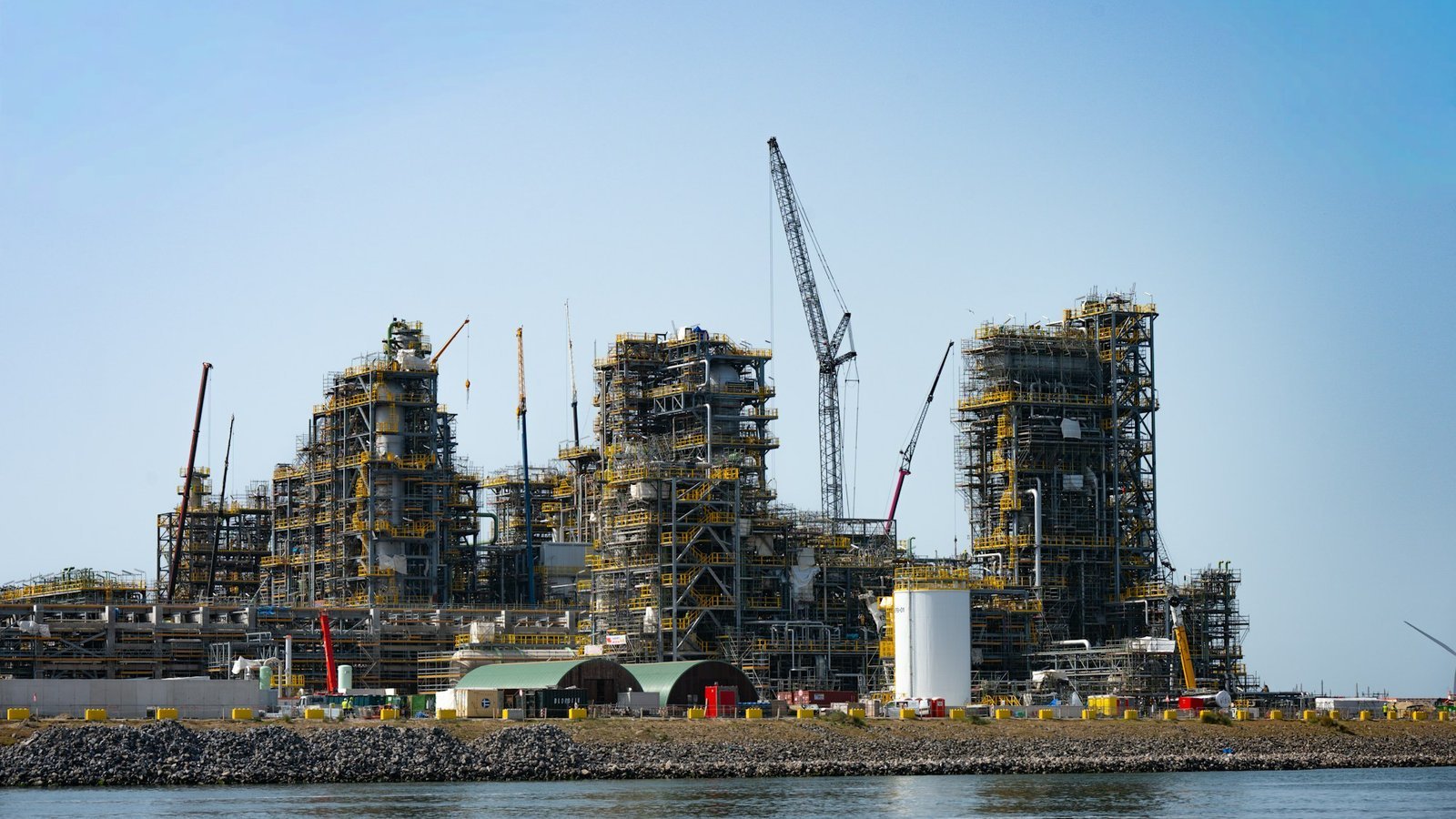 Project 54A process plant under construction on the waterfront. The register that decides who may bid is completed long before work like this is tendered.
Article 77 makes the gate lawful and the criteria disclosable
European energy, water, transport and postal buyers procure under Directive 2014/25/EU rather than the general public procurement directive, and that instrument gives prequalification an explicit legal basis. Article 77, headed Qualification systems, opens with the plain permission: "Contracting entities which so wish may establish and operate a system of qualification of economic operators." A register is not a private convenience that a utility has invented. It is a recognised procurement instrument.
The same article constrains it in a way suppliers under-use. Contracting entities operating such a system "shall establish objective rules and criteria for the exclusion and selection of economic operators", and those criteria and rules "shall be made available to economic operators on request". Where the rules change, the updated version "shall be communicated to interested economic operators". The test a supplier is being judged against is, by law, obtainable. Very few commercial teams ever ask for it.
Two practical consequences follow. First, a rejection or a low tier is an auditable outcome against published criteria, not a matter of taste, so it can be addressed specifically. Second, the register exists whether or not a supplier engages with it, because the buyer's obligation is to run it objectively, not to recruit into it.
Seventy six buyers, nineteen thousand suppliers, one questionnaire
The dominant commercial operator in this space is Achilles, which runs a set of industry and country networks that buyers subscribe to and suppliers register in. Its own network page listed 229 buyers and 61,319 suppliers when checked on 31 October 2026. Its energy-specific network, Global Energy, listed 76 buyers and 19,065 suppliers on the same day, and shows Equinor, Orsted, Repsol, Prosafe, Xlinks and Waterise among the buying organisations a registered supplier is placed in front of.
Divide those two numbers and the shape of the problem appears: roughly 250 registered suppliers for every buying organisation in the energy network. That is the real competitive set, and it is a set a buyer navigates by filtering, not by reading. Which means the fields a supplier completes are not administration. They are the index terms by which the company can be retrieved at all, in exactly the sense a search engine uses the word.
Entry itself is deliberately frictionless. Achilles describes the Global Energy starting point as a free fast-track questionnaire covering key company information and the products and services the supplier offers, with the scope of everything that follows determined by those answers and by the audit type the buying community requires. The network references NORSOK S-006 and IOGP standards, which is to say the assurance vocabulary of the buyers, not of the supplier's marketing.
The direction of travel is worth noting. When Achilles launched its Oil and Gas Europe community in August 2019 it described 148 buyers and 6,000 suppliers. Supplier numbers in these communities have grown faster than buyer numbers since. Registration is becoming more common, which steadily reduces what merely being listed is worth.
| Achilles Global Energy level | What the supplier provides | What it signals to a buyer |
|---|---|---|
| Member | Free fast-track questionnaire: company information, products and services offered | Present and categorised. Discoverable in a filtered search, with nothing yet verified |
| Silver | Full questionnaire. For suppliers without a European trading address whose scope the buying community does not class as critical. No desktop or on-site audit | Declared capability, self-reported |
| Silver Plus | Silver, plus the IOGP Self-Assessment question set | Declared capability against the buyers' own assurance vocabulary |
| Gold | For critical products or services with a European trading address. Desktop audit to meet IOGP 423-01 and European operator requirements, upgradeable to on-site | Independently checked. Eligible for scopes the community treats as critical |
Silver is a questionnaire, Gold is an audit
The tier names read like a pricing ladder and are routinely treated as one, which is the most expensive misreading in this whole area. Achilles ties its Global Energy levels to what the supplier sells and where it trades from, not to how much it wants to spend. Gold is described as the level for suppliers offering products or services classed as critical by the buying community and holding a European trading address, and it carries a desktop audit against IOGP 423-01 and European operator requirements, with an on-site upgrade available. Silver is explicitly the level for suppliers outside that definition, without a desktop or on-site audit.
So the question a commercial director should ask is not what the tiers cost. It is whether the scopes the company wants to win are classed as critical by the buyers it is targeting. If they are, a Silver entry is not a cheaper route to the same destination. It is a record that fails the eligibility test for the work in question, maintained at some annual cost, and generating nothing.
The reverse error is also common and less discussed. A supplier whose scope is not critical, buying assurance it will never be asked for, has bought a stronger badge for a filter that does not check it. Both errors come from reading the ladder as status rather than as a scope definition.
A hundred thousand euro line, and every EU tender
Buyers publish their thresholds, which makes this one of the few parts of energy B2B where the rules of eligibility can simply be looked up. Vattenfall runs its own register, the Vattenfall Supplier Bank, administered by Achilles. Its supplier registration page states that Member level is mandatory for all suppliers taking part in tendering contracts with an estimated value of 100,000 euros or more, and for all suppliers providing services related to MBL section 38 in Sweden. Silver or Silver Plus is mandatory for all suppliers from high risk countries regardless of contract value, and for all suppliers participating in EU tenders.
Read that as a commercial boundary rather than a compliance note. Under those rules a supplier without a Vattenfall Supplier Bank entry is confined to work below a hundred thousand euros, and is excluded from EU-tendered work entirely without the Silver levels. The register is not describing how the company will be perceived. It is describing the maximum size of deal it can be in.
Vattenfall also sets a values floor rather than only a capability one: suppliers should agree to the ten principles of the UN Global Compact, and its minimum requirements include completing a Vattenfall-specific questionnaire. At Silver the full questionnaire is required with documentation optional; at Silver Plus the documentation becomes mandatory, so a claimed ISO certification has to be uploaded rather than asserted. The pattern across buyers is consistent: the higher the exposure, the less the buyer will accept a claim without a document behind it.
The distinction that matters for anyone selling across Europe and the Gulf is that this is the European mechanism. In the Gulf, the equivalent gate is largely local-content scoring rather than third-party registration, which we set out separately in iktva and ICV local content in the GCC. The instrument differs; the logic is identical. Something structured and scored decides eligibility before anything persuasive is read.
Treat the register entry as a retrieval index
The useful mental shift is to stop thinking of prequalification as procurement's paperwork and start thinking of it as a second search index, one with a far smaller and far more valuable audience than Google's. The supplier controls the content of that index. Almost nobody manages it. The work is unglamorous and the leverage is high, because a correction to a category code can change which filtered searches a company appears in for a whole year.
It also sits beside work the company is probably already doing. The same discipline that makes a page retrievable by an AI assistant, matching explicit claims to verifiable evidence, is the discipline a prequalification record rewards. Buyers increasingly check the claim against the public web, and so do the assistants their analysts use. Two records that disagree is a credibility problem in both directions, which is why we treat findability as one system rather than two.
Establish which registers your buyers use
Each target account's own supplier page names the mechanism. Achilles Global Energy lists Equinor, Orsted and Repsol among its buyers; Vattenfall runs its own Supplier Bank. Build the list account by account before buying anything.
Read your own entry the way a buyer filters it
Ask to see the record. Check the product and service categories, the geographies, the legal entity names and the certificates actually attached. An entry in the wrong category is invisible at every tier, and nothing in the marketing plan can compensate.
Set the tier from the scope you sell
Gold exists for scopes the buying community classes as critical and carries an IOGP 423-01 desktop audit. Decide by the work you intend to win, then budget. Do not infer the tier from the price list.
Request the criteria, then close the gaps you find
Article 77 obliges a contracting entity running a qualification system to make its rules and criteria available on request. Ask, compare them against the record, and fix the specific shortfall rather than redesigning the website.
Rising registration, audit standards and the gap between two records
The first thing to watch is dilution. Supplier counts in these communities have risen faster than buyer counts since 2019, so presence is becoming the baseline rather than the differentiator. The competitive edge is migrating to the quality of the record: verified documentation, audited tiers, accurate categorisation. Expect being listed to be worth less each year and being verified to be worth more.
The second is the assurance vocabulary. Where a buying community anchors its audit on a named standard, as Achilles does on IOGP 423-01 and references NORSOK S-006, that standard becomes the de facto specification for a supplier's quality narrative. It is cheaper to describe your operation in the buyer's framework than to ask the buyer to translate yours.
The third is the widening gap between the register entry and the public record. Buyers verify claims against company websites, and so do the AI assistants that increasingly sit between an analyst and a shortlist. A certification claimed in marketing and absent from the register, or present in the register and unmentioned publicly, is a discrepancy that is now trivially easy to find and expensive to explain.
If you want to know what that pair of records currently says about your company, that is precisely what an Energy Findability Audit examines: whether the buyers and the systems they use can find you, and whether what they find agrees with itself.
Listen & take it with you
Prefer audio, or need the deck for an internal review? The full briefing is available as a podcast episode and a downloadable slide presentation.
A target operator has told you it only considers suppliers registered in its prequalification system, and you are not in it. What do you do first?
Frequently asked
A formal register of suppliers a buyer is willing to consider, run under Article 77 of Directive 2014/25/EU. The article permits contracting entities in the water, energy, transport and postal sectors to establish and operate a system of qualification of economic operators. Entities running one must set objective rules and criteria for exclusion and selection, make those criteria available to suppliers on request, and communicate updates to interested suppliers.
Not universally, but individual buyers make it mandatory for defined work. Vattenfall's supplier registration page states that its Supplier Bank Member level is mandatory for all suppliers tendering contracts with an estimated value of 100,000 euros or more, and that Silver or Silver Plus is mandatory for all suppliers participating in EU tenders and for suppliers from high risk countries regardless of value. The requirement is set by each buyer, so the practical answer depends on which accounts you are targeting.
Achilles' own network page listed 229 buyers and 61,319 suppliers across its networks when checked on 31 October 2026. Its energy-specific Global Energy network listed 76 buyers and 19,065 suppliers on the same date, which is approximately 250 registered suppliers for every buying organisation in that network.
Scope and verification, not price tier. Achilles describes Silver as the level for suppliers that do not offer products or services classed as critical by the buying community and do not hold a European trading address, with no desktop or on-site audit. Gold is for suppliers offering critical products or services with a European trading address, and includes a desktop audit to meet IOGP 423-01 and European operator requirements, which can be upgraded to an on-site audit. Silver Plus sits between them, adding the IOGP Self-Assessment question set.
No. It sets the boundary of the set that marketing competes inside. Prequalification decides eligibility; positioning, evidence and relationships decide the outcome among eligible suppliers. The failure mode worth avoiding is spending on the second while the first quietly excludes you, which is common because the register is maintained by a different function from the one that owns the pipeline.
Get the next intelligence drop
Join energy and industrial leaders getting our marketing, AI-growth and revenue-architecture intelligence, direct, no filler.
You're on the list
Welcome to The Energy Growth Brief, watch your inbox for the next dispatch.