



Three Orders in Nine Days: When a Nuclear Project Actually Buys
Between 29 October and 5 November 2026, three separate nuclear programmes placed manufacturing orders for major components. None of them has a construction site in operation. For a supplier, that sequence is the whole lesson: the nuclear buying window opens at the component tier, years before the construction award that most sales teams are waiting for.
- Three nuclear component orders landed in nine days — NuScale and Doosan Enerbility on 29 October 2026, X-energy with Alleima and Doosan on 4 November, and IHI for Westinghouse's Polish AP1000 on 5 November. All three are manufacturing contracts. None is a construction contract.
- The Polish order shows the real timeline: long-lead items ordered in November 2026, construction beginning in 2028, first unit in commercial operation in 2036 and the plant at full capacity by 2038. The purchase order precedes first concrete by about two years and operation by about a decade.
- The same manufacturer appears in two of the three orders, and in both cases the relationship predates the purchase order by years: Doosan's work with NuScale dates from 2019 and its technical work with X-energy from 2021. Incumbency in nuclear is built five to seven years before anyone issues a purchase order.
- The qualification question has a specific name. ISO 19443:2018 sets quality management requirements for organisations supplying products and services “important to nuclear safety” (ITNS), applying ISO 9001:2015 to that population. It is complementary to a customer's and a regulator's own requirements, not a substitute for them.
- Not every line item is safety-significant. The same Polish order covers a containment vessel and the CA01 structural “super module”, over 26 m long, 29 m wide and 23 m high, and Westinghouse placed conditional orders for other modules with four Polish fabricators. The non-ITNS scope is where most new entrants actually get in.
Three component orders, nine days, no construction site
On 29 October 2026, NuScale Power and Doosan Enerbility announced a contract covering the upper reactor coolant system of the NuScale Power Module, to be produced at Doosan's reactor facility in Changwon, South Korea. The companies described the work as moving from preparation into production of the First Article for that system. No end customer and no project were named in the announcement.
Six days later, on 4 November, X-energy, Alleima and Doosan Enerbility announced the first order for steam generator tubing for the Xe-100 reactor. Alleima manufactures the specialised stainless steel tubing; Doosan bends it into the helical coils at the heart of the Xe-100 steam generator. The release describes the order as one that “advances procurement of a safety-significant, long-lead component for the first deployment of the Xe-100”, a proposed four-unit plant with Dow in Texas under the US Department of Energy's Advanced Reactor Demonstration Program.
On 5 November, IHI confirmed an order from Westinghouse for engineering and procurement of long-lead items for one containment vessel and the associated CA01 steel “super module” for the first of three AP1000 units at Lubiatowo-Kopalino in Poland, the project owned by Polskie Elektrownie Jądrowe. The order covers technical documentation, quality and supervision plans, selecting and contracting suppliers, and beginning material procurement. Production and delivery of the finished components are to be covered by a later order, which the project company plans to issue as part of the construction contract.
Read individually, each is a routine industry announcement. Read together, in the order they arrived, they describe a procurement pattern that is easy to miss from the outside: in nuclear, the money starts moving at the component tier long before anything resembling a construction project exists to sell to.
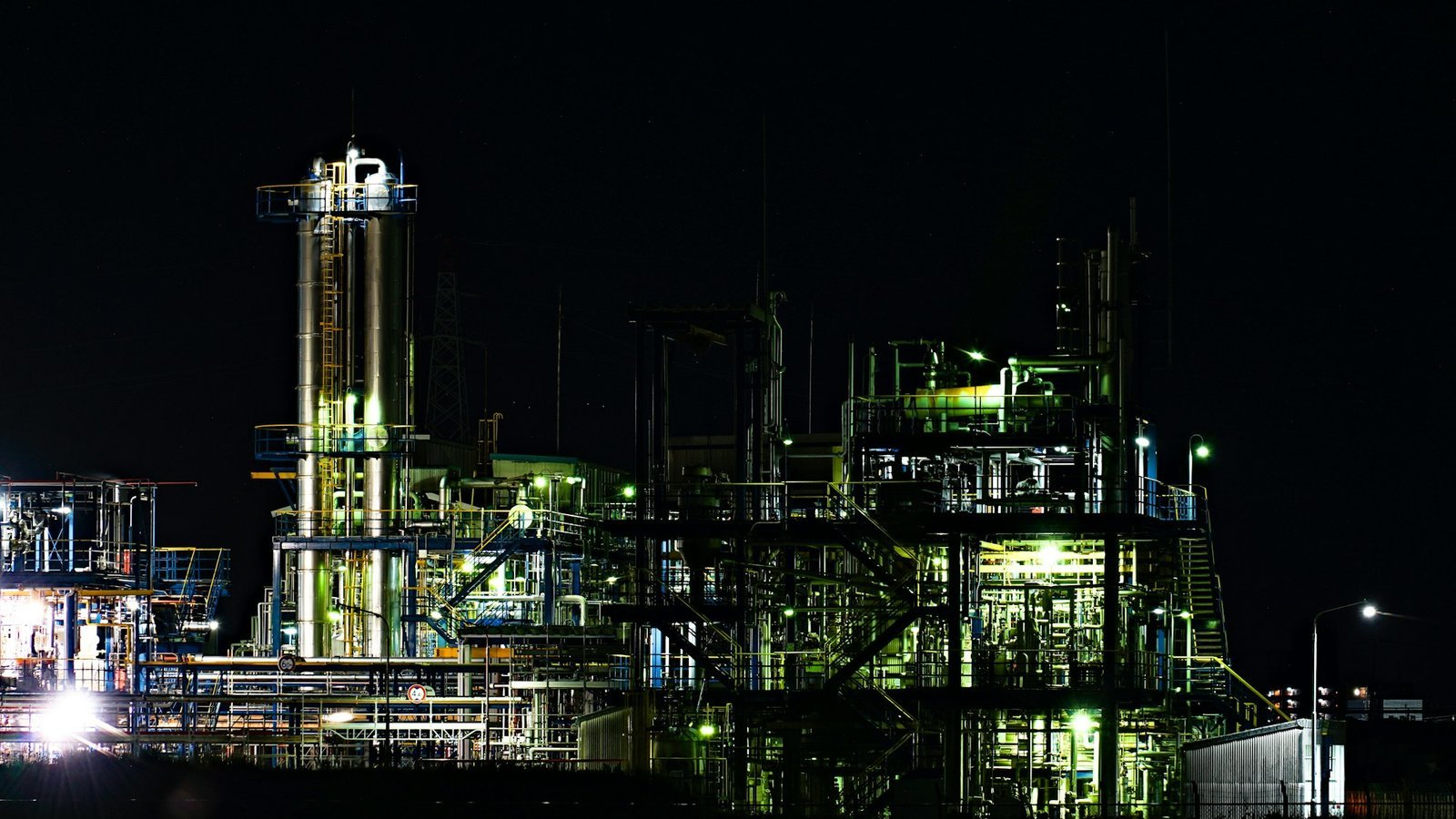 Unsplash LicenceA process plant structure illuminated against a black night sky.
The purchase order lands about two years before first concrete
The Polish project gives the clearest arithmetic, because every date in it is public. The long-lead order was placed in November 2026. Construction is scheduled to begin in 2028. The first unit is scheduled to enter commercial operation in 2036, with the plant reaching full capacity in 2038 — three years later than previously planned. Subtracting, the order for the containment vessel sits roughly two years before first construction and roughly ten years before the unit produces power.
The advanced reactor programmes compress those gaps but keep the sequence. X-energy's steam generator tubing was ordered for a plant that has not been built, and the November order itself sits behind an earlier agreement: a December 2025 arrangement with Doosan “reserving capacity for 16 sets of Xe-100 pressure vessels” along with reactor, steam generator and internal nuclear-grade steel components. Capacity was reserved eleven months before the first tubing order was placed.
This is not unusual practice being reported as news. World Nuclear News, covering the IHI order, notes that early procurement of this kind is common in nuclear projects worldwide, because it secures production capacity and reduces the risk of delay. That is the point. The behaviour is normal inside the industry and invisible from outside it, which is precisely why a supplier reading the trade press for construction awards is reading the wrong signal.
The practical consequence for a sales plan is unforgiving. If your pipeline treats the construction contract as the trigger to engage, every safety-significant long-lead item on that project was specified, sourced and in many cases ordered before you opened the opportunity. The decisions you want to influence were taken while the project still looked like a feasibility study.
Incumbency is built five to seven years before the order
Doosan Enerbility appears in two of the three announcements, as NuScale's manufacturer and as X-energy's coil fabricator. Both releases date the relationship, and the dates are the useful part. NuScale's release describes manufacturing processes, supply chain and production infrastructure developed with Doosan since 2019. X-energy's release states that technical work with Doosan began in 2021. The purchase orders landed in 2026.
So the gap between the start of the technical relationship and the first order is seven years in one case and five in the other. Neither was won in a tender cycle. They were won through years of joint qualification work, design-for-manufacture iteration and demonstrated capacity, after which the order is close to a formality.
The scale behind that preference is also stated: Doosan has supplied 34 reactor vessels and 124 steam generators worldwide. Alleima is described in the same release as one of the world's largest steam generator tubing suppliers. Carl von Schantz, President of Tube Division at Alleima, framed the logic plainly: “Moving from today's reactor technologies to the next generation of nuclear power requires trusted materials partners.”
Two executives in these releases said the same thing from opposite ends of the transaction. Jongdoo Kim, CEO of Doosan Enerbility's Nuclear Business Group, called the NuScale contract one that “marks an important step as SMR technology moves from technical validation into actual manufacturing”. John Hopkins, President and Chief Executive Officer of NuScale Power, described it as “a meaningful step in converting our approved design into deliverable modules”. Both are describing the moment a design becomes a procurement programme — the moment the supply chain stops being a slide and starts being a set of contracts.
ITNS is the line that decides which conversation you are in
The dividing line in nuclear procurement is whether what you supply is important to nuclear safety, abbreviated ITNS. That phrase is not jargon invented by buyers; it is the defined population of an international standard written specifically for this supply chain.
ISO 19443 was published in May 2018 under the title “Quality management systems — Specific requirements for the application of ISO 9001:2015 by organizations in the supply chain of the nuclear energy sector supplying products and services important to nuclear safety (ITNS)”. Its published scope states that “this International Standard applies to organizations supplying ITNS products or services”. An amendment covering climate action changes was issued in 2024, and ISO lists the standard as due for revision.
Two features of that scope matter commercially. First, ISO 19443 is built on top of ISO 9001:2015 rather than beside it, so the certification conversation starts from a quality system a serious industrial supplier probably already has, not from zero. Second, ISO explicitly frames its requirements as complementary to a customer's and a regulator's own requirements, not a replacement for them. Certification is an entry ticket to the evaluation, not the end of it: the licensee, the vendor and the national regulator each add their own demands, and applying the standard to activities on a licensed nuclear site requires the licensee's prior agreement.
There is no credible shortcut here, and pretending otherwise is how suppliers waste a year. The honest sequence is: decide whether you intend to sell ITNS scope at all; if you do, budget for the quality system, the documentation discipline and the audits before you budget for business development; and if you do not, say so clearly, because the non-safety scope of a nuclear project is large and is bought on ordinary commercial terms.
The widest door into a nuclear programme is the one that is not ITNS
The same Polish order illustrates the range inside a single contract. One part of it is a containment vessel, an essential safety system enclosing the reactor. Another is the CA01 “super module”, a steel structure more than 26 metres long, 29 metres wide and 23 metres high. Both are enormous engineering undertakings; they are not the same procurement problem, and they are not evaluated by the same people.
The localisation route is visible in the same project. After the project company approved Westinghouse ordering long-lead items, Westinghouse placed conditional purchase orders for other modules with four Polish firms — EPG, FAMAK, Mostostal Kielce and Mostostal Kraków. Those are heavy fabricators entering a nuclear programme through structural scope, in a country with a national interest in domestic content. That is a real and repeatable entry path, and it does not begin with a reactor-grade certificate.
Beyond the pressure boundary, a nuclear construction programme buys what any megaproject buys: cranage and heavy lift, site logistics, scaffolding and access, cabling and cable management, inspection and non-destructive testing services, welding consumables and welder qualification, digital engineering and document control, security, training and workforce supply. Some of that scope touches ITNS and some does not, and the distinction is decided item by item in the project's own classification, not by the sector the buyer belongs to.
This section is a reading of the commercial structure rather than a published finding, so treat it as reasoning: the generalisable point is that “can we sell into nuclear?” is the wrong first question. “Is the scope we already sell classified as important to nuclear safety on this project?” is answerable, and the answer changes which door you walk through and how long it takes.
Sell to the manufacturer, not to the project
The following is judgement rather than published data, and no number is attached to it. It follows from the sequence above rather than from any single source.
First, change the account, not the pitch. In all three November announcements the buyer that mattered was a manufacturer — Doosan, Alleima, IHI — rather than the utility, the project company or the reactor vendor. If you supply materials, components, tooling, inspection or software, your customer is probably somebody else's tier-one supplier, and that company's qualification programme is the thing to get into.
Second, treat the five-to-seven-year relationship gap as the actual sales cycle and resource it accordingly. The work that wins a 2033 order is being done in 2026: joint development, design-for-manufacture input, trial pieces, audit readiness. A pipeline stage that cannot hold an opportunity for five years will quietly delete the nuclear ones.
Third, read capacity reservations as the earliest public buying signal available. An agreement reserving manufacturing capacity — as the December 2025 arrangement for 16 sets of Xe-100 pressure vessels did — tells you where volume is being committed roughly a year before the first component order appears. It is published, it is specific, and almost nobody is reading it as a demand signal.
If you want this mapped against your own scope — which programmes classify it as ITNS, which tier-one manufacturers buy it, and where you would currently be found — that is what our Audit de la capacité de recherche énergétique is for.
Écoutez et emportez-le avec vous
Vous préférez le format audio ou vous avez besoin de la présentation pour une analyse interne ? Le compte rendu complet est disponible sous forme d’épisode de podcast et de diaporama téléchargeable.
Your product could be classified as important to nuclear safety on some projects but not others. What do you do first?
Questions fréquemment posées
A component whose manufacturing time is long enough that it has to be ordered well before the work it belongs to begins. X-energy's release describes its steam generator tubing order as advancing procurement of a “safety-significant, long-lead component”. In practice these are large forgings, pressure vessels, steam generators, specialised tubing and major structural modules.
It is not a law. ISO 19443:2018 is a voluntary international standard, and ISO frames its requirements as complementary to a customer's and a regulator's own requirements rather than replacing them. In practice buyers of scope important to nuclear safety use it, or an equivalent regime, as a screening condition, so for ITNS scope it behaves like a prerequisite even though it is not legally one.
On the first Polish AP1000 unit the gap is about a decade. The long-lead order was placed in November 2026, construction is scheduled to begin in 2028, the first unit is scheduled for commercial operation in 2036 and the plant is expected to reach full capacity in 2038.
Because it is one of a small group of manufacturers with heavy nuclear capacity and a track record buyers can point to: its own figures put it at 34 reactor vessels and 124 steam generators supplied worldwide. Its position in the 2026 orders also reflects long relationships — work with NuScale dating from 2019 and technical work with X-energy from 2021.
Frequently, yes, and the Polish project shows the mechanism. Westinghouse placed conditional purchase orders for modules with four Polish fabricators — EPG, FAMAK, Mostostal Kielce and Mostostal Kraków — on a project with a strong national interest in domestic industrial participation. Structural and fabrication scope is a common first step.
The sequence is the same and the manufacturers overlap: Doosan appears in both the NuScale small modular reactor contract and the X-energy advanced reactor order, and also builds conventional reactor vessels. What differs is repeatability. Small modular programmes reserve capacity in multiples — the December 2025 agreement reserved capacity for 16 sets of Xe-100 pressure vessels — which turns a project sale into a production run.
Obtenez la suite gouttelettes de renseignement
Rejoignez les leaders des secteurs de l'énergie et de l'industrie et recevez directement nos informations stratégiques en matière de marketing, de croissance par IA et d'architecture des revenus, sans superflu.
Vous êtes sur la liste
Bienvenue dans The Energy Growth Brief, consultez votre boîte de réception pour le prochain numéro.