

XRG Against Its Peers: Why It Is Not a Sovereign Fund, a Venture Arm, or a Subsidiary
XRG's disclosed enterprise value is 151 billion dollars, restated at the ADNOC board meeting of 24 November 2025. Aramco Ventures runs a 7.5 billion dollar venture programme across its whole operation. KUFPEC's entire ten year growth plan is 6 billion dollars. PIF reports over 900 billion dollars, but that is assets under management, which is not the same measure at all. A structural comparison of XRG against the sovereign funds, corporate venture arms and national oil company subsidiaries it keeps being filed alongside, and what the differences change for anyone selling into it.
- The structural tell is an administrative filing, not a strategy document. On 11 September 2025 ADNOC transferred its shareholdings in four listed subsidiaries, ADNOC Distribution, ADNOC Drilling, ADNOC Gas and ADNOC Logistics & Services, into XRG by off-market transfer on the ADX, stating expressly that the purpose was to give XRG access to dividend streams. A fund has an allocation and a return hurdle. XRG has a dividend income line and an acquisition mandate.
- Enterprise value is not assets under management, and the comparison fails if you pretend otherwise. XRG's 151 billion dollars, announced 24 November 2025 and reported by Gulf News, is the enterprise value of consolidated and held businesses. PIF's over 900 billion dollars, from its own 2025 annual report, is assets under management. The two measure different things and should never be ranked in the same column without saying so.
- The 80 billion dollar figure is stale and still in circulation. Trade coverage dated 26 September and 1 October 2026 still describes XRG as having an enterprise value exceeding 80 billion dollars. That was the launch figure from November 2024. Separately, ADNOC approved 150 billion dollars of its own capital investment for 2026 to 2030, which is a capex approval and not XRG's valuation.
- XRG buys control where the asset is a company and minority where the asset is a project. Control: the ADNOC group holds 95.1 per cent of Covestro's shares, through XRG and ADNOC International Germany Holding, and Borouge Group International completed on 31 March 2026 at a stated enterprise value of 60 billion dollars. Minority and non-operated: Rio Grande LNG, Absheron at 30 per cent, the announced Argentina position at 32 per cent, Arcius Energy at 49 per cent.
- Santos shows a counterparty exactly where the line sits. The XRG led consortium with ADQ and Carlyle raised its offer twice to 5.62 dollars a share, valuing Santos at 18.7 billion dollars, then withdrew on 17 and 18 September 2025 over what it described as fair distribution of risk, specifically regulatory approval risk and domestic gas supply commitments. It walked on terms, not on price.
- There is no such thing as selling to XRG, and that is the most expensive misunderstanding in the market. Work reaches suppliers through three separate doors: ADNOC group procurement via the Supplier Hub, where an uncertified bidder scores zero on ICV; the acquired portfolio company's own procurement on German or Austrian commercial terms; and the transaction itself, which generates advisory demand. Because XRG is dividend funded from listed subsidiaries, its spending capacity can be modelled from public ADX filings, which is impossible for QIA or ADIA.
A holding company with an acquisition mandate
Project 54 has already set out what XRG is and who controls it, and this piece does not repeat that work. What it does instead is answer the question that keeps being asked badly: XRG gets compared with sovereign wealth funds, with corporate venture arms and with conventional national oil company international subsidiaries, and it is none of them. Getting the category wrong is not a semantic problem. It changes who you call, what cycle you plan for, and whether you model a return hurdle that does not exist.
Start with the legal form, because it is the thing most coverage skips. The entity is XRG P.J.S.C., a UAE private joint stock company, identified as such in the ADX and SCA disclosure filed by ADNOC Distribution on 11 September 2025. It is 100 per cent owned by ADNOC, and ADNOC's own press release of the same date states that ADNOC retains ultimate control through its 100 per cent ownership of XRG. It was announced on 27 November 2024, formally commenced activities in the first quarter of 2025, and its board was endorsed on 12 December 2024 by UAE President Sheikh Mohamed bin Zayed Al Nahyan, per Energy Connects.
Now the funding, which is where the comparison actually breaks. Through 2025 ADNOC pushed two things into XRG. First, on 16 July 2025, the 24.9 per cent OMV shareholding. Second, on 11 September 2025, by off-market transfer on the ADX, its shareholdings in four listed ADNOC companies: ADNOC Distribution, ADNOC Drilling, ADNOC Gas and ADNOC Logistics & Services. ADNOC's stated reason was to give XRG access to dividend streams. That single clause is the whole structural argument. XRG is funded by dividends from listed national champion subsidiaries and spends them on international mergers and acquisitions.
It is worth being precise about what is not disclosed here, because the gaps are as informative as the figures. ADNOC has not published the consideration paid for the OMV transfer or for the listed subsidiary transfers. The ADX disclosure refers to majority shareholdings without quantifying the exact percentage of each listed subsidiary moved. XRG has published no assets under management figure in fund terms, no target internal rate of return, no return hurdle, and no internal delegated authority thresholds. If a competitor or an adviser tells you XRG's hurdle rate, they are guessing.
The model is not unprecedented in Abu Dhabi. It is close to what ADQ does domestically, where Mohamed Hassan Alsuwaidi has said of its holdings that those assets today are our main source of capital, per AGBI. XRG is that structure pointed outward, at global gas and chemicals. The consequence for a counterparty is direct: a fund has an investment committee and an allocation, whereas XRG has a board, a balance sheet, operating subsidiaries and a strategy. Which is why it bids for whole companies, and why it walks away on commercial terms rather than on price.
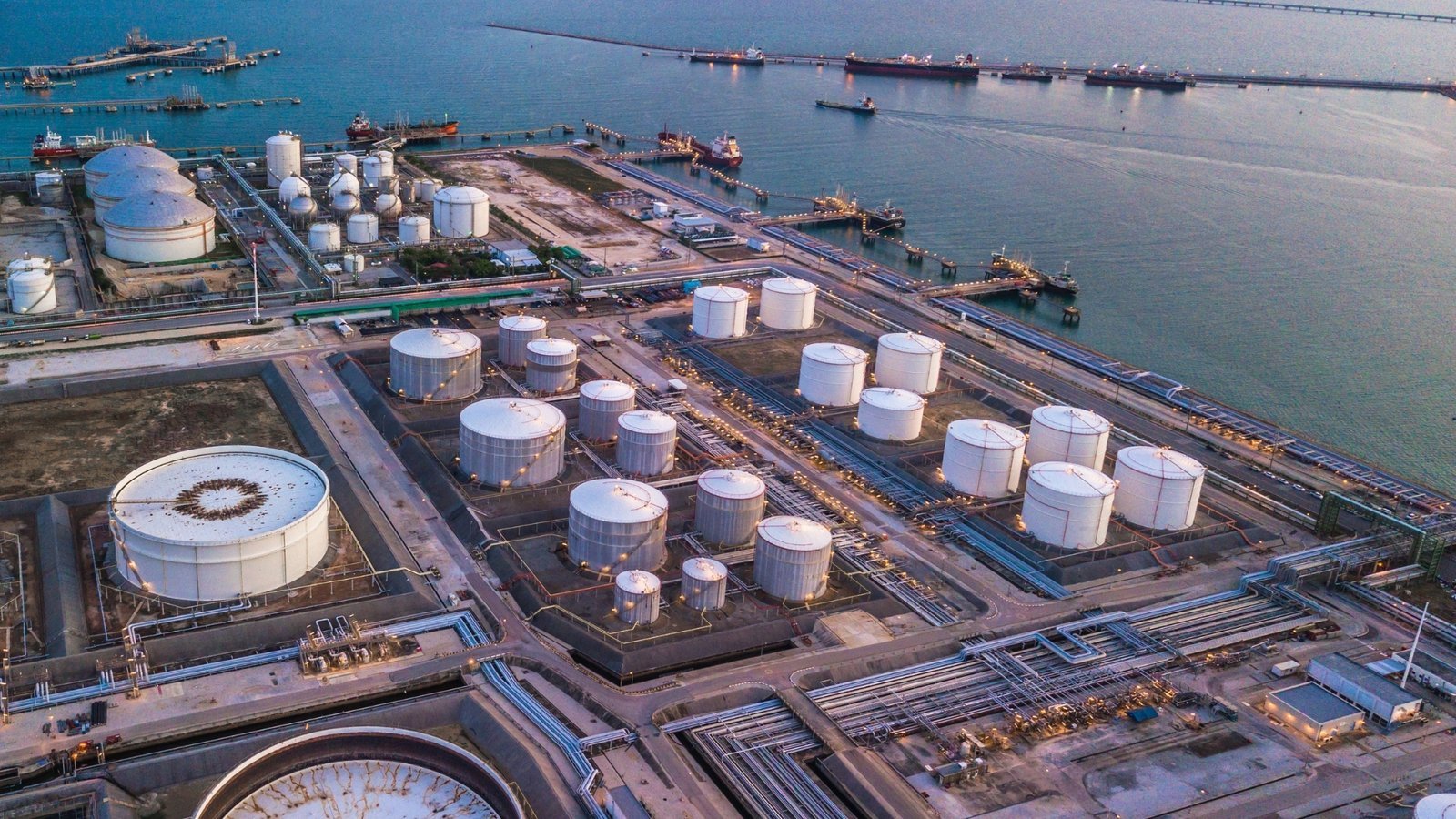 Projet 54Aerial view of a large crude and products storage tank farm beside a marine terminal
Three wrong boxes, and the evidence for each
The first wrong box is the sovereign wealth fund. A sovereign fund receives capital from the state against a return mandate with asset allocation limits, and it is deliberately diversified away from the national resource. The Qatar Investment Authority exists expressly to reduce Qatar's reliance on energy prices by investing outside energy. Norges Bank Investment Management is structurally barred from much of what XRG does: its unlisted renewable energy infrastructure allocation is restricted to developed markets in Europe and North America, with development phase projects capped at 2 per cent of that allocation. A sovereign fund is a portfolio manager working inside constraints. XRG is a buyer working inside a strategy.
The second wrong box is the corporate venture arm. That model means small cheques, minority stakes, strategic rather than financial return, and a parent that can switch it off. Aramco Ventures runs 7.5 billion dollars across the whole programme, disclosed by Aramco on 17 January 2024, with Prosperity7 at 3 billion dollars per Prosperity7's own release and Wa'ed at 500 million dollars. Its chief executive Mahdi Aladel has put the logic plainly, telling Forbes in April 2026 that for Aramco, while financial returns do matter, the real reward is in multiples of value from unique applications. Corporate venture capital is also reversible in a way platform investing is not. TotalEnergies wound its venture unit down into the TotalEnergies On accelerator in 2022, and Reuters reported in March 2026 that Shell was exploring sales from a Shell Ventures portfolio of more than 100 companies as it refocused on LNG trading and upstream under Wael Sawan.
The third wrong box is the conventional national oil company international subsidiary. That is an operating company that farms into blocks and grows production against a capital expenditure budget. KUFPEC has a 6 billion dollar ten year plan, roughly 4 billion dollars of acquisitions and 2 billion dollars of development, moving from 80,000 barrels of oil equivalent per day today toward a 200,000 target by 2034, with a portfolio already 76 per cent gas weighted and a target of 80 per cent. ONGC Videsh runs 32 projects in 19 countries at roughly 200,000 barrels of oil equivalent per day, with 2P reserves of 474 million tonnes of oil equivalent and a 40 million tonne target for 2040. These are capex budgets rather than balance sheets, and KUFPEC's entire ten year plan is about 4 per cent of XRG's enterprise value.
The one genuine partial match in the set is Mubadala Energy, which pursues a similar gas value chain thesis. Mansoor Mohammed Al Hamed, its managing director and chief executive, framed the August 2025 Caturus investment as reflecting plans to invest across the gas value chain in key global energy hubs. But Mubadala sits inside a sovereign fund reporting 385 billion dollars of assets under management as at 9 April 2026, it took 24.1 per cent of Caturus rather than control, and it has no chemicals leg at all. XRG is the only platform in this comparison pursuing two control scale industrial verticals simultaneously, gas and LNG on one side and chemicals on the other.
Read the table below with one rule in mind. Every figure is marked as disclosed by the entity itself or estimated by a third party, and the measures are not interchangeable. An enterprise value, an assets under management figure, a capital expenditure plan and a production target are four different kinds of number, and the industry's habit of stacking them in a single league table is the reason this comparison is usually wrong before it starts.
| Platform | Propriétaire | Legal form or model | Stated scale, disclosed or estimated | Strategy focus | Stake preference |
|---|---|---|---|---|---|
| XRG | ADNOC, 100 per cent | XRG P.J.S.C., a UAE private joint stock company. Holding company with an acquisition mandate, funded by dividends from listed ADNOC subsidiaries | 151 billion dollars enterprise value, disclosed, announced at the ADNOC board meeting of 24 November 2025 and reported by Gulf News. The launch figure in November 2024 was over 80 billion dollars. Stated target, not realised: double asset value over the next decade | International gas and LNG, with a stated target of top five global gas and LNG at 20 to 25 million tonnes per annum by 2035, plus global chemicals with a stated top three ambition. Lower carbon work as an adjunct: carbon capture and storage, biofuels, low carbon hydrogen and ammonia | Split by sector. Control where the asset is a company: the ADNOC group holds 95.1 per cent of Covestro and controls Borouge Group International. Minority and non-operated where the asset is a project: Rio Grande LNG at 7.6 and 11.7 per cent, Absheron 30 per cent, Argentina 32 per cent announced, Arcius Energy 49 per cent |
| Aramco Ventures, including Prosperity7 and Wa'ed | Saudi Aramco | Corporate venture capital | 7.5 billion dollars total programme, disclosed by Aramco on 17 January 2024 and described as assets under management by Forbes in April 2026. Prosperity7 at 3 billion dollars and Wa'ed at 500 million dollars, both disclosed | Deep technology. Artificial intelligence and digital is the largest segment, with sustainability and cleantech, life sciences and fintech alongside | Minority venture stakes only. Strategic deployment value is prioritised over financial return |
| PIF | The Saudi state | Sovereign wealth fund | Over 900 billion dollars of assets under management, disclosed in PIF's 2025 annual report. Global SWF estimates 1.343 trillion dollars as at April 2026 | Domestic transformation. Mandated to deliver 70 per cent of Saudi Arabia's 2030 renewables target, with over 9 billion dollars across eight renewables projects via Badeel and ACWA Power | Control or anchor stakes in domestic national champions, minority positions in international listed equities |
| QatarEnergy with QIA | The Qatari state | A national oil company investing directly off its own balance sheet, alongside a separate sovereign fund deliberately diversified away from energy. There is no combined investment vehicle | QatarEnergy: 77 million tonnes per annum of LNG now, with a stated target of 142 million tonnes by 2030 and studies for 150 to 160 million tonnes by 2035. Golden Pass LNG at 70 per cent, 18 million tonnes per annum, first cargo in the first quarter of 2026. QIA publishes nothing and is estimated at 580 to 600 billion dollars by Global SWF in April 2026 | Pure LNG volume growth plus international exploration farm-ins. QIA is explicitly non-energy | Operated majority at home, minority farm-ins abroad, such as 27 per cent offshore Egypt from Shell |
| Mubadala Energy and Mubadala | Government of Abu Dhabi | A sovereign wealth fund with an operating energy subsidiary | Mubadala group reported 385 billion dollars of assets under management, 1.4 trillion dirhams, disclosed 9 April 2026 and up 17 per cent, with 39 billion dollars deployed in 2025 | The gas value chain in what it calls key global energy hubs, weighted to United States gas and LNG | Minority. It took 24.1 per cent of Caturus, formerly Kimmeridge Texas Gas plus Commonwealth LNG at 9.5 million tonnes per annum, closing 8 August 2025, with a 13 billion dollar Commonwealth LNG final investment decision in May 2026 alongside CPP Investments |
| KUFPEC | Kuwait Petroleum Corporation and the Kuwaiti state | Conventional national oil company international upstream subsidiary | A 6 billion dollar plan over a decade, stated target rather than realised, split roughly 4 billion dollars of acquisitions and 2 billion dollars of development. Production of 80,000 barrels of oil equivalent per day now, targeting 200,000 by 2034 | Gas and LNG weighted, 76 per cent of the portfolio today against a target of 80 per cent | Working interests, both operated and non-operated, in Egypt, Indonesia, Australia and Canada |
| ONGC Videsh | ONGC and the Indian state | Conventional national oil company international subsidiary, a Navratna central public sector enterprise | 32 projects in 19 countries, disclosed. 10.28 million tonnes of oil equivalent in financial year 2025, roughly 200,000 barrels of oil equivalent per day, with 2P reserves of 474 million tonnes of oil equivalent and a stated target of 40 million tonnes by 2040 | Reserve replacement for Indian energy security. Russia and Mozambique account for 86 per cent of reserves | Operator on 16 assets and non-operator on 16. Has taken interests below 1 per cent, as in ACG and BTC |
Four kinds of number, routinely stacked in one column
The honest answer to how big XRG is compared with PIF is that the question cannot be answered cleanly, and saying so is a credibility asset rather than a weakness. XRG's 151 billion dollars is an enterprise value, the value of consolidated and held businesses. PIF's over 900 billion dollars is assets under management. One is a corporate valuation and the other is a portfolio total. They are not the same denominator and the gap between them is not a ranking.
Where the comparison does work is against platforms measured the same way, and there the scale difference is the finding. Aramco Ventures' 7.5 billion dollar programme is roughly 5 per cent of XRG's enterprise value. KUFPEC's entire ten year plan of 6 billion dollars is roughly 4 per cent. Those are not platforms operating at a different pace in the same market, they are platforms operating in a different market. A vendor who treats XRG as the Gulf equivalent of a corporate venture arm has mis-sized the opportunity by a factor of twenty.
The estimates need marking too, because the published numbers disagree. PIF's own 2025 report says over 900 billion dollars, while Global SWF's April 2026 ranking puts PIF at 1.343 trillion dollars. QIA publishes no holdings and no assets under management figure at all, and the 580 to 600 billion dollar range is a third party estimate from Global SWF and other secondary sources. ADQ was estimated at about 263 billion dollars by Global SWF and about 300 billion dollars by AGBI before its consolidation. Mixing disclosed figures and estimates silently is how most of these comparisons go wrong.
Two further numbers need separating, because they are routinely conflated with XRG's valuation and with each other. Khaleej Times reports that XRG exceeds 150 billion dollars while Gulf News reports 151 billion dollars, and those are reasonably the same fact reported two ways. ADNOC separately approved 150 billion dollars of its own capital investment for the 2026 to 2030 period. That is a parent company capital expenditure approval over five years. It is not XRG's enterprise value, it is not a commitment to XRG, and the numerical coincidence has made it the single most common error in current coverage.
Finally, a word on what XRG says it will become rather than what it is. It has stated that it plans to double asset value over the next decade, and targets a top five position in global gas and LNG with 20 to 25 million tonnes per annum by 2035 and a top three position in global chemicals. These are targets, not disclosures, and they should be read as mandate rather than record. The same caution applies to the lower carbon framing discussed further down.
Control in chemicals, minority in gas, and a rule behind it
The single most useful observation available from the record is a pattern, and it is consistent enough to plan against. XRG buys control where the asset is a company, and takes a minority where the asset is a project.
On the control side, the ADNOC group completed Covestro on 10 December 2025, a transaction of 14.7 billion euros, about 17 billion dollars, with a 1.17 billion euro capital increase at closing. Precision matters here, because the common shorthand is wrong: XRG does not legally hold all of Covestro. The ADNOC group, through XRG and ADNOC International Germany Holding, holds 95.1 per cent of the shares, split 83.43 per cent to ADNOC International Germany Holding and 11.68 per cent to XRG. Final clearance came from the German Federal Ministry for Economic Affairs and Energy on 21 November 2025, after European Commission scrutiny under the Foreign Subsidies Regulation and revised proposals submitted in October 2025. Covestro keeps its management board, its Leverkusen headquarters and its works agreements, and a squeeze-out of the minority was set later. Borouge Group International AG completed on 31 March 2026, merging Borouge, Borealis and the acquired Nova Chemicals into a stated 60 billion dollar enterprise value business producing 13.6 million tonnes a year of polyolefins, the fourth largest polyolefins producer globally, with an Austrian tax domicile, a UAE regional headquarters and over 500 million dollars of identified annual EBITDA run-rate, 75 per cent of it targeted within three years.
On the minority side, every 2026 gas transaction put XRG in the non-operator seat. It completed a second Rio Grande LNG transaction on 3 July 2026, taking 7.6 per cent of Trains 4 and 5 from Global Infrastructure Partners and BlackRock on top of an 11.7 per cent indirect Phase 1 interest covering Trains 1 to 3, giving it interests across all five trains at an undisclosed value. It completed a Southern Gas Corridor acquisition in Azerbaijan on 15 September 2026 from the Ministry of Economy of the Republic of Azerbaijan, covering Shah Deniz, the South Caucasus Pipeline, TANAP, TAP and shares in Azerbaijan Gas Supply Company, on a corridor with capacity of up to 26 billion cubic metres a year. Egypt Oil and Gas reports that stake at 12.5 per cent; World Pipelines' completion report states no percentage, so the figure is attributed rather than asserted. Eleven days later, on 26 September 2026, it took a final investment decision on the next phase of Absheron at 30 per cent alongside SOCAR at 35 and TotalEnergies at 35, targeting first production in 2029 at 600 million cubic feet a day of gas and 47,000 barrels a day of condensate, with up to 5 trillion cubic feet recoverable.
This is not indecision. It reads as a rule: own the molecule to customer chain where branding, research and development and customer relationships create value, and ride alongside an experienced operator where the value sits in construction and throughput. For a supplier, that rule is the most actionable thing in this article, because it tells you whether the eventual buying decision will be made in Leverkusen, in Vienna, in Abu Dhabi or at an operator who is not XRG at all.
The counterparties are worth noting separately. In a single quarter XRG transacted with a sovereign ministry in Baku and with the world's largest infrastructure manager in New York. A platform operating in two deal cultures at once is a platform with two very different sets of expectations about diligence, documentation and timetable, and advisers should price accordingly.
One framing caution, offered as record rather than accusation. At launch in November 2024 XRG presented three equal platforms: chemicals, international gas, and low carbon energies. By June 2025 the public framing had become gas, chemicals and energy solutions, with carbon capture and storage, biofuels and low carbon hydrogen described as opportunities offering attractive returns rather than a standalone pillar. The 2026 transaction flow is gas, gas infrastructure and polyolefins. That is a gap between the stated mandate and the record of transactions, and it is a legitimate observation about where capital has actually gone. It is not evidence of bad faith, and it should not be read as one.
| Transaction | Statut | Date | XRG position |
|---|---|---|---|
| Arcius Energy, Egypt gas joint venture with bp | Completed | 16 December 2024 | 49 per cent, with bp at 51 per cent. bp contributed its 10 per cent Shorouk interest covering Zohr, 100 per cent of North Damietta covering Atoll, and three exploration agreements. Chief executive Naser Saif Al Yafei from ADNOC, chief financial officer Katerina Papalexandri from bp |
| Turkmenistan Block I | Completed | Announced 2025 | 38 per cent, alongside Petronas |
| OMV shareholding transferred in from ADNOC | Completed | 16 July 2025 | 24.9 per cent. Consideration not disclosed |
| Shareholdings in four listed ADNOC subsidiaries transferred in | Completed by off-market transfer on the ADX | 11 September 2025 | ADNOC Distribution, ADNOC Drilling subject to approval, ADNOC Gas and ADNOC Logistics & Services. The ADX disclosure says majority shareholdings without quantifying. Consideration not disclosed |
| Covestro | Completed | 10 December 2025 | The ADNOC group holds 95.1 per cent of shares, split ADNOC International Germany Holding 83.43 per cent and XRG 11.68 per cent. Transaction of 14.7 billion euros, about 17 billion dollars |
| Borouge Group International AG | Completed | 31 March 2026 | Control. Merger of Borouge, Borealis and Nova Chemicals at a stated 60 billion dollar enterprise value |
| Rio Grande LNG, Texas, second transaction | Completed | 3 juillet 2026 | 7.6 per cent of Trains 4 and 5 bought from Global Infrastructure Partners and BlackRock, on top of an 11.7 per cent indirect Phase 1 interest. Value undisclosed. Non-operator |
| Southern Gas Corridor, Azerbaijan | Completed | 15 September 2026 | 12.5 per cent per Egypt Oil and Gas; World Pipelines' completion report states no percentage. Seller was the Ministry of Economy of the Republic of Azerbaijan. Value undisclosed. Non-operator |
| Absheron next phase, Azerbaijan | Final investment decision taken | 26 September 2026 | 30 per cent, with SOCAR at 35 per cent and TotalEnergies at 35 per cent. Non-operator |
| Vaca Muerta blocks and floating LNG, Argentina | Pipeline. Announced subject to regulatory approvals and not completed as at 1 October 2026 | Announced 29 June 2026 | 32 per cent proposed, with Eni at 32 per cent and YPF at 36 per cent, across Meseta Buena Esperanza, Aguada Villanueva and Las Tacanas, operated by YPF, feeding a 12 million tonne per annum floating LNG first phase |
| Santos, Australia | Lapsed. Offer withdrawn | 17 and 18 September 2025 | XRG led consortium with ADQ and Carlyle. Indicative offers of 5.04 and 5.42 dollars a share in March 2025, then 5.62 dollars, valuing Santos at 18.7 billion dollars, or 28.17 billion Australian dollars, for 100 per cent |
Speed with discipline, on the evidence of both
Governance is where the comparison turns into something a counterparty can actually use, because decision speed is a commercial variable. XRG's board is endorsed at head of state level and chaired by Dr Sultan Ahmed Al Jaber, who is simultaneously ADNOC's Managing Director and Group Chief Executive. Alongside UAE state figures Mohamed Hassan Alsuwaidi, Dr Ahmed Mubarak Al Mazrouei and Jasem Al Zaabi sit three people drawn from international private capital and industry: Jon Gray, Nassef Sawiris and Bernard Looney. The enterprise value restatement to 151 billion dollars was announced at an ADNOC board meeting chaired by the UAE President on 24 November 2025. Read plainly, strategic approval sits very high, and the people who sit on it have done large private mergers and acquisitions before.
What that buys in practice is speed with discipline rather than speed at any price, and the record supports both halves. On speed, Arcius Energy closed on 16 December 2024, within weeks of XRG's launch announcement, and two Caspian milestones landed inside a single fortnight in September 2026. On the limits of that speed, Covestro ran from the 2024 offer to a 10 December 2025 close, gated by the European Commission's Foreign Subsidies Regulation review and a German ministerial clearance on 21 November 2025. That is roughly twelve months of regulatory process on one transaction, and no board composition shortens it.
On discipline, Santos is the cleanest available evidence. The consortium raised its offer twice, reaching 5.62 dollars a share and an 18.7 billion dollar valuation, then withdrew. The stated reason was Santos's reluctance over fair distribution of risk, specifically who carried regulatory approval risk and domestic gas supply commitments. XRG's own statement was that while disappointed not to move forward, XRG, and its consortium partners, are responsible, disciplined investors with a clear focus on creating value for our shareholders and driving long-term growth. The commercially useful reading is that this was a terms failure rather than a price failure, which tells a future counterparty exactly which clauses to prepare for.
Against the peers, the contrast is sharp in both directions. PIF, QIA and the new Abu Dhabi vehicle L'imad all carry royal or head of state level chairmanship and are substantially less transparent, with QIA's structure and decision making procedures characterised as non-transparent and no published holdings. NBIM is the opposite extreme: its mandate is issued by the Ministry of Finance, published, and specifies what it may and may not own. Corporate venture arms are fast on small cheques and institutionally fragile, as TotalEnergies in 2022 and Shell in 2026 both demonstrate. KUFPEC and ONGC Videsh move at state procurement pace, with ONGC Videsh additionally bound by Indian central public sector enterprise governance.
One clarification that readers consistently need. On or about 30 January 2026 Abu Dhabi consolidated ADQ under a new sovereign investor, L'imad, chaired by Crown Prince Sheikh Khaled bin Mohamed bin Zayed Al Nahyan with Jassem Mohamed Bu Ataba Al Zaabi as managing director and chief executive. ADQ's pre-merger portfolio was estimated at 263 billion dollars by Global SWF. Neither ADNOC nor XRG was part of that consolidation. The two reorganisations are separate, they involve different parts of the Abu Dhabi estate, and conflating them produces a picture of a single merged investment entity that does not exist. L'imad's consolidated assets under management after the merger are not public.
Several other things are not public and should be treated as unknown rather than estimated: XRG's assets under management in fund terms, its target internal rate of return or any return hurdle, its internal delegated authority thresholds, the deal values for Rio Grande LNG in either tranche, Southern Gas Corridor, Turkmenistan Block I or the Argentina blocks, and whether ADNOC in-country value requirements apply to XRG's foreign portfolio companies. Equinor Ventures and bp Ventures do not disclose fund sizes, and no figure should be attributed to either.
Analysis: three doors, and most vendors knock on the wrong one
This section is Project 54's analysis built on the sourced facts above. No third party research exists comparing how these platforms buy, and none should be implied.
The practical headline is that there is no such thing as selling to XRG. It is a holding and investment company. It does not run tenders for compressors, catalysts or inspection services. Work reaches the market through three distinct doors, and the commercial terms, the qualification burden and the cycle length are different at each one.
The cycle length differences are worth setting out explicitly, because they drive resourcing decisions. For XRG itself, the decision unit is a board with state and private capital members, with strategy set at ADNOC board level; a transaction runs one to twelve months to sign and up to twelve months more for clearance, as Covestro demonstrated. For a conventional national oil company subsidiary such as KUFPEC or ONGC Videsh, the decision unit is the parent board under state oversight, cycles are budget driven and capital expenditure caps are hard. For a sovereign fund such as PIF, QIA, NBIM or Mubadala, the decision unit is an investment committee working to a return mandate on allocation cycles rather than project cycles, and a vendor almost never sells to the fund, only to the underlying portfolio company. For a corporate venture arm, the cheques are small, the cycle runs weeks to months, and the relationship is reversed: you do not sell to it, you raise from it.
There is one advantage in this structure that has no equivalent among the sovereign comparators, and it is underused. XRG's funding comes from dividends paid by listed ADNOC subsidiaries. Those dividends are disclosed, and so are the subsidiaries' results. A vendor or an adviser can therefore model XRG's spending capacity from public ADX filings in a way that is simply impossible for QIA, which publishes no holdings at all, or for ADIA. Most organisations build their Gulf account plans on relationship intelligence. Against XRG, a substantial part of the answer is sitting in a stock exchange filing.
Écoutez et emportez-le avec vous
Vous préférez le format audio ou vous avez besoin de la présentation pour une analyse interne ? Le compte rendu complet est disponible sous forme d’épisode de podcast et de diaporama téléchargeable.
Which description of XRG do you think is closest to right?
Questions fréquemment posées
No. XRG is XRG P.J.S.C., a UAE private joint stock company wholly owned by ADNOC, identified as such in the ADX and SCA disclosure filed by ADNOC Distribution on 11 September 2025. A sovereign wealth fund receives capital from the state against a return mandate with asset allocation limits and is typically diversified away from the national resource, as QIA is expressly, and as NBIM is by a published Ministry of Finance mandate that restricts its unlisted renewable energy infrastructure to developed markets in Europe and North America. XRG has published no assets under management figure in fund terms, no target internal rate of return and no return hurdle. What it does have is a dividend income stream: on 11 September 2025 ADNOC transferred its shareholdings in ADNOC Distribution, ADNOC Drilling, ADNOC Gas and ADNOC Logistics & Services into XRG by off-market transfer on the ADX, stating that the purpose was to give XRG access to dividend streams. That makes it a holding company with an acquisition mandate rather than a fund with an allocation.
The two cannot be compared directly, and anyone who does so without saying why is misleading you. XRG's 151 billion dollars, announced at the ADNOC board meeting of 24 November 2025 and reported by Gulf News, is an enterprise value, meaning the value of consolidated and held businesses. PIF's over 900 billion dollars, from its own 2025 annual report, is assets under management, meaning a portfolio total; Global SWF's April 2026 ranking estimates PIF at 1.343 trillion dollars instead. Those are different denominators. Two further cautions. The frequently quoted over 80 billion dollars was XRG's launch figure from November 2024 and is stale, although trade coverage dated 26 September and 1 October 2026 still uses it. And ADNOC's separate approval of 150 billion dollars of its own capital investment for 2026 to 2030 is a five year parent company capex figure, not XRG's valuation, despite the numerical coincidence.
You generally do not sell to XRG, because it is a holding and investment company that does not run operational tenders. There are three routes. First, for anything touching ADNOC's own operations or its listed subsidiaries, register on the ADNOC Supplier Hub, built on SAP Ariba: an Ariba account, profile questionnaire, Integrity Due Diligence and an ADNOC Unified ID, then pre-qualification through a technical and operational questionnaire and a technical and commercial review. An Abu Dhabi mainland DED licence is normally required for oil and gas work, and while an in-country value certificate is not formally mandatory, an uncertified bidder scores zero on ICV and ADNOC applies that score in tender evaluation. Second, sell to the acquired portfolio company directly, because Covestro retains its management board, Leverkusen headquarters and works agreements, and Borouge Group International is an Austrian domiciled AG, so you are selling on European commercial terms. Third, if you are an adviser, sell into the transaction: merger control, foreign investment screening, reserves diligence and political risk work. Whether ADNOC ICV rules extend to XRG's foreign portfolio companies is not public, so ask rather than assume.
Both, and the split follows a pattern that is useful to plan against: control where the asset is a company, minority where the asset is a project. On the control side, the ADNOC group completed Covestro on 10 December 2025 in a 14.7 billion euro transaction, about 17 billion dollars, and holds 95.1 per cent of the shares, though not through XRG alone. The group holds it through XRG and ADNOC International Germany Holding, split 83.43 per cent to ADNOC International Germany Holding and 11.68 per cent to XRG. Borouge Group International completed on 31 March 2026 at a stated 60 billion dollar enterprise value, and the lapsed Santos bid was for 100 per cent. On the minority side, XRG was the non-operator in every 2026 gas transaction: Rio Grande LNG at 7.6 per cent of Trains 4 and 5 on top of an 11.7 per cent indirect Phase 1 interest, Absheron at 30 per cent, Arcius Energy at 49 per cent, Turkmenistan Block I at 38 per cent, and a Southern Gas Corridor stake reported at 12.5 per cent by Egypt Oil and Gas, a figure World Pipelines' completion report does not state. The announced Argentina position of 32 per cent remains subject to regulatory approval and was not completed as at 1 October 2026.
No, and this is the most common structural confusion in the market. On or about 30 January 2026 Abu Dhabi consolidated ADQ under a new sovereign investor, L'imad, chaired by Crown Prince Sheikh Khaled bin Mohamed bin Zayed Al Nahyan with Jassem Mohamed Bu Ataba Al Zaabi as managing director and chief executive. ADQ's pre-merger portfolio was estimated at 263 billion dollars by Global SWF, and about 300 billion dollars by AGBI. Neither ADNOC nor XRG was included. They are separate parts of the Abu Dhabi estate under separate governance, and the only overlap in the public record is commercial: ADQ was a member of the XRG led consortium that bid for Santos and withdrew in September 2025. L'imad's consolidated assets under management after the merger are not public.
Obtenez la suite gouttelettes de renseignement
Rejoignez les leaders des secteurs de l'énergie et de l'industrie et recevez directement nos informations stratégiques en matière de marketing, de croissance par IA et d'architecture des revenus, sans superflu.
Vous êtes sur la liste
Bienvenue dans The Energy Growth Brief, consultez votre boîte de réception pour le prochain numéro.