


Masdar's 100 GW: Underwritten, Not Built
Masdar went from 10 GW to 65 GW in under five years and has deployed about USD 45 billion doing it. Almost none of that came from the green bonds it is known for. The capacity was bought, the risk was underwritten by three Abu Dhabi shareholders, and the hydrogen target quietly died in August 2026. For suppliers, the practical consequence is that there is no single Masdar to sell to.
- The 100 GW target is not a build target on the usual definition. Masdar reported 65 GW of portfolio capacity in January 2026 but 45.8 GW operating or under construction at the end of 2025, with 20.7 GW secured or near final investment decision. About 54 GW of physical build remains by 2030, roughly 10 GW a year.
- Green bonds are a credibility instrument, not the funding base. Masdar says it has deployed about USD 45 billion and needs USD 30 to 35 billion more by 2030, against USD 2.75 billion of green bonds outstanding after issues in July 2024 and May 2025. That is about 6 per cent of capital deployed. The engine is shareholder equity and non recourse project debt.
- Growth came by acquisition and co-investment, not greenfield development. Terna Energy in Greece at an enterprise value of about EUR 3.2 billion, Saeta Yield from Brookfield at about USD 1.4 billion, 50 per cent of Terra-Gen in the United States, two Endesa transactions in Spain, and 50 per cent of the 1.4 GW East Anglia THREE offshore project with Iberdrola.
- Minority stakes inflate the headline. Terra-Gen at 50 per cent, Endesa at 49.99 per cent and East Anglia THREE at 50 per cent are consolidated into gross portfolio capacity while Masdar holds half the economics and shares governance. The gap between portfolio gigawatts and net attributable gigawatts is not disclosed.
- Hydrogen is effectively over and firmed power has replaced it. The 1 million tonne a year green hydrogen target slipped beyond 2030 in October 2024, and in August 2026 Masdar cancelled a 100 MW electrolyser for Emsteel after bids had already been submitted, redirecting about 6 GW of solar to AI data centres instead.
- The governance detail is the sharpest part. Masdar's renewables business is TAQA controlled at 43 per cent, while the green hydrogen business is ADNOC controlled at 43 per cent. The retreat happened inside the vehicle the oil company controls, not the one the utility controls.
- Storage, not solar, is where the specification difficulty sits. The Abu Dhabi project with EWEC pairs 5.2 GW of solar with 19 GWh of batteries to deliver 1 GW of baseload at a financed cost of about USD 6.1 billion. A roughly five to one ratio of nameplate solar to firm output implies severe duty cycle, thermal and degradation requirements in Gulf conditions.
- There is almost no independent scrutiny of any of this. We could find no Wood Mackenzie, Rystad, BloombergNEF or IEEFA analysis of the 100 GW target. Masdar has no listed equity, so there is no sell side coverage. Trade press largely reproduces company releases. The absence is itself worth noting before relying on any of the figures.
Sixty five gigawatts, three different definitions, and one audited number
Masdar announced in January 2026 that it had reached 65 GW, up from 10 GW in under five years, as it marked twenty years since founding. That is the figure that travels. It is not the only figure the company publishes.
Masdar's thirteenth sustainability report, covering 2025 and published in late September 2026, puts operating and under construction capacity at 45.8 GW at the end of 2025, up from 32 GW a year earlier, with a further 20.7 GW secured or close to final investment decision and a total portfolio of 66.5 GW. Clean power generation reached 40.2 TWh in 2025, up 38 per cent on 29.2 TWh in 2024. Credit ratings stand at AA minus from S&P, A1 from Moody's and AA minus from Fitch.
The difference between 65 GW and 45.8 GW is the difference between a portfolio and a plant. About 20 GW of the headline is advanced pipeline. Applying the company's own stricter definition, Masdar has to physically deliver on the order of 54 GW between now and 2030, roughly 10 GW a year, in a global supply chain where, as Siemens Energy's record grid backlog shows, transformer and switchgear capacity is the binding constraint until 2030. Note also that all capacity figures here are company stated rather than audited, and that the 65 GW and 66.5 GW numbers come from different cut off dates and consolidation boundaries, since Terna and Saeta were consolidated for the first time in 2025.
The 100 GW target itself dates from the shareholder restructuring. When TAQA, Mubadala and ADNOC completed the Masdar transaction in December 2022, having announced it in December 2021, the stated purpose was to grow renewable energy capacity to at least 100 GW by 2030. The shareholding that came out of it is the detail most coverage skips: in the renewables business TAQA holds 43 per cent, Mubadala 33 per cent and ADNOC 24 per cent, while in the green hydrogen business the order is reversed, with ADNOC at 43 per cent, Mubadala at 33 per cent and TAQA at 24 per cent.
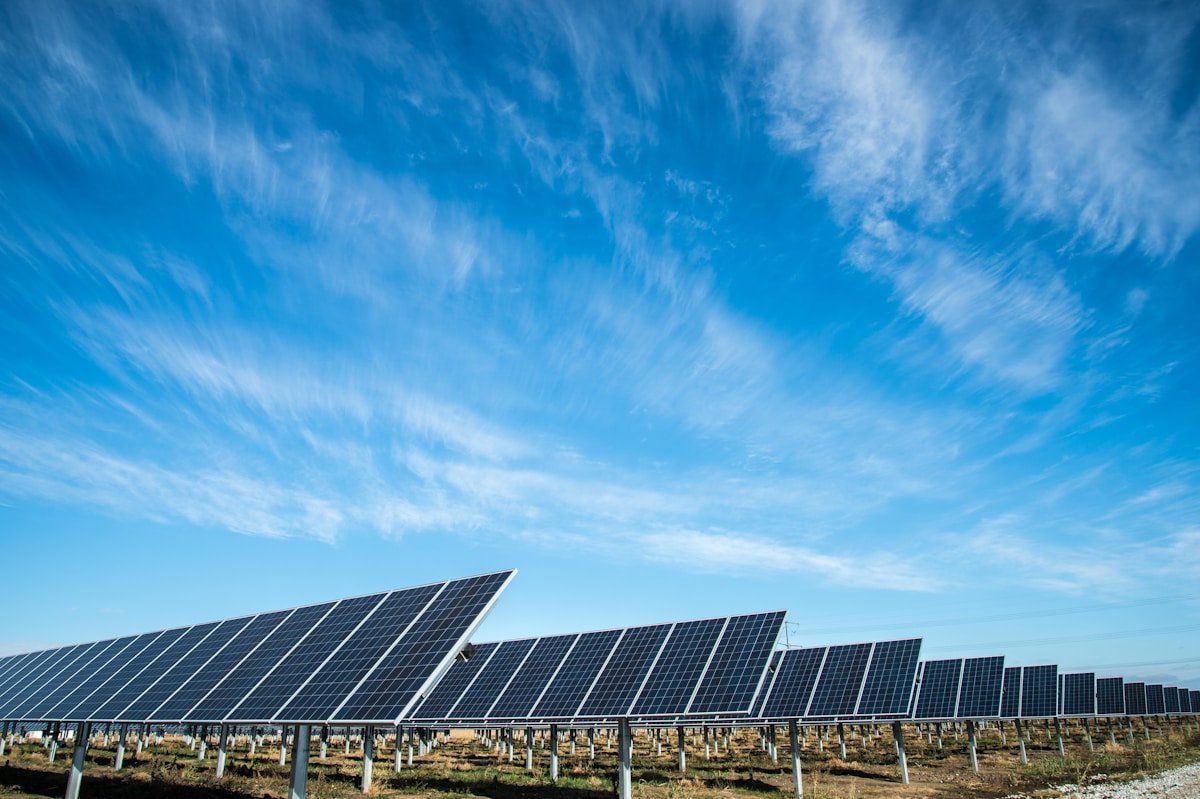 Project 54Utility scale solar in open country. Masdar's headline capacity is counted in gigawatts like this, but roughly a third of it is pipeline rather than plant, and a large share of what is built is only half owned.
| Measure | Value | As at | Source |
|---|---|---|---|
| Headline portfolio capacity | 65 GW, from 10 GW in under five years | January 2026 | Masdar |
| Operating and under construction | 45.8 GW, from 32 GW | End 2025 | Masdar sustainability report |
| Secured or near final investment decision | 20.7 GW | End 2025 | Masdar sustainability report |
| Clean power generation | 40.2 TWh, up 38 per cent | 2025 | Masdar sustainability report |
| Capital deployed to date | About USD 45 billion | January 2026 | Masdar, via Semafor |
| Further capital needed by 2030 | USD 30 to 35 billion, about 10 GW a year | January 2026 | Masdar, via Semafor |
| Green bonds outstanding | USD 2.75 billion | After May 2025 issue | Masdar |
| Green bonds as share of capital deployed | About 6 per cent | Project 54 calculation | Project 54 |
| Implied remaining build to 100 GW | About 54 GW on the operating plus under construction definition | Project 54 calculation | Project 54 |
The green bonds are the shop window, not the warehouse
Masdar is widely described as a green bond issuer, and it is a good one. Its July 2024 issue raised USD 1 billion in two USD 500 million tranches at 4.875 per cent for five years and 5.25 per cent for ten, against an order book of USD 4.6 billion. Its May 2025 issue raised a further USD 1 billion at 4.875 and 5.375 per cent, 80 and 90 basis points over US Treasuries, with a peak book of USD 6.6 billion, roughly seven times covered, and 85 per cent international allocation. Total outstanding is USD 2.75 billion.
Set that against about USD 45 billion deployed and the proportion is the story. Green bonds account for roughly 6 per cent of capital deployed. Chief Financial Officer Mazin Khan said as much at the World Future Energy Summit in Abu Dhabi in January 2026, in a formulation that rewards close reading: we view green bonds as a vital third pillar in achieving our ambition of 100 gigawatt in renewable energy. Vital, and third. He added that in December, we hit the 65 GW mark from a level of 10 GW in less than five years, and that this exponential growth rate will continue and green bonds will be integral to that.
The first two pillars are the ones that matter commercially. The first is shareholder equity from three Abu Dhabi entities with sovereign backing. The second is non recourse project debt, of which Masdar raised around USD 6 billion in 2024 alone across roughly 11 GW of projects. Moody's analysis, dated but still the only substantial published credit work on the company, noted that financial leverage is high on a proportional basis, that Masdar lacks control over many renewable projects, that project debt carries restrictive covenants that may limit dividends, and that downgrade triggers include reduced willingness or ability of shareholders or the Abu Dhabi government to support the company. The rating is explicitly a sovereign support rating rather than a standalone one. Masdar has been upgraded since, but the structure has not changed.
There is a third funding feature that gets little attention and should get more. In the second Endesa transaction, announced in March 2025 and closed on 2 October 2025, Masdar acquired 49.99 per cent of four Spanish plants totalling 446 MW for EUR 368 million, about USD 432 million. Masdar's own equity contribution was EUR 69 million. TAQA, its 43 per cent shareholder, lent EUR 115 million of acquisition finance. A developer that can borrow from its own shareholder at shareholder terms is competing on a cost of capital no private sponsor can match, and no competitor should assume it is bidding against a normal balance sheet.
A map of platforms, not a map of projects
The acquisition record is the clearest evidence for the underwriting thesis. In June 2024 Masdar agreed to acquire Greece's Terna Energy at an enterprise value of about EUR 3.2 billion and equity value of about EUR 2.4 billion at EUR 20.00 a share, taking 67 per cent and then tendering to full ownership and delisting. In September 2024 it agreed to buy Saeta Yield from Brookfield Renewable for an enterprise value of about USD 1.4 billion, bringing 745 MW operating in Spain and Portugal plus a 1.6 GW pipeline. In March 2024 it agreed to take 50 per cent of Terra-Gen in the United States from Energy Capital Partners, closing in October 2024, adding 2.4 GW and 5.1 GWh of storage across 32 sites, at a price that was never disclosed.
In Spain it bought into Endesa twice: about 50 per cent of a 2 GW, 48 plant portfolio for EUR 817 million in July 2024, then 49.99 per cent of four plants totalling 446 MW in the deal described above. In July 2025 it took 50 per cent of Iberdrola's 1.4 GW East Anglia THREE offshore wind project in a EUR 5.2 billion co-investment supported by GBP 3.5 billion of project finance from 24 banks. All 95 foundations were installed by August 2026.
The pattern continues into the most recent quarter. In September 2026 Masdar signed a memorandum with RWE covering Germany's 2027 offshore auctions with potential above EUR 3 billion, alongside an existing 3.6 GW UK joint venture, and a separate memorandum with Luxcara on batteries and offshore wind, both signed during the UAE President's visit to Germany. In the same month it reached financial close with SOCAR Green on the 315 MW Neftchala project in Azerbaijan with AIIB, EBRD and ADB, and agreed a further 350 MW of solar and up to 200 MWh of batteries at Garadagh. In October 2026 its Uzbekistan portfolio was confirmed at nine projects, USD 4.2 billion and 4.8 GW. In Serbia the Cibuk 2 project at 154 MW was inaugurated with Taaleri Energia in September 2026, taking that complex to 312 MW.
Read as a list it looks like momentum. Read as a procurement map it looks like something else. Terna, Saeta, Terra-Gen, Endesa, Iberdrola and ScottishPower, RWE, SOCAR Green, Taaleri, and in Egypt a proposed 10 GW onshore wind programme with Infinity Power and Hassan Allam. Every one of those has its own engineering function, its own approved vendor list and, in the fifty fifty cases, a co-sponsor with equal governance rights.
Cancelled after bids, and the shareholder structure explains why
Masdar's green hydrogen target of 1 million tonnes a year was pushed beyond 2030 in October 2024. That was reported as a delay. What happened in August 2026 was not a delay.
Masdar cancelled a 100 MW electrolyser project for Emsteel after bids had already been submitted, retaining only a 2.1 MW pilot, and redirected roughly 6 GW of solar capacity towards AI data centres. Suppliers that had priced and submitted into that tender carried the cost of doing so. That is the single most useful fact in this dossier for anyone deciding whether to bid into a Masdar hydrogen opportunity.
The governance reading is sharper than the commercial one. Masdar's green hydrogen business is 43 per cent ADNOC controlled, while its renewables business is 43 per cent TAQA controlled. The retrenchment therefore happened inside the vehicle controlled by the oil company, while the vehicle controlled by the utility kept expanding. For anyone tracking the wider pattern of national oil company backed investment platforms, of which ADNOC's XRG is the other Abu Dhabi example, that is the cleanest available evidence that these platforms allocate according to the parent's own conviction, not according to a group level transition narrative.
What replaced hydrogen is firmed power. The Abu Dhabi project with EWEC, which broke ground in October 2025 and reached financial close in July 2026, pairs 5.2 GW of solar with 19 GWh of batteries to deliver 1 GW of round the clock baseload, at a financed cost of about USD 6.1 billion split roughly USD 5.1 billion debt and USD 1 billion equity across thirteen lenders, with commercial operation targeted for 2027. Add 200 MWh in Azerbaijan, 70 MWh at Rochdale in the United Kingdom which entered commercial operation in August 2026, 5.1 GWh inside Terra-Gen, a 500 MW storage plan with Endesa, the Luxcara battery memorandum, and pumped hydro inherited with Terna. The direction is unambiguous.
No listed equity, no sell side, and a portfolio number nobody audits
The most important thing to say about scrutiny of Masdar is that there is almost none. We searched for Wood Mackenzie, Rystad, BloombergNEF and IEEFA commentary on the 100 GW target and found nothing. There is no listed equity, so there is no sell side coverage, and trade press reporting is largely reproduced from company releases. A platform that has deployed about USD 45 billion is operating with less independent analysis than a mid cap utility.
Within that vacuum, four specific cautions stand up. The first is the consolidation question. Masdar reports gross portfolio capacity including assets it half owns. Terra-Gen is 50 per cent, Endesa is 49.99 per cent, East Anglia THREE is 50 per cent. Net attributable capacity is never disclosed, so the gap between 65 GW of portfolio and whatever Masdar actually owns is unquantifiable from public documents.
The second is delivery on technology bets, already covered. A slipped hydrogen target followed by a tender cancelled after bids is a track record, not an anomaly.
The third is related party financing, also covered, which is a genuine competitive advantage and should be understood as such by anyone bidding against Masdar for an asset.
The fourth is structural, and it is the one Masdar cannot answer. ADNOC is expanding oil production capacity while Masdar expands clean generation, both ultimately for the same owner. Writing in Middle East Monitor on 2 October 2026, Dr Kamran Yeganegi called this the model's central tension and argued that whether it reduces or extends hydrocarbon dependence remains less settled, adding that renewable investment places Emirati capital inside foreign electricity systems for decades. That is an opinion piece rather than financial analysis, and it is offered here as the argument rather than as a finding, but it is the right argument.
There is also an exposure the company concedes itself. Speaking to Semafor in January 2026 about the United States policy rollback, Chief Executive Mohamed Jameel Al Ramahi said he is not a big fan of anyone who comes in and makes a retroactive change, that the rollback is not good for business, and that the business we built is not designed to be built and expire in one year. He also said this electron is the backbone of any economy. That is not going to change. Masdar is simultaneously exposed to US policy and saying it wants to deploy more capital there.
Three conclusions, none of which involve a meeting in Abu Dhabi
First, sell to the platform, not to Masdar. Growth is arriving through acquired and co-owned vehicles, and procurement authority sits with their operating teams and co-sponsors. A vendor's Masdar strategy is really eight to ten separate account strategies across Terna in Greece and south eastern Europe, Saeta in Iberia, Terra-Gen in the United States, the Endesa joint ventures, Iberdrola and ScottishPower on East Anglia THREE, RWE in the UK and Germany, SOCAR Green in Azerbaijan, Taaleri in Serbia and Infinity Power and Hassan Allam in Egypt. The useful corollary is the cheerful one: if you already sell to Iberdrola, RWE or a Brookfield legacy asset team, you already sell to Masdar and should say so.
Second, lead with firming, not with nameplate. The money and the engineering difficulty are both in storage and round the clock delivery. A 5.2 GW solar and 19 GWh battery asset producing 1 GW of firm output at about USD 6.1 billion implies a roughly five to one ratio of nameplate to firm, which in Gulf ambient conditions translates into hard duty cycle, thermal management and degradation commitments. Marketers should be selling availability guarantees, augmentation economics and long term operations and maintenance, not dollars per kilowatt hour of nameplate. Grid, high voltage and transformer suppliers should also note that a thirteen bank financing means the lenders' technical advisers, not the sponsor, effectively set the qualification bar.
Third, price the commitment risk into bid validity. Masdar cancelled a tendered 100 MW electrolyser after offers were in, slipped its hydrogen target by at least five years, and carries about 20 GW of its headline capacity as pipeline rather than commitment. The practical rules follow directly: treat anything labelled hydrogen as speculative, treat anything labelled data centre or baseload as live, charge for long bid validity windows, and in your own forecasting distinguish committed capacity from pipeline the way Masdar's sustainability report does and its press releases do not.
The demand signal underneath all of this is real and large. On Masdar's own definitions roughly 54 GW must still be physically built by 2030, concentrated in solar, batteries, offshore wind balance of plant and grid equipment, across Spain, Greece, the United Kingdom, Germany, Uzbekistan, Azerbaijan, Saudi Arabia, Egypt, Malaysia and the United States. The mistake would be to read that as one buyer.
Listen & take it with you
Prefer audio, or need the deck for an internal review? The full briefing is available as a podcast episode and a downloadable slide presentation.
You supply balance of plant to renewables developers. Masdar announces a 4.8 GW programme in a new market. What is your first move?
Frequently asked
Masdar announced 65 GW of portfolio capacity in January 2026, up from 10 GW in under five years. Its own thirteenth sustainability report, covering 2025 and published in late September 2026, gives a more precise breakdown: 45.8 GW operating or under construction at the end of 2025, up from 32 GW a year earlier, plus 20.7 GW secured or close to final investment decision, for a total portfolio of 66.5 GW. Clean power generation was 40.2 TWh in 2025, up 38 per cent. All of these are company stated figures rather than audited capacity.
Three Abu Dhabi entities, in different proportions for the two businesses. Following the transaction announced in December 2021 and completed in December 2022, the renewable energy business is held 43 per cent by TAQA, 33 per cent by Mubadala and 24 per cent by ADNOC. The green hydrogen business is held 43 per cent by ADNOC, 33 per cent by Mubadala and 24 per cent by TAQA. The same transaction set the target of at least 100 GW by 2030.
It depends entirely on which definition is used, and Masdar uses more than one. Counting the 65 GW headline, which includes roughly 20 GW of advanced pipeline, it is about two thirds of the way there. Counting only operating and under construction capacity, 45.8 GW at the end of 2025, roughly 54 GW of physical build remains, about 10 GW a year to 2030. Masdar says it has deployed about USD 45 billion and needs USD 30 to 35 billion more. No independent analyst assessment of deliverability was found in researching this piece.
Mainly through shareholder equity and non recourse project debt, not through green bonds. Masdar has USD 2.75 billion of green bonds outstanding after issues in July 2024 and May 2025, against about USD 45 billion deployed, so bonds represent roughly 6 per cent of capital. Chief Financial Officer Mazin Khan described green bonds in January 2026 as a vital third pillar, listing them third. Masdar raised around USD 6 billion of project debt in 2024 alone, and in one 2025 Endesa transaction its shareholder TAQA provided EUR 115 million of acquisition finance directly.
It has not formally abandoned it, but the practical position is close. The 1 million tonne a year target was pushed beyond 2030 in October 2024, and in August 2026 Masdar cancelled a 100 MW electrolyser project for Emsteel after bids had been submitted, keeping only a 2.1 MW pilot and redirecting about 6 GW of solar towards AI data centres. Suppliers should treat hydrogen labelled opportunities as speculative and firmed power or data centre opportunities as live.
It is a project with EWEC pairing 5.2 GW of solar with 19 GWh of battery storage to deliver 1 GW of round the clock baseload power. Construction began in October 2025 and financial close was reached in July 2026 at a reported cost of about USD 6.1 billion, roughly USD 5.1 billion of debt and USD 1 billion of equity across thirteen lenders, with commercial operation targeted for 2027. The roughly five to one ratio of nameplate solar to firm output is what makes the storage specification unusually demanding.
Not as one account. Masdar's capacity has come largely through acquired platforms and fifty fifty co-investments, so procurement and vendor qualification sit with Terna Energy, Saeta Yield, Terra-Gen, the Endesa joint ventures, Iberdrola and ScottishPower, RWE, SOCAR Green, Taaleri and, in Egypt, Infinity Power and Hassan Allam. Treat it as eight to ten account strategies, lead with firming and availability rather than nameplate cost, and price long bid validity windows into any speculative technology line.
Get the next intelligence drop
Join energy and industrial leaders getting our marketing, AI-growth and revenue-architecture intelligence, direct, no filler.
You're on the list
Welcome to The Energy Growth Brief, watch your inbox for the next dispatch.