



Non-Price Criteria: What EU Renewable Auctions Now Score
Since 30 December 2025 European renewable energy auctions have had to score things other than price. Responsible business conduct, cybersecurity and the ability to deliver are now pass or fail. Where component supply is concentrated in one country, origin is scored too. Ireland has already put price at no more than 85 per cent of the award. For a supplier, the consequence is direct: the evidence you can hand your customer is now part of whether they win.
- The lowest bid no longer automatically wins. Article 26 of the Net-Zero Industry Act requires EU auctions for renewable deployment to apply non-price pre-qualification and award criteria, and the obligation has applied since 30 December 2025.
- Three of the criteria are pass or fail, not points. Responsible business conduct, cybersecurity and data security, and the ability to deliver the project fully and on time are pre-qualification under Commission Implementing Regulation (EU) 2025/1176. A bid that fails them is not scored at all.
- Resilience is an origin test with a concentration trigger. It engages where a single third country supplies more than half of Union supply of a technology or of its main components, and it then caps how much of a bid may come from that source.
- It is not the whole auction, yet. The duty attaches to at least 30 per cent of annual auctioned volume or 6 GW, and the Net-Zero Industry Act's recitals set an ambition of reaching 50 per cent by the end of 2029. Member states may go further, and Ireland has.
- The supplier is now part of the buyer's score. Carbon footprint data, cyber posture, component origin and delivery evidence sit with vendors, not developers. A supplier that can hand that over in a usable form makes its customer's bid stronger, and is easier to buy.
A procurement rule inside an industrial policy
The Net-Zero Industry Act, Regulation (EU) 2024/1735, is usually discussed as a manufacturing-capacity law. Two of its articles are procurement law, and they are the part that reaches commercial teams. Article 25 sets minimum environmental sustainability requirements for public procurement of net-zero technologies. Article 26 requires member states to apply non-price criteria in auctions for the deployment of renewable energy.
The dates matter more than the drafting. The regulation entered into force in June 2024, but the auction obligation did not bite immediately. The Irish government's own consultation page records the operative date plainly: from 30 December 2025, all relevant auctions must include non-price factors. The European Commission's July 2026 guidance notice refers to the same date when it describes the questions national authorities have raised since then.
Between those two points the Commission filled in the detail. Commission Implementing Regulation (EU) 2025/1176 of 23 May 2025, published in the Official Journal on 18 June 2025 and in force twenty days later, specifies the pre-qualification and award criteria for renewable deployment auctions. It is directly applicable, so it does not wait on national transposition.
Then, on 22 July 2026, the Commission published two guidance documents, one on Article 25 and one on Article 26, with the stated aim of consistent and proportionate application across the EU. Guidance arriving eighteen months after the implementing regulation is itself a finding: national authorities and bidders were asking the same questions, and the answers were not obvious from the text.
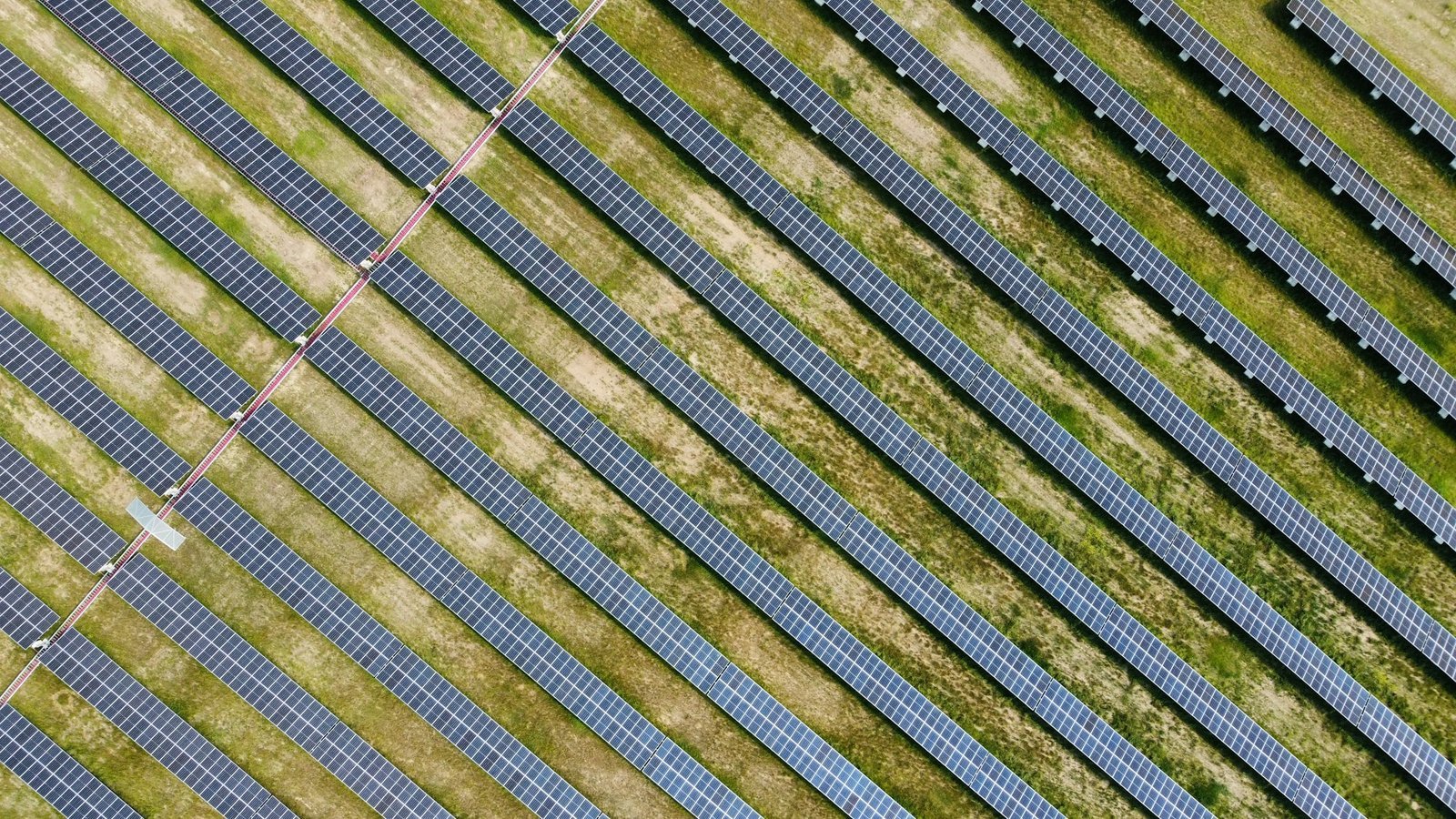 Project 54Rows of solar panels seen from above. Under Article 26 of the Net-Zero Industry Act, a bid to build capacity like this is scored on more than its price.
Three gates, then a scorecard
The distinction between a gate and a score is the single most useful thing to understand here, because it changes what a bidder has to do. A gate is binary and cannot be traded against price. A score can.
Implementing Regulation 2025/1176 makes three criteria pre-qualification. Responsible business conduct sits in Article 4, cybersecurity and data security in Article 5, and the ability to deliver the project fully and on time in Article 6. Article 6(1) asks a bidder to produce two or more from a list of six document types, which is a deliberately evidential test rather than a declaration of intent.
The scored criteria are grouped. The resilience contribution is Article 7. The sustainability contribution runs across Articles 8 to 15: carbon footprint, circular economy, biodiversity impact, energy efficiency, water use and pollution avoidance, pollution, innovation, and energy system integration. Articles 16 and 17 deal with assessment, compliance and penalties, which is where a commitment made at bid stage acquires consequences later.
Small bidders are not caught by all of it. Natural persons, companies outside the scope of the corporate reporting directive and renewable energy communities are outside the responsible business conduct obligations, and the regulation's recitals describe such bidders as entirely exempt for projects below 10 MW. Member states may nonetheless extend the core due diligence duties to those bidders for projects above 10 MW.
| Criterion | How it is applied | Where it sits |
|---|---|---|
| Responsible business conduct | Pre-qualification. Pass or fail. | Art. 4, Reg. (EU) 2025/1176 |
| Cybersecurity and data security | Pre-qualification. Pass or fail. | Art. 5 |
| Ability to deliver fully and on time | Pre-qualification. Two or more of six document types. | Art. 6 |
| Resilience contribution | Scored. Triggered by supply concentration in one third country. | Art. 7 |
| Carbon footprint, circular economy, biodiversity, energy efficiency, water, pollution, innovation, energy system integration | Scored, as the sustainability contribution. | Arts. 8 to 15 |
| Assessment, compliance, penalties | Applies after award, to what was promised at bid. | Arts. 16 and 17 |
No. It starts at 30 per cent, and rises
It does not. The obligation is calibrated, and the calibration is where member states have discretion. Implementing Regulation 2025/1176 opens by restating the Article 26 threshold as at least 30 per cent of the volume auctioned per year per member state, or 6 GW per year.
There is a wording divergence worth recording rather than smoothing over. The Commission text reads as 30 per cent or, alternatively, 6 GW. The Irish Department of Climate, Energy and the Environment's consultation document describes the same requirement as at least 30 per cent of auctioned capacity or 6 GW annually, whichever is lower. For a large auctioning state those two readings are not the same number. We could not retrieve the verbatim text of Article 26 itself from EUR-Lex to settle it, so the honest position is that the threshold is 30 per cent or 6 GW and that the interaction between the two is worth checking against national auction terms rather than assumed.
Two carve-outs reduce the base. The regulation's recitals allow member states to exclude auctions supporting projects with a maximum capacity of 10 MW from the calculation of total auctioned volume, and to exclude the undersubscribed share of an auction's volume. Both make sense: the first keeps small community projects out of a heavy compliance regime, and the second avoids penalising a state for an auction nobody filled.
The direction of travel is explicit. The Net-Zero Industry Act's recitals say the share carrying non-price criteria should strive to reach 50 per cent by the end of 2029. Anyone treating this as a 30 per cent problem is planning for the floor at the start of a ratchet.
Ireland put price at no more than 85 per cent
Ireland is the clearest worked example in the public record, because the department published both its consultation and its decision. The consultation document opened on 10 October 2025 and closed on 21 November 2025. The Initial Decision and Consultation Response Notice followed in December 2025.
The decision keeps the three statutory gates as gates. Responsible business conduct, cybersecurity and data security, and ability to deliver are pre-qualification in the Renewable Electricity Support Scheme, and a project that fails them is disqualified rather than down-scored. No further pre-qualification criteria were added.
On the scored side Ireland carried forward two options, both using two technology pots. One puts price at 85 per cent, resilience at 5 per cent and energy system integration at 10 per cent. The other puts price at 70 per cent, resilience at 5 per cent and energy system integration at 25 per cent. Resilience is fixed at 5 per cent in both. A proposed evaluation correction factor was removed. The final split between price and energy system integration was deferred, to be settled before the next relevant auction.
Two choices in that decision matter more than the percentages. First, Ireland applies the criteria to 100 per cent of the volume from RESS 6, with no phasing, rather than to the 30 per cent minimum. Second, the evidence timing is staged: self-declarations at application, supporting documentation later, with responsible business conduct documentation requested after award and energy system integration documentation due before commercial operation. A bidder therefore commits before it fully proves, and Articles 16 and 17 of the implementing regulation are what stand behind the commitment.
| Element | Ireland's decision (RESS 6 onward) |
|---|---|
| Price weighting | 70 to 85 per cent, final split deferred |
| Resilience | 5 per cent, fixed |
| Energy system integration | 10 to 25 per cent |
| Evaluation correction factor | Removed |
| Pre-qualification | Responsible business conduct, cybersecurity, ability to deliver. Disqualifying. |
| Share of auctioned volume covered | 100 per cent, no phasing |
Where the components come from, once concentration is proven
Resilience is the criterion most likely to change a supply chain, and it is the one most often described loosely. It is not a general preference for European content. It is a conditional test that engages only when concentration is established.
Under Article 7 of Implementing Regulation 2025/1176, the trigger is a single third country supplying more than 50 per cent of Union supply of the relevant technology or of its main specific components. There is an alternative trigger based on a share rising by at least 10 percentage points on average across two consecutive years and reaching at least 40 per cent. The condition has to exist nine months or more before the auction is published, which gives bidders a known lead time rather than a surprise at tender.
Once engaged, the test works on components, not on headline origin. The regulation sets out how many of a technology's main specific components must come from outside the concentrated source, and the counts differ by technology: solar photovoltaics, onshore wind, offshore wind, electrolysers and heat pumps are each treated separately. It also caps the share of any single main component that may come from that country, with a different cap where the concentration is above 85 per cent.
The practical reading for a vendor is unglamorous and specific. Your customer may need to know, at bid stage and with documentation, which of your main components originate where. If you cannot answer that at component level, you are not an obstacle to your customer's sustainability ambitions; you are an obstacle to their score.
Six questions that are answerable from published documents
None of this needs a consultant to establish. The regulation is published, the implementing regulation is published, and member states publish their auction terms. Six questions turn it into something a commercial team can act on.
One. Which auctions do your projects sit in? The duty attaches to auctions for the deployment of renewable energy under Article 26, for the technologies the Net-Zero Industry Act lists. If your customers bid into a national support scheme, name it and find its current terms.
Two. What share of that scheme's volume carries the criteria? The floor is 30 per cent of annual auctioned volume or 6 GW. A member state may apply them to everything, as Ireland has from RESS 6. The answer changes whether this affects some of your pipeline or all of it.
Three. Which criteria are gates in that scheme? Responsible business conduct, cybersecurity and ability to deliver are pre-qualification under the implementing regulation. If a national scheme treats them as disqualifying, a missing certificate is not a lost point, it is a lost bid.
Four. Is the resilience trigger live for your technology? It engages on a single third country supplying more than half of Union supply, or on a share that has climbed at least 10 percentage points on average over two consecutive years to reach 40 per cent, and the condition must exist nine months or more before the auction is published. That lead time is the planning window.
Five. Which of the scored sustainability criteria does the scheme actually use? Articles 8 to 15 are a menu, not a mandate to use all eight. Ireland scores energy system integration and leaves biodiversity net gain out for now. Scoring what the scheme does not use is wasted effort.
Six. When is each piece of evidence due? Declaration at application and documentation later is one pattern, and the dates differ by criterion. Knowing your customer's two deadlines is worth more than knowing the regulation.
Your evidence pack became part of your customer's bid
The temptation is to file this under regulatory compliance and leave it with legal. That misreads where the work lands. A developer bidding into a renewable auction has to assert things about carbon footprint, circularity, cyber posture, component origin and deliverability. Almost none of those facts are generated by the developer. They are generated by its suppliers.
So the obligation is the developer's and the evidence is the supplier's. That gap is a commercial opening. Three things follow from it.
First, audit-ready beats impressive. A product carbon footprint figure that comes with its methodology, boundary and date is usable in a bid. A sustainability brochure is not. The same holds for cyber: a certification a bidder can cite outperforms a page describing your security culture.
Second, component-level origin data is now a sales asset, not a confidentiality problem. A supplier that can state where main components come from, and keep that statement current, is materially cheaper to buy from than one that cannot, because the alternative is the customer carrying the risk of a resilience score it cannot defend.
Third, the timing of evidence is a service, not a form. Ireland's staged model, declaration at application and documentation later, means a developer needs the same facts twice, months apart, in different formats. A supplier whose commercial team knows that calendar is in the room at a moment competitors are not.
None of this requires a product change. It requires knowing which of your facts your customer is now scored on, and making those facts easy to pass through. If you want a second pair of eyes on which of your evidence a buyer actually has to cite, that is the kind of thing we work on in a strategy call.
And if you sell into the Gulf as well as Europe, the structure will feel familiar: scored local-content and in-country-value systems have been doing a version of this for years, as our note on iktva and ICV scoring sets out. The novelty in Europe is not the idea of scoring a supply chain. It is that the score now sits inside an auction a developer either wins or loses.
Listen & take it with you
Prefer audio, or need the deck for an internal review? The full briefing is available as a podcast episode and a downloadable slide presentation.
A developer you supply asks, at bid stage, for component-level origin data and a product carbon footprint with its methodology, in four working days. What happens in your organisation?
Frequently asked
From 30 December 2025. The obligation comes from Article 26 of the Net-Zero Industry Act, Regulation (EU) 2024/1735, which entered into force in June 2024, and the Irish government's consultation page records 30 December 2025 as the date from which all relevant auctions must include non-price factors. The criteria themselves were specified earlier, by Commission Implementing Regulation (EU) 2025/1176 of 23 May 2025.
Responsible business conduct, cybersecurity and data security, and the ability to deliver the project fully and on time. They are Articles 4, 5 and 6 of Commission Implementing Regulation (EU) 2025/1176. They are pass or fail rather than scored, so a bid that does not meet them is not weighed against price at all.
At least 30 per cent of the volume auctioned per year per member state, or 6 GW per year. Member states may exclude auctions for projects with a maximum capacity of 10 MW from the calculation, and may exclude an auction's undersubscribed share. The Net-Zero Industry Act's recitals set an ambition of reaching 50 per cent by the end of 2029, and a member state may apply the criteria to all of its volume, as Ireland has from RESS 6.
No. It is a conditional test, not a local-content rule. It engages when a single third country supplies more than half of Union supply of a technology or of its main specific components, or where that share has risen by at least 10 percentage points on average over two consecutive years and reached at least 40 per cent. The condition has to exist nine months or more before the auction is published. Once engaged, it limits how many of a technology's main components, and how much of any single component, may come from that source.
Nothing is owed directly to the auction, because the bidder is the developer. What a supplier is asked for is evidence the developer can cite: product carbon footprint figures with their methodology and boundary, a citable cybersecurity certification, component-level origin information, and delivery evidence of the kind Article 6 contemplates, which asks a bidder for two or more of six document types. The useful question is not whether you have these facts, but whether a customer can lift them into a bid without rewriting them.
Get the next intelligence drop
Join energy and industrial leaders getting our marketing, AI-growth and revenue-architecture intelligence, direct, no filler.
You're on the list
Welcome to The Energy Growth Brief, watch your inbox for the next dispatch.