


The global LNG market is entering a cycle of massive supply expansion, and for the last 24 months, the National Oil Companies (NOCs) of the Arabian Gulf have been positioning themselves to be the dominant traders of the next decade. However, recent developments have forced a sharp recalibration of how that dominance is achieved.
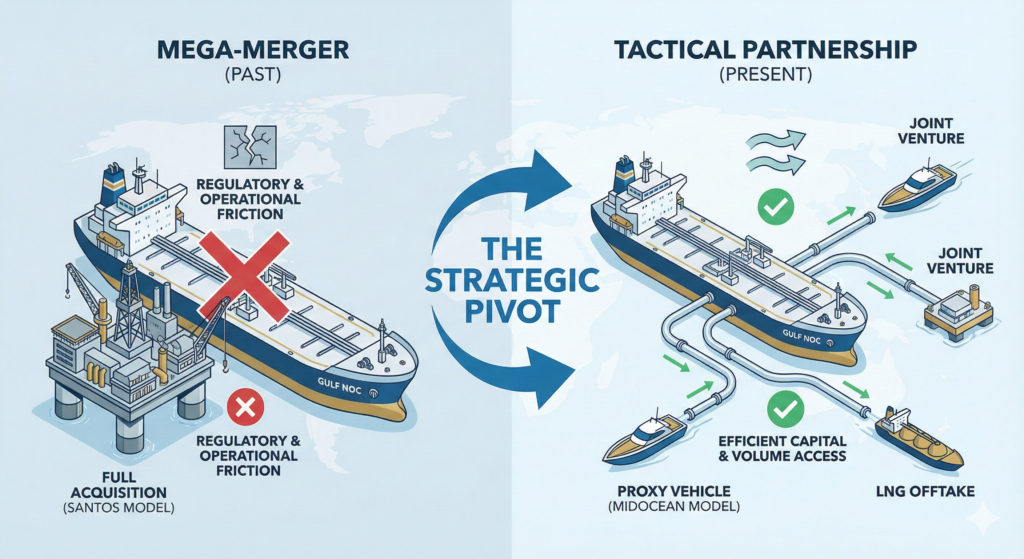
The contrasting fortunes of two major deals—Saudi Aramco’s increased stake in MidOcean Energy and ADNOC’s withdrawal from the Santos acquisition—mark a definitive pivot in the region’s corporate strategy. We are moving from an era of unchecked asset accumulation to one of tactical, risk-adjusted partnerships.
The Santos Wall: Valuation Meets Regulation
The withdrawal of the $19 billion bid for Australia’s Santos Ltd by XRG (an ADNOC subsidiary) and its consortium partners is the most significant M&A correction of 2025. While officially attributed to “commercial disagreements” over valuation, the deal faced substantial headwinds that every BD leader in the region must recognize.
- Regulatory Friction: Acquiring a strategic national asset in a Tier-1 jurisdiction like Australia is becoming increasingly difficult for sovereign-backed entities. The scrutiny from foreign investment review boards is intensifying, adding a “political risk premium” to any full takeover bid.
- Operator Risk: Becoming the operator of record for assets like Santos’s Barossa or Gladstone LNG projects invites direct exposure to local environmental activism, labor disputes, and tax regime changes. For a Gulf NOC, this operational drag can outweigh the strategic value of the reserves.
The MidOcean Model: The Proxy Play
Contrast this with Saudi Aramco’s approach. By increasing its stake in MidOcean Energy to 49%, Aramco is essentially effectively “outsourcing” its M&A engine.
MidOcean, managed by institutional investor EIG, acts as a specialized vehicle. It acquires the assets (like interests in four Australian LNG projects and Peru LNG), manages the regulatory approvals, and handles the operational partnerships. Aramco, as the major shareholder:
- Secures the Offtake: Gaining access to the LNG volumes for its growing trading desk.
- Limits Exposure: Avoiding the direct “sovereign buyer” label that complicates deals in Western markets.
- Deploys Capital Efficiently: Gaining exposure to multiple geographies (Latin America and Asia-Pacific) for a fraction of the cost of a single corporate takeover.
Strategic Drivers: Volume Over Vanity
This shift is driven by a fundamental realization: You don’t need to own the well to trade the gas.
For MENA executives, this signals a change in the flow of outbound capital. The “Checkbook Diplomacy” of buying entire companies is fading. It is being replaced by sophisticated joint ventures, equity-light offtake agreements, and investments in agile midstream vehicles.
Key Takeaways for Business Development:
- Target the Vehicle, Not the Asset: If you are selling into this market, structure your deals as partnerships or minority equity opportunities rather than full divestments.
- The Trading Desk is King: The ultimate goal for both ADNOC and Aramco is to feed their trading arms. Any deal that brings flexible LNG volumes (destination-free cargoes) will be prioritized over fixed-asset acquisitions.
- Jurisdiction Matters: Expect capital to flow away from “difficult” regulatory environments (like Australian M&A) toward more transactional markets or US Gulf Coast brownfield expansions where offtake financing is king.
The failure of the Santos deal is not a retreat; it is a refinement. The Gulf’s capital is still looking for a home in the global gas market, but the terms of engagement have strictly changed.