



- China's oil demand in 2026 is about 15.1 million barrels per day, or roughly 753 million tonnes for the year, according to PetroChina's Planning and Engineering Institute.
- That is a fall of about 4.9 percent from 2025, the clearest sign yet that China's oil demand has passed or is passing its peak.
- Consumption, imports and production are three different numbers: China consumes about 15 million barrels a day, produces about 4.4 million, and imports the balance.
- CNPC's research institute puts new-energy-vehicle displacement at about 885,000 barrels per day of gasoline in 2025, the single biggest driver of the decline.
- For oil markets and energy B2B, a structurally softer China demand curve reshapes pricing, supplier strategy and where growth capital should go.
About 15 million barrels a day, and falling
China consumes roughly 15 million barrels of oil per day in 2026, and the country's two state majors no longer agree on how fast that number is falling. PetroChina's Planning and Engineering Institute forecast total Chinese oil consumption of about 753 million tonnes in 2026, a fall of 4.9 percent, in a report published in June 2026. Converted at CNPC's own tonne-to-barrel ratio, that is 15.1 million barrels per day: CNPC's Economic & Technology Research Institute puts crude throughput at 734 million tonnes, or 14.74 million barrels a day, which implies 7.33 barrels per tonne, and 753 million tonnes at that ratio is 15.12 million barrels per day. The 2025 base of about 15.9 million barrels per day is derived from the same forecast rather than separately measured. Three months later, in September 2026, the Sinopec Economics & Development Research Institute put the 2026 decline at 600,000 barrels per day and said Chinese demand had already peaked in 2025. Both are single-institution forecasts from competing state majors, and they disagree; we give both rather than choose.
The direction of travel matters as much as the number. For two decades China was the engine of global oil demand growth. A forecast fall of nearly 5 percent in a single year is a structural signal, not a blip, and it is why analysts increasingly talk about China's oil demand having peaked. We covered the reserve side of this story in China's oil storage capacity and whether China is still stockpiling oil.
One caution on precision: China does not publish a single official daily demand figure in the way some analysts would like, so headline numbers are estimates built from refinery runs, imports, production and inventory changes. The 15 million barrels per day figure is an estimate, but it is a well supported one, consistent across PetroChina, the IEA and independent trackers.
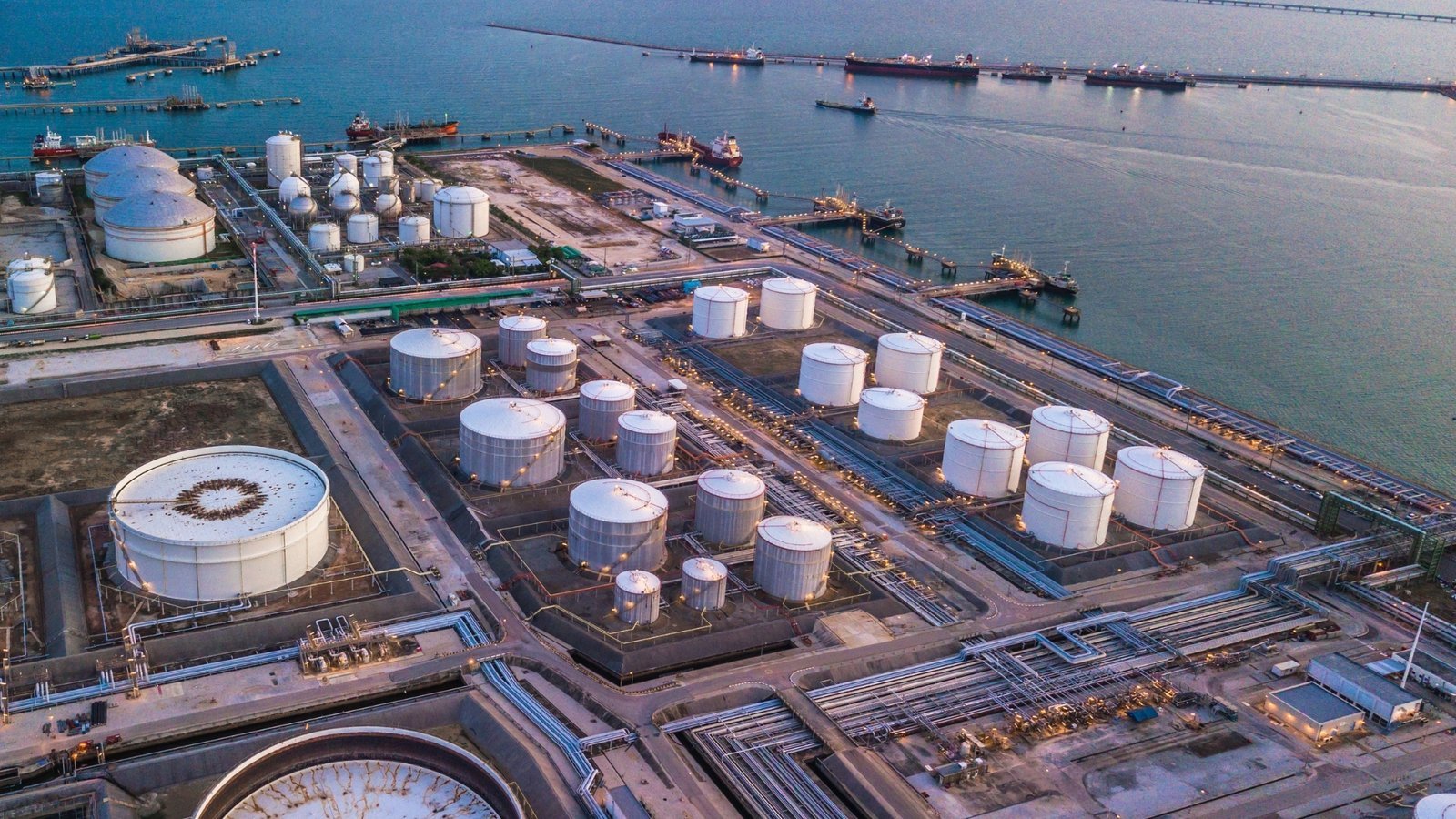 Project 54Coastal storage and berth capacity is where Chinese crude demand becomes visible to the rest of the market.
Three different numbers that get confused
A lot of confusion comes from mixing up three separate figures. Consumption is how much oil China actually uses. Production is how much it pumps at home. Imports are what it buys from abroad to cover the gap. They are not the same, and each tells a different part of the story.
China's domestic production is forecast at about 217 million tonnes in 2026, roughly 4.4 million barrels per day, up a modest 0.5 percent. Crude imports set an annual record of 11.6 million barrels per day in 2025, but fell hard in 2026, dropping to about 8.1 million barrels per day in the second quarter, 32 percent below the prior quarter. So the country that imports around 8 to 11 million barrels a day still consumes about 15, because domestic production and inventory draws make up the rest. For the import side specifically, see how much oil China imports per day.
| Measure | 2026 figure | Approx. barrels per day |
|---|---|---|
| Total consumption | circa 753 million tonnes | circa 15.1 million |
| Domestic production | circa 217 million tonnes | circa 4.4 million |
| Crude imports (Q2 2026) | quarterly average | circa 8.1 million |
Electric vehicles, and a changing economy
The biggest single reason is electrification of transport. CNPC's Economic & Technology Research Institute estimates that China's new-energy vehicles displaced 38 million tonnes of gasoline, about 885,000 barrels per day, and that LNG heavy trucks displaced a further 28 to 30 million tonnes of gasoil, more than 15 percent of total gasoil demand. For the first half of 2026 the investment bank Jefferies, citing a study by the Centre for Research on Energy and Clean Air, put total oil displaced by electric vehicles at 33.7 million tonnes of oil equivalent, about 1.4 million barrels per day and up 42 percent year on year. That last figure is an analyst estimate rather than an issuer number and we have not been able to verify it against a primary source, so it is given here with that caveat. Add increasingly electric trucking, and the two segments that historically drove Chinese gasoline and diesel growth are now shrinking.
Underneath that sits a slower, more services led economy and a weaker property sector, both of which soften industrial and construction fuel demand. Petrochemicals remain a growth area, which is why refiners are pivoting from fuels toward chemicals feedstock, but it is not enough to offset falling road fuel use. The result is a demand curve that has flattened years earlier than most forecasts assumed a decade ago.
Plan for a market where China no longer sets the ceiling
For anyone selling into or around the oil value chain, a structurally softer China is a planning assumption, not a headline to skim. It caps the crude price ceiling, shifts trade flows, and moves growth toward petrochemicals, gas and renewables rather than road fuels. Suppliers and marketers who still frame China as an endless growth story are selling to a market that no longer exists.
The commercial move is to reposition around where the demand is going: chemicals, LNG, grid and efficiency, not gasoline. Sellers who can speak to that shift, with data rather than assumption, will lead the conversations that matter. As with every number in this brief, the point is to build strategy on evidence, engineered not assumed.
Listen & take it with you
Prefer audio, or need the deck for an internal review? The full briefing is available as a podcast episode and a downloadable slide presentation.
What matters most about China consuming about 15 million barrels of oil a day in 2026?
Frequently asked
Roughly 15 million barrels per day. PetroChina's Planning and Engineering Institute forecasts about 753 million tonnes of oil consumption for 2026, close to 15.1 million barrels per day, down about 4.9 percent from around 15.9 million barrels per day in 2025.
No. Consumption is what China actually uses, about 15 million barrels a day. Imports are what it buys abroad, which fell to about 8.1 million barrels per day in the second quarter of 2026 after a record 11.6 million in 2025. Domestic production of about 4.4 million barrels a day, plus inventory changes, covers the difference.
Mainly electric vehicles. CNPC's Economic & Technology Research Institute estimates that new-energy vehicles displaced 38 million tonnes of gasoline in 2025, about 885,000 barrels a day, with LNG heavy trucks displacing a further 28 to 30 million tonnes of gasoil. Analyst estimates for the first half of 2026 are higher, at roughly 1.4 million barrels a day, but those are not issuer figures and are not independently verified. Add gas and electric trucking and a slower, more services led economy. Petrochemicals are still growing but not enough to offset falling road fuel demand.
Most analysts now think China's oil demand has peaked or is at its peak. A forecast fall of about 4.9 percent in 2026 is the clearest sign yet, driven by structural factors like electrification rather than a temporary slowdown, though petrochemical demand continues to grow.
China is the world's second largest oil consumer after the United States and its largest crude importer. At roughly 15 million barrels a day it still accounts for a large share of global demand, so even a small percentage fall has an outsized effect on oil markets.
Get the next intelligence drop
Join energy and industrial leaders getting our marketing, AI-growth and revenue-architecture intelligence, direct, no filler.
You're on the list
Welcome to The Energy Growth Brief, watch your inbox for the next dispatch.