

The Dangote Refinery Is Redrawing the Atlantic Fuel Map
Nigeria went from fuel importer to net petrol exporter in two years. Here is how one 650,000 barrel a day refinery, and the policy shift that made it possible, is reshaping Atlantic Basin fuel flows, and what it means for energy sellers.
- Nigeria has flipped from importing most of its fuel to exporting it. The Dangote Refinery supplies about 80 percent of domestic petrol and the country is now a net petrol exporter.
- Scale is the weapon. At 650,000 barrels a day, with an expansion targeted at 1.4 million, one site can reset trade flows across the whole Atlantic Basin.
- Policy made it possible. The 2021 Petroleum Industry Act and the 2023 removal of the fuel subsidy created the deregulated market a private refiner needed to compete.
- The fault line is crude supply, not demand. The plant has struggled to secure enough Nigerian crude at a workable price and has imported cargoes from the United States and elsewhere to run.
- Europe is the loser. A petrol trade to West Africa once worth around 17 billion dollars a year is now under direct threat, accelerating European refinery closures.
The policy shift underneath the steel
For decades Nigeria pumped crude and shipped almost all of it abroad, then bought back refined petrol at a premium. The country ran four state refineries that barely worked and spent billions of dollars a year subsidising imported fuel. The Dangote Refinery, a 650,000 barrel a day plant built by Africa's richest person, Aliko Dangote, for a reported 20 billion dollars, was the bet that Nigeria could refine at home instead.
What turned that bet into a business was policy. The 2021 Petroleum Industry Act rewrote the rules for the sector, and in 2023 President Bola Tinubu removed the petrol subsidy that had held pump prices artificially low. Nigeria's own government has since said plainly that the refinery could not have operated under the old subsidy regime, and that removing it was necessary to create a viable market for private refining, as reported by Economic Confidential. It is the same deregulation pressure now moving through African oil states, from Nigeria's own IEA membership to the wider OPEC market share strategy.
Aliko Dangote framed the achievement in national terms, saying he wanted to salute the people of Nigeria and the government of President Bola Tinubu for creating the environment for the company to thrive and to achieve the monumental task of giving energy to the people for growth, development and prosperity. The subtext is commercial. Deregulation converted a captive, loss making import market into one where a low cost domestic refiner can win on price.
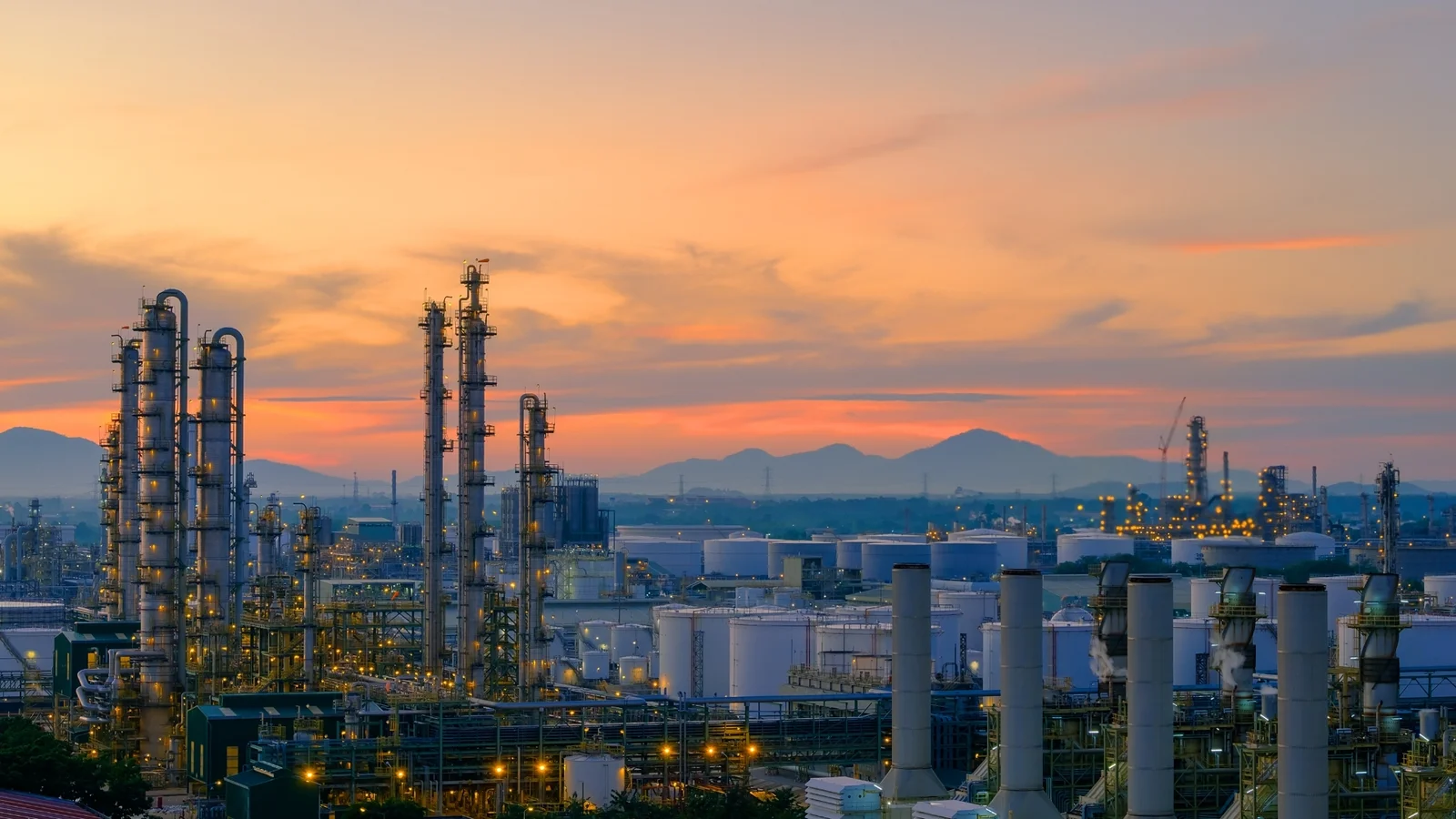 Project 54A refinery and petrochemical complex at dusk, the kind of large single site plant now reshaping Atlantic Basin fuel flows.
From importer to Atlantic supplier in two years
In February 2026 the refinery announced it had reached its full 650,000 barrel a day capacity after tuning its crude distillation unit. It now meets roughly 80 percent of Nigeria's petrol demand and has helped the country reach net petrol exporter status, a reversal that would have looked impossible in 2022.
The export story is where the global impact shows. From early 2026 Dangote ramped up shipments of petrol, diesel and especially jet fuel into Europe, filling gaps left by lower Russian flows and tighter Middle East supply. In July 2026 Europe imported around 2.06 million tonnes of jet fuel, and Dangote was the single largest source, ahead of the United States and the Middle East, according to The Africa Report.
West Africa is the deeper prize. Several African governments, including South Africa, have opened talks on long term supply, and the plant is positioned to take over a regional fuel market that Europe has supplied for years.
| Metric | Figure | Why it matters |
|---|---|---|
| Nameplate capacity | 650,000 barrels a day | Largest refinery in Africa, among the largest single site plants worldwide |
| Share of Nigeria's petrol | About 80 percent | Turned a chronic importer into a net petrol exporter |
| Europe jet fuel, July 2026 | Largest single supplier | Overtook the United States and the Middle East on Europe's jet fuel imports |
| Expansion target | Toward 1.4 million barrels a day | Would make it the largest refinery in the world |
| Europe to West Africa petrol trade at risk | About 17 billion dollars a year | The market Dangote is set to capture from European refiners |
A refinery is only as strong as its feedstock
The refinery's biggest constraint is not selling fuel, it is buying crude. Its chief executive has said the plant needs roughly 13 to 15 cargoes of crude a month to run at full rate, but for long stretches it received about five from Nigeria's own producers. To keep the units fed, Dangote has imported crude from the United States and elsewhere, an awkward outcome for a plant built to refine Nigerian oil, as The Africa Report has detailed.
Price is part of it. Dangote has said Nigeria's pricing structure adds around 3 to 4 dollars a barrel to feedstock costs because purchases are routed through producers' trading arms. Nigeria's upstream regulator counters that pricing and weak supply contracts, not a shortage of oil, explain why domestic refiners received less than half their allocated crude in early 2026. In 2026 the government began weighing crude supply reforms to help Dangote and other refiners, per Hydrocarbon Processing, and the plant has at times priced its fuel in dollars when local crude fell short.
Reliability is the other risk. In May 2026 the residual fluid catalytic cracking unit, the part that lifts petrol yield, was cut by about 34 percent after a crude slate mismatch and a valve fault, and a catalyst problem was expected to force a temporary shutdown of that unit with repairs stretching toward late 2026. None of this is fatal, but it is a reminder that a single site carrying a national fuel supply concentrates risk as much as it concentrates scale. A record initial public offering is also being lined up, and investors are focused squarely on these crude supply costs.
The map is moving south
The forward story is expansion. Dangote has said it is pushing capacity toward 1.4 million barrels a day, which would make it the largest refinery in the world. At that scale it does not just supply Nigeria, it reshapes the Atlantic Basin. Analysts at Argus Media and Hellenic Shipping News describe the plant as a sea change in regional flows, capable of displacing Europe as the main supplier of refined products to West Africa.
For Europe the implication is blunt. Its refining sector is already shrinking under plant closures, and losing the West African export market, worth around 17 billion dollars a year in petrol alone, removes a pillar of demand that kept marginal refineries alive. Expect more European closures and a widening regional deficit in diesel. The same fragility runs through other state oil systems, from Libya's fragile output recovery to national refiners across the Atlantic.
For energy sellers the lesson is about where demand physically sits. Import substitution and backward integration are redrawing the map of who refines, who buys equipment and services, and where product flows. Procurement demand, from catalysts and turnarounds to logistics and offtake, is migrating toward new hubs in West Africa and the Gulf. Suppliers and marketers who still aim their pipeline at legacy European and Atlantic buyers are selling into a market that is moving out from under them. The commercial edge belongs to the teams that track where refining capacity, and therefore spend, is relocating.
Listen & take it with you
Prefer audio, or need the deck for an internal review? The full briefing is available as a podcast episode and a downloadable slide presentation.
What is the most important signal in the Dangote Refinery's rise?
Frequently asked
It has a nameplate capacity of 650,000 barrels a day, reached in February 2026, making it the largest refinery in Africa and among the largest single site refineries in the world. Aliko Dangote has said the plant is being expanded toward 1.4 million barrels a day, which would make it the largest refinery globally.
Yes. The refinery supplies about 80 percent of Nigeria's domestic petrol demand and the country has reached net petrol exporter status, exporting petrol, diesel and jet fuel. This reverses decades in which Nigeria exported crude and imported refined fuel.
Because it has struggled to secure enough Nigerian crude at a workable price. The plant needs roughly 13 to 15 cargoes a month to run at full rate but has often received about five from local producers, so it has imported crude from the United States and elsewhere. The company also says Nigeria's pricing structure adds around 3 to 4 dollars a barrel to its feedstock costs.
It is displacing European suppliers. In July 2026 Dangote was Europe's largest source of imported jet fuel, ahead of the United States and the Middle East, and it is set to take over the West African petrol market that Europe has long supplied, a trade worth around 17 billion dollars a year. That accelerates the decline of Europe's already shrinking refining sector.
Policy. Nigeria's 2021 Petroleum Industry Act reformed the sector and the 2023 removal of the fuel subsidy created a deregulated market where a low cost private refiner could compete on price. Nigeria's government has said the refinery could not have operated under the previous subsidy regime.
Get the next intelligence drop
Join energy and industrial leaders getting our marketing, AI-growth and revenue-architecture intelligence, direct, no filler.
You're on the list
Welcome to The Energy Growth Brief, watch your inbox for the next dispatch.