



What Is Stratos? The Plant, Not the Press Release
Stratos is Occidental's 500,000 tonne a year direct air capture plant in Ector County, Texas, built by its subsidiary 1PointFive with 550 million dollars from BlackRock. Every number you have read about it is design capacity. As of Occidental's last reported quarter the plant was not in commercial operation, full commissioning was expected to begin around the end of 2026, and no verified tonne of captured carbon dioxide has ever been published.
- Stratos is not yet operating commercially. Phase 1 unit operations completed commissioning and the process performed as expected, but as of 6 August 2026 the company expected full plant commissioning to begin around the end of 2026, with the transition to operations in 2027. The original target was mid 2025.
- Every 500,000 tonne figure in circulation is design capacity. 1PointFive's own regulatory disclosure says up to 250,000 tonnes a year rising to up to 500,000 at full capacity. Occidental has never published an expected steady state capture rate, and no verified tonnage captured or injected has ever been released. This is the single most common error in coverage of this plant.
- The carbon dioxide goes to saline storage, not enhanced oil recovery. Three Class VI wells, permitted by the EPA on 7 April 2025 and by the Texas Railroad Commission on 16 October 2025, inject into the Lower San Andres formation about four miles from the plant. Permitted volume is about 8.5 million tonnes over twelve years, which exceeds plant nameplate because combustion carbon dioxide is injected too.
- The subsidy changed decisively in 2025. The One Big Beautiful Bill Act, signed 4 July 2025, raised the 45Q credit for direct air capture with utilisation or enhanced oil recovery from 130 to 180 dollars a tonne, matching the saline storage rate. That removes the 50 dollar penalty for sending captured carbon dioxide to oil production, which is the heart of the ethical argument about this plant.
- Offtake is signed but undelivered. Microsoft 500,000 tonnes over six years, Airbus 400,000 over four, Amazon 250,000 over ten, plus JPMorganChase, TD, ANA and Bain, with roughly ten further buyers whose volumes are undisclosed. No price has been published for any agreement. Buyers pay only after the removals are produced, and no Stratos credit is known to have been issued on any registry.
- The cost is reported, not confirmed. Figures of 1.2 and 1.3 billion dollars circulate, against an initial 2022 estimate of 800 million to 1 billion. Occidental has not published a Stratos specific total in any release or earnings call we could verify. At 1.2 billion that is roughly 2,400 dollars per tonne of annual capacity, about twice the capital intensity in Carbon Engineering's own 2018 design paper.
- No DOE money funds Stratos. The 500 million dollar award was for the separate South Texas DAC Hub, which appeared on a leaked DOE cancellation list in October 2025 and was then retained on DOE's April 2026 list to Congress, with roughly 50 million dollars obligated. The surrounding programme faces a proposed 2.3 billion dollar rescission.
- Scale perspective matters. At full nameplate Stratos would be about fourteen times the capacity of Climeworks' Mammoth in Iceland, the largest direct air capture plant actually operating. It would also need a full year to remove less than ten minutes of global emissions.
Commissioning, not operation, and no published tonnage at all
This is the question most coverage gets wrong, so take it slowly. Stratos has been through startup activity. During Phase 1 commissioning the plant ran wet commissioning, operated carbon dioxide compression at design pressure, added potassium hydroxide and captured carbon dioxide from the atmosphere, built pellet inventory and tested calciner burners. On the first quarter 2026 call of 6 May 2026 the company said Phase 1 unit operations had completed commissioning and the technology and process unit operations performed as expected.
That is not commercial operation. On the second quarter 2026 call of 6 August 2026, chief executive Richard Jackson said the company was making good progress on the nontechnology related repair and commissioning of Trains 3 and 4, and that it expected full plant commissioning to begin around the end of the year as it transitioned to operations in 2027. That was the most recent company statement as at 12 October 2026. Occidental's third quarter call had not yet taken place.
The delay is attributed to the facility, not the chemistry. Jackson, then chief operating officer, said in May 2026 that the company had identified an issue related to non process components of the facility, unrelated to the technology, and was evaluating the repair timeline and assessing the impact on the operations schedule. The specific component and the cost of the repair have not been disclosed.
And on the number everyone quotes: there is no published figure for tonnes of carbon dioxide actually captured or injected at Stratos. Not from Occidental, not from 1PointFive, not from the EPA, not from any registry. 1PointFive's own California disclosure uses the phrasing up to 250,000 tonnes rising to up to 500,000 tonnes a year at full capacity. Design capacity and delivered removals are different quantities, and only one of them retires an emission.
For scale, the largest direct air capture plant actually operating, Climeworks' Mammoth in Iceland, has a design capacity of around 36,000 tonnes a year. Stratos at full nameplate would be roughly fourteen times that. It would also take a full year to remove under ten minutes of global emissions, which is the honest framing of what a first of a kind plant is for: learning curve, not abatement.
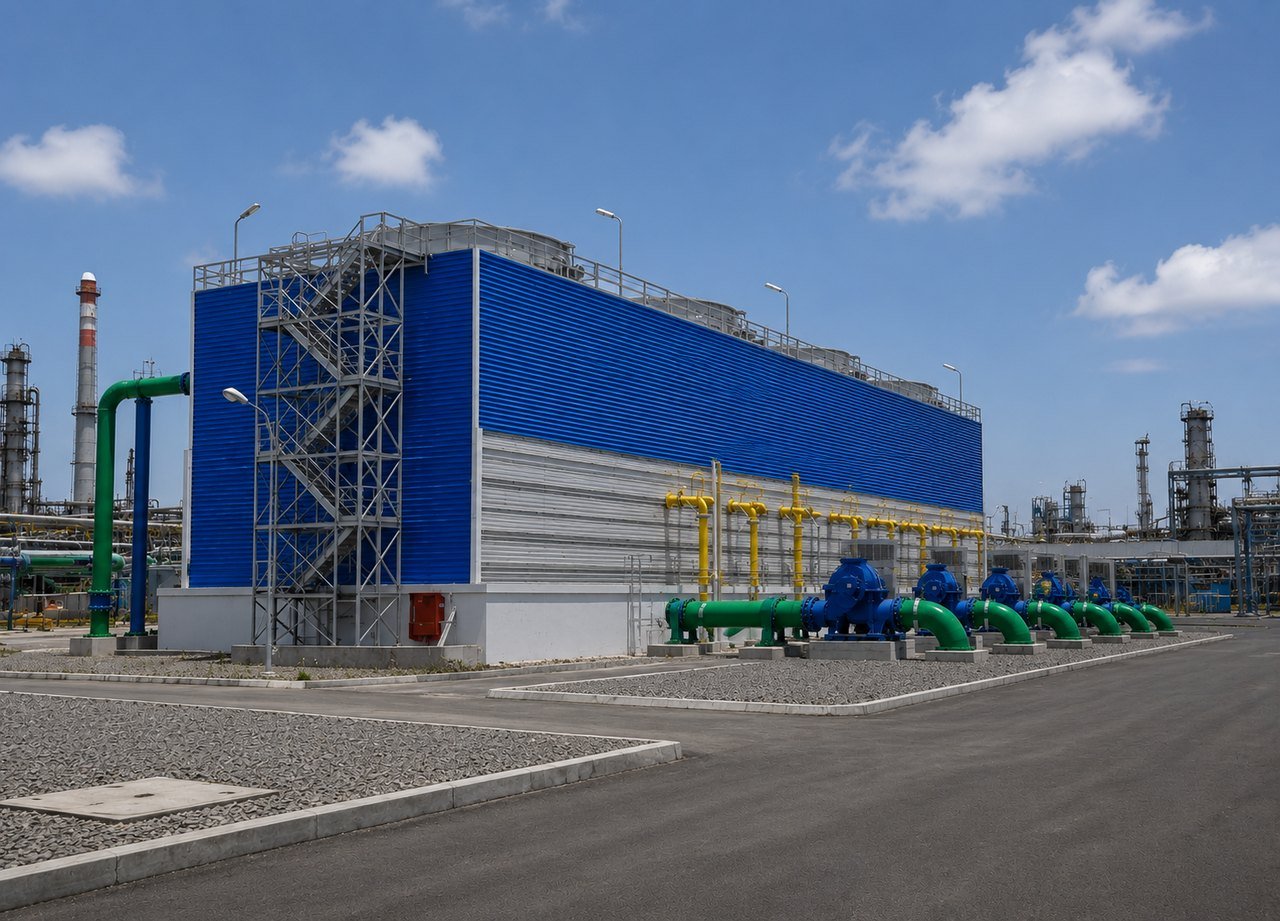 Projet 54An industrial water cooling tower and process pipework. Whatever else direct air capture is, mechanically it is a chemical process plant, and it has the commissioning risk of one.
| Mesure | Value | As at | Source |
|---|---|---|---|
| Design capacity, full build | Up to 500,000 tonnes CO2 a year | 7 April 2025 | Occidental |
| Phase structure | Two phases of 250,000 tonnes, four air contactor trains | 6 May 2026 | Occidental Q1 2026 call |
| Verified CO2 captured or injected | No figure published by any party | 12 October 2026 | Project 54 check |
| Operational status | Full commissioning expected to begin around end 2026, operations 2027 | 6 August 2026 | Occidental Q2 2026 call |
| BlackRock commitment | 550 million dollars into the owning joint venture | 7 November 2023 | Occidental |
| Permitted Class VI injection | About 8.5 million tonnes over twelve years, three wells | EPA 7 Apr 2025, Texas RRC 16 Oct 2025 | EPA, Texas Railroad Commission |
| 45Q credit, DAC with saline storage | 180 dollars a tonne | Current | Carbon Capture Coalition |
| 45Q credit, DAC with EOR or utilisation | Raised from 130 to 180 dollars a tonne | 4 July 2025 | One Big Beautiful Bill Act |
| Reported capital cost, not company confirmed | 1.2 to 1.3 billion dollars, from an initial 800 million to 1 billion estimate | May to June 2026 reporting | Trade press |
A joint venture nobody has named, with an equity split nobody has published
Stratos is developed and operated by 1PointFive, the carbon capture, utilisation and sequestration subsidiary of Occidental Petroleum. On 7 November 2023 Occidental announced that BlackRock would invest 550 million dollars on behalf of clients, through a fund managed by its Diversified Infrastructure business, into a joint venture with 1PointFive that would own the plant.
Two things are worth being precise about, because both are commonly misstated. First, the equity percentages have never been disclosed in any Occidental or BlackRock primary release, and the joint venture is not named in it. Secondary coverage characterising the 550 million dollars as about 40 per cent of the total is that outlet's inference, not a disclosed figure. Second, Global Infrastructure Partners is frequently attached to this deal in commentary. We could find no primary source tying GIP to the Stratos joint venture. The 2023 release names BlackRock's Diversified Infrastructure business only.
The technology comes from Carbon Engineering of Squamish, British Columbia, which Occidental agreed to acquire for approximately 1.1 billion dollars in August 2023. The licensor is therefore now wholly owned by the customer, which removes a royalty but also removes an independent technical check.
The rest is Occidental's balance sheet, through Oxy Low Carbon Ventures. On the second quarter 2026 call Jackson said approximately 400 million dollars of low carbon ventures capital would fully roll off beginning the following year, while chief financial officer Sunil Mathew put the midstream Stratos roll off at around 200 million dollars. The call did not reconcile the two figures.
On total cost, the public record is genuinely contradictory. An initial 2022 estimate of 800 million to 1 billion dollars, a 1.3 billion figure after the BlackRock investment, and a 1.2 billion figure attributed to a disclosure filing and reported in May 2026. Occidental has not published a Stratos specific total in any release or call we could verify. At 1.2 billion dollars the capital intensity is roughly 2,400 dollars per tonne of annual capacity. Carbon Engineering's own 2018 design paper, Keith and colleagues in Joule, assumed about 1,146 dollars per tonne of annual capacity for its baseline gas fired case. The real plant is therefore roughly twice the licensor's published baseline, which is the normal fate of a first of a kind unit and should be read that way.
Saline storage on the permit record, and ten years of offtake against zero deliveries
The carbon dioxide goes into deep saline formations, not into enhanced oil recovery. The EPA issued three Class VI permits on 7 April 2025 for wells BRP CCS 1, 2 and 3 under the Brown Pelican sequestration project, permittee Oxy Low Carbon Ventures, and the Texas Railroad Commission issued Permit 55294 for the same wells on 16 October 2025. The injection zone is the Lower San Andres formation at roughly 4,380 to 5,160 feet, with the Upper San Andres and Grayburg as the primary confining zone, about four miles from the plant. Permitted volume is around 8.5 million tonnes over a twelve year injection period, which exceeds plant nameplate because the carbon dioxide from the calciner's natural gas combustion is co captured and injected too.
This matters because a widely circulated April 2026 opinion piece claimed Stratos will use its captured carbon dioxide for enhanced oil recovery. The permit record does not support that. Microsoft's purchase was explicitly described as carbon dioxide stored underground in saline formations, not used for oil and gas production. No saline versus enhanced oil recovery split of contracted volumes has been published, but the permits that exist are geologic storage permits.
The offtake book is substantial and entirely undelivered. Microsoft signed for 500,000 tonnes over six years in July 2024, the largest direct air capture purchase at the time. Airbus took 400,000 tonnes over four years in 2022. Amazon took 250,000 over ten years in September 2023. JPMorganChase 50,000 in June 2025, All Nippon Airways 30,000 in 2025, TD Bank Group 27,500 in November 2023, Bain and Company 9,000 over three years in January 2026. A further group including Boston Consulting Group, Trafigura, AT&T, Palo Alto Networks, NYK, Verizon and two Houston sports franchises have agreements with undisclosed volumes.
No price has been publicly disclosed for any of them. 1PointFive's own disclosure states that buyers pay only after Stratos has produced the relevant removals. Stratos received a pre issuance AAApre rating from BeZero Carbon in September 2025, but we could find no record of a single Stratos credit being issued on any registry. For a corporate buyer, that means the exposure here is delivery risk on a first of a kind plant, not price risk on a commodity.
On energy and water, there is no Stratos specific measured figure in the public domain. The 1PointFive project page describes natural gas supplying the calciner's high temperature heat with the combustion carbon dioxide co captured, electricity as a mix of on site power and off site renewable specified grid power designed to be net zero on an annual average over four quarters, and brackish non potable water drawn from the Capitan Reef aquifer and used in a closed loop. The only quantified figures available are Carbon Engineering's 2018 design estimates for the generic process: 8.81 gigajoules of natural gas per tonne in the all gas case, and roughly 4.7 tonnes of water per tonne of carbon dioxide at 20 degrees Celsius and 64 per cent relative humidity. Those are design estimates for a process, not measurements of this plant.
Cost, subsidy design, and a chief executive who said the quiet part out loud
The cost objection is the mainstream one and it comes from people who work on carbon capture, not from opponents of it. Howard Herzog, senior research engineer at the MIT Energy Initiative, says of direct air capture cost claims that most estimates out there are unrealistic, and puts a reasonable 2030 cost at 600 to 1,000 dollars a tonne, three to six times the 180 dollar 45Q credit. On the storage question he adds that if your primary goal is negative emissions, enhanced oil recovery is not a good fit. The International Energy Agency's Fatih Birol has said that removing carbon from the atmosphere is costly and uncertain, with IEA estimates of scaled operating costs at 230 to 630 dollars a tonne.
The stronger objection is thermodynamic. Mark Jacobson of Stanford argues there is never a case where direct air capture or carbon capture is useful, on the grounds that the energy consumed would avoid more carbon dioxide if it displaced fossil generation instead. That is a contested position and it is worth knowing it is contested, but it is a serious one held by a serious researcher, and a piece that omits it is not being straight with you.
The subsidy objection sharpened in 2025. The One Big Beautiful Bill Act, signed 4 July 2025, raised the 45Q credit for direct air capture with utilisation or enhanced oil recovery from 130 to 180 dollars a tonne, matching the rate for secure saline storage. The 50 dollar penalty for sending captured carbon dioxide into oil production is gone. Put that next to what Occidental's then chief executive Vicki Hollub told NPR in December 2023, that if oil is produced in the way she was describing, there is no reason not to produce oil and gas forever, and you have the whole argument in two sentences. Hollub retired as chief executive on 1 June 2026 and was succeeded by Richard Jackson, but the strategic logic she articulated is the one the company is still executing.
Be careful with the loudest critics too. A widely shared April 2026 opinion piece by Jonathan Lesser of the National Center for Energy Analytics calls direct air capture an astonishingly expensive and unrealistic approach, and argues that two billion tonnes a year would consume nearly 60 per cent of current US electricity generation for roughly three thousandths of a degree of warming reduction. The scaling argument is worth engaging with. The same piece states that Stratos will use its carbon dioxide for enhanced oil recovery, which the permit record contradicts, and implies a one million tonne capacity when nameplate is half that. Cite the argument, not the article.
Finally, the government money. No DOE award funds Stratos itself. The 500 million dollar award went to the separate South Texas DAC Hub, which appeared on a leaked DOE cancellation list in October 2025 and was then retained on DOE's April 2026 list to Congress alongside the Louisiana hub, up to 1.2 billion dollars combined, with roughly 50 million obligated per hub. DOE's FY2027 budget request seeks to rescind 2.3 billion dollars of the 3.5 billion DAC Hubs programme, and ten of the programme's original 21 projects were terminated in October 2025. So the correct statement as at 12 October 2026 is that no award to Occidental or 1PointFive has been cancelled in a confirmed, documented action, that the award survives at a fraction of its headline, and that Stratos does not depend on it.
Écoutez et emportez-le avec vous
Vous préférez le format audio ou vous avez besoin de la présentation pour une analyse interne ? Le compte rendu complet est disponible sous forme d’épisode de podcast et de diaporama téléchargeable.
You are evaluating a direct air capture offtake agreement for your company's net zero commitment. What is the first question you ask?
Questions fréquemment posées
Not commercially. As of Occidental's second quarter 2026 earnings call on 6 August 2026, chief executive Richard Jackson said the company expected full plant commissioning to begin around the end of 2026, with the transition to operations in 2027. Phase 1 unit operations had completed commissioning and performed as expected, and repair and commissioning work on Trains 3 and 4 was in progress. The original target was mid 2025.
No figure has ever been published, by Occidental, 1PointFive, the Environmental Protection Agency or any carbon registry. The 500,000 tonnes a year number that appears everywhere is design capacity at full build, and 1PointFive's own regulatory disclosure phrases it as up to 250,000 tonnes rising to up to 500,000 at full capacity. Design capacity and delivered removals are not the same thing.
It is owned through a joint venture between 1PointFive, Occidental's carbon capture subsidiary, and BlackRock, which committed 550 million dollars on behalf of clients through a fund managed by its Diversified Infrastructure business in November 2023. The equity split has never been disclosed and the joint venture has not been publicly named. We found no primary source connecting Global Infrastructure Partners to this joint venture.
Into deep saline formations, not enhanced oil recovery. Three Class VI wells, permitted by the EPA on 7 April 2025 and by the Texas Railroad Commission on 16 October 2025, inject into the Lower San Andres formation at roughly 4,380 to 5,160 feet, about four miles from the plant. Permitted volume is around 8.5 million tonnes over twelve years, which exceeds plant nameplate because combustion carbon dioxide from the calciner is co captured and injected too.
180 dollars a tonne for carbon dioxide placed in secure geologic storage, and since the One Big Beautiful Bill Act was signed on 4 July 2025, also 180 dollars a tonne when the carbon dioxide is used or stored through enhanced oil recovery, up from 130. That change removed the financial penalty for routing captured carbon dioxide into oil production, and it applies to projects placed in service after enactment.
Named buyers include Microsoft at 500,000 tonnes over six years, Airbus at 400,000 over four, Amazon at 250,000 over ten, JPMorganChase at 50,000, All Nippon Airways at 30,000, TD Bank Group at 27,500 and Bain and Company at 9,000 over three years, plus roughly ten further companies with undisclosed volumes. No price has been published for any agreement, buyers pay only once removals are produced, and no Stratos credit is known to have been issued on a registry.
Not in any confirmed action. The up to 500 million dollar award was for the separate South Texas DAC Hub, not for Stratos. It appeared on a leaked Department of Energy cancellation list in October 2025, then was retained on DOE's April 2026 list to Congress with roughly 50 million dollars obligated, while the department's FY2027 budget request seeks to rescind 2.3 billion dollars of the 3.5 billion DAC Hubs programme. Stratos itself receives no DOE award.
Stratos's 500,000 tonne a year design capacity is roughly fourteen times the approximately 36,000 tonnes a year of Climeworks' Mammoth plant in Iceland, the largest direct air capture facility currently in operation. Even at perfect nameplate performance, Stratos would need a full year to remove under ten minutes of global emissions.
Obtenez la suite gouttelettes de renseignement
Rejoignez les leaders des secteurs de l'énergie et de l'industrie et recevez directement nos informations stratégiques en matière de marketing, de croissance par IA et d'architecture des revenus, sans superflu.
Vous êtes sur la liste
Bienvenue dans The Energy Growth Brief, consultez votre boîte de réception pour le prochain numéro.