


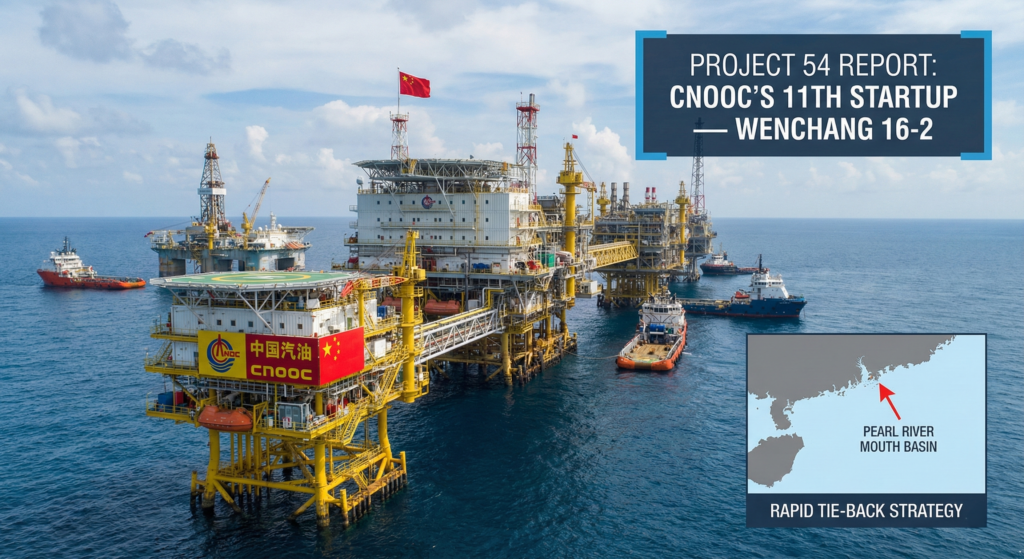
In the global oil and gas theatre, 2025 has been a year of contrasting narratives. While many Western International Oil Companies (IOCs) focus on share buybacks and portfolio consolidation, China’s state-backed offshore giant, CNOOC Limited, is engaged in a sprint for capacity. The company’s recent announcement of its 11th domestic project startup of the year—the Wenchang 16-2 Oilfield—is more than just a production milestone; it is a definitive signal of where the capital and strategic focus of the Asian energy market currently resides.
For C-suite executives and business development managers observing the region, CNOOC’s performance offers a masterclass in two critical areas: Capital Efficiency via Infrastructure Leveraging and State-Mandated Energy Security.
The Wenchang 16-2 Model: Economy of Scale in Action
The specific details of the Wenchang 16-2 project reveal the tactical playbook CNOOC is using to maintain this frenetic pace. Located in the Pearl River Mouth Basin with an average water depth of 150 metres, the project is not a massive greenfield behemoth. Instead, it is a smart, tactical tie-back.
CNOOC has constructed a new jacket platform that integrates production and drilling functions but—crucially—relies on adjacent, existing facilities for processing and power. This “satellite” approach drastically reduces the upfront CAPEX and shortens the timeline from Final Investment Decision (FID) to First Oil.
With peak production expected to reach 11,200 barrels of oil equivalent per day (boe/d) of light crude in 2027, the project is a high-margin addition to the portfolio. It requires minimal new infrastructure while extending the economic life of the existing Wenchang hub. For business development managers, this highlights a booming market in Asia not for massive new megastructures, but for brownfield modification, subsea tie-back technologies, and life-extension services.
The Macro Context: The “Ballast Stone” Strategy
CNOOC’s acceleration is not happening in a vacuum. It is the tip of the spear for Beijing’s “Seven-Year Action Plan” to boost domestic supply. The National Energy Administration recently confirmed that China is on track to hit a record 215 million metric tons of crude output in 2025, with offshore fields accounting for over 60% of that growth.
In Chinese policy circles, domestic oil and gas are referred to as the “ballast stone”—the stabilising force ensuring national security amidst global geopolitical volatility. While the energy transition is accelerating (China is also the world leader in solar and wind deployment), fossil fuels remain non-negotiable for baseline security.
For the C-suite, this clarifies the investment horizon. Unlike in Europe, where regulatory pressure is curbing upstream investment, the Asian offshore sector has a state-guaranteed mandate for growth. Service companies and technology providers that align themselves with this efficiency-plus-security narrative will find a receptive and capital-rich audience.
Beyond Volume: The Tech and Green Pivot
It would be a mistake to view CNOOC as a traditional volume-chaser. The 2025 strategy is heavily layered with technological sophistication. The company is rolling out its “Hi-Energy” AI model across these new startups. This digital twin and predictive analytics capability allows for unmanned platforms and remote operations—vital for keeping OPEX low in mature basins like the South China Sea.
Furthermore, the “Green Power Substitution” initiative is gaining traction. CNOOC aims to consume over 1 billion kWh of green electricity this year. Integrating offshore wind with oil and gas platforms is no longer a pilot concept in China; it is becoming standard operating procedure to lower the carbon intensity of every barrel produced.
Conclusion: The New Asian Benchmark
CNOOC’s ability to bring 11 projects online in a single year—alongside major international startups like Yellowtail in Guyana and Buzios7 in Brazil—sets a new benchmark for operational velocity.
For competitors and partners alike, the message is clear: The Asian upstream sector is not winding down; it is speeding up. However, the nature of the game has changed. It is no longer about finding the biggest field; it is about who can connect the most barrels to existing steel in the shortest amount of time. In 2025, speed is the ultimate currency, and right now, CNOOC has the fastest chequebook in the East.