



How Much Oil Was China Adding to Its Reserves Per Day in 2026?
China's crude stockpiling rate is one of the most watched numbers in the oil market, because it sets the floor under global demand. The rate did not hold steady in 2026: it started near 1.24 million barrels a day, then fell sharply during the Hormuz supply shock, before builds resumed. This dossier sets out the rate month by month, why it moved, and what the pace signals commercially. All figures are third-party estimates and are marked as such.
- The rate was not constant. It ran near 1.24 million barrels a day early in 2026, then dropped to roughly 430,000 barrels a day by April as the Hormuz crisis cut imports.
- Different trackers disagree because none see the real number. Estimates for 2026 range from about 430,000 barrels a day in the weakest month to a full-year average near 730,000 barrels a day.
- The build is measured indirectly: apparent supply (imports plus domestic output) minus refinery runs. That residual is what analysts call stockpiling, and it carries real error bars.
- By April 2026, aboveground crude stocks reached an estimated record 1.24 billion barrels, on top of state reserves and expanding storage capacity.
- The pace is a commercial signal. When China buys the dip aggressively it puts a floor under prices; when it pauses, as during the Hormuz spike, it removes one.
A Number That Moved With the Market, Not a Constant
The single figure hides a moving target. China does not publish how fast it fills its reserves, so every rate is reconstructed from customs data, refinery runs and tanker tracking. Those reconstructions put early 2026 additions well above the 2025 pace, then show a sharp slowdown when the Hormuz supply shock pushed prices up and China stopped chasing barrels.
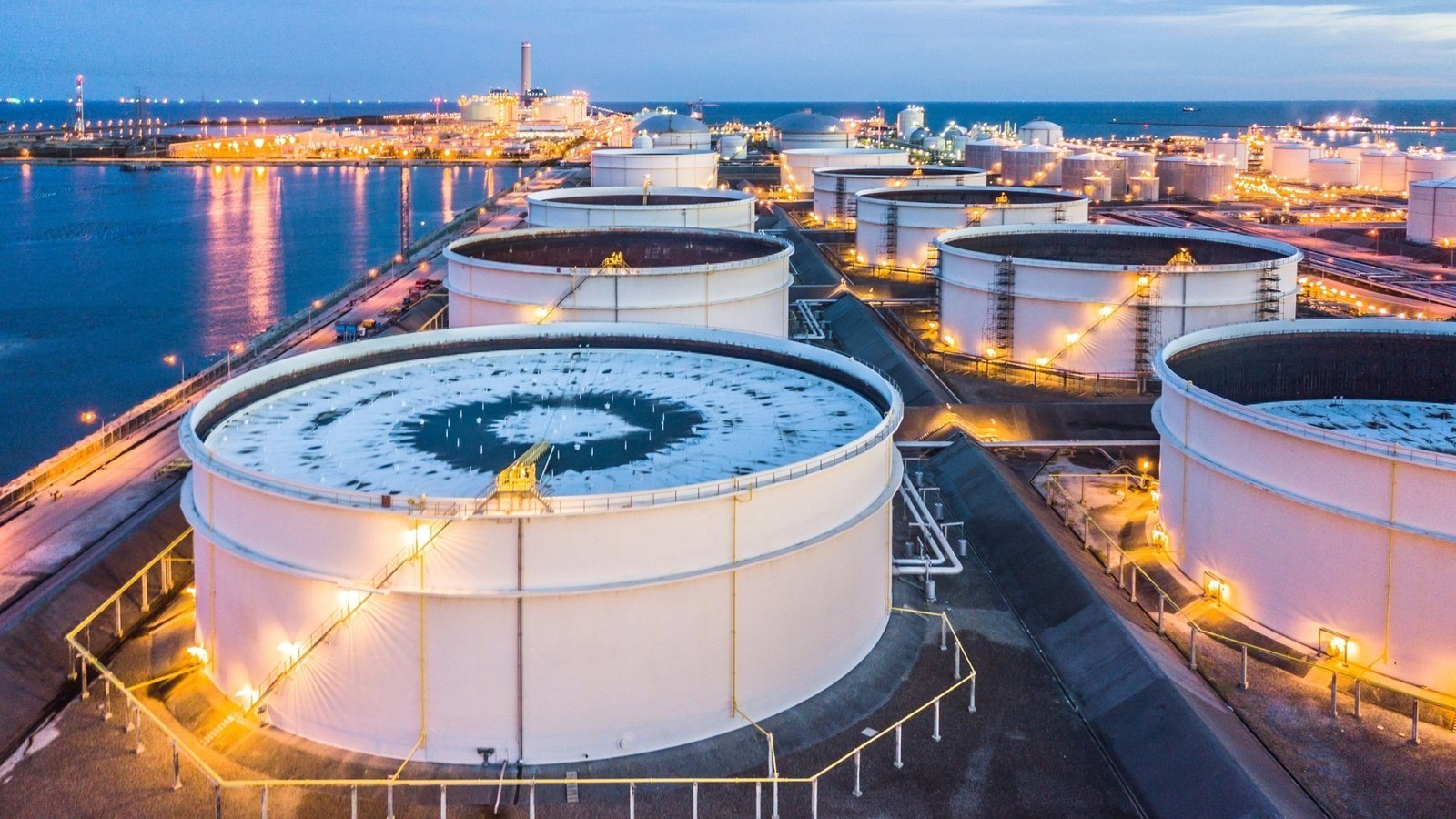 Project 54China's crude stockpiling rate is reconstructed from customs and tanker data, because the flows are never published.
| Period | Estimated build rate | Basis |
|---|---|---|
| 2025 average | ~1.1 million b/d | Apparent-supply residual |
| Jan to Feb 2026 | ~1.24 million b/d | Preliminary customs and refinery data |
| April 2026 | ~430,000 b/d | Import slump during the Hormuz crisis |
| April 2026 (alt. tracker) | ~580,000 b/d | Vortexa aboveground stock build |
| Full-year 2026 (est.) | ~730,000 b/d | FGE inventory forecast |
Price Discipline, Not Capacity, Set the Pace
The swing was a choice, not a constraint. Through late 2025 and early 2026 China took advantage of soft prices to build aggressively. When the mid-2026 Hormuz crisis spiked crude, China did the opposite of a panic buyer: it drew on existing stocks and let imports fall rather than pay up, which is why the April build collapsed to an estimated 430,000 barrels a day.
This is the behaviour of a buyer with cover. State and commercial inventories together were estimated near 1.4 billion barrels entering 2026, giving Beijing the room to wait. State companies including Sinopec and CNOOC are adding at least 169 million barrels of storage capacity across eleven sites through 2025 and 2026, explicitly framed as lifting reserves toward three months of net import cover, so the capacity to keep buying is expanding even when the pace pauses.
The Fill Rate Is a Price Floor You Can Read
For anyone selling into or pricing off the oil market, China's fill rate is a leading indicator. A fast build absorbs surplus barrels and puts a floor under prices, which is why sellers watch it as closely as OPEC output. A pause, like April 2026, signals that China judges prices too high and is willing to wait, which removes support. Reading the rate, and its direction, is more useful than any single headline number, because the direction is the demand signal. For the full reserve picture, see our dossier on China's strategic petroleum reserve in 2026.
Listen & take it with you
Prefer audio, or need the deck for an internal review? The full briefing is available as a podcast episode and a downloadable slide presentation.
What does China's stockpiling rate tell you most reliably?
Frequently asked
An estimated 1.24 million barrels a day in January and February 2026, above the roughly 1.1 million barrels a day averaged in 2025. The rate then fell to an estimated 430,000 barrels a day by April during the Hormuz crisis, with some trackers still showing builds near 580,000 barrels a day. FGE has estimated a full-year 2026 build near 730,000 barrels a day.
Because none of them measure the reserve directly. China does not publish stockpiling flows, so analysts infer them from apparent supply, which is imports plus domestic production, minus refinery runs. Different assumptions about refinery throughput and unreported barrels produce different rates, which is why a single month can be quoted as 430,000 or 580,000 barrels a day.
Because prices rose during the Hormuz supply shock and China chose not to chase them. With inventories estimated near 1.4 billion barrels, Beijing had the cover to draw down and let imports fall rather than pay up, which cut the April build to an estimated 430,000 barrels a day.
Aboveground crude stocks reached an estimated record 1.24 billion barrels by April 2026 on Vortexa data, and total inventories including underground and government stocks were estimated near 1.4 billion barrels entering the year, with state-controlled reserves around 360 million barrels.
Because China is the marginal buyer. A fast build absorbs surplus barrels and puts a floor under prices; a pause removes that support. The rate, and especially its direction, is a leading demand signal that traders and sellers watch as closely as OPEC output decisions.
Get the next intelligence drop
Join energy and industrial leaders getting our marketing, AI-growth and revenue-architecture intelligence, direct, no filler.
You're on the list
Welcome to The Energy Growth Brief, watch your inbox for the next dispatch.