



The Year Energy Regulation Went Backwards
The IEA's State of Energy Policy 2026 measured something the energy sector has not had to price in for twenty years. In 2025, efficiency standards covering 30 per cent of global energy demand were weakened or delayed, against 17 per cent that were tightened. The IEA calls it a historic reduction in coverage and stringency. For suppliers whose commercial case rests on a compliance deadline, the ratchet has stopped being a ratchet.
- The number to quote is 30 against 17. Standards covering 30 per cent of global energy demand were loosened or delayed in 2025; standards covering 17 per cent were tightened. Source: IEA, State of Energy Policy 2026. The IEA calls it a historic reduction in coverage and stringency, and it is the reason a compliance led pitch now needs a second leg.
- The rollback is specific and nameable, not a mood. The United States removed CAFE civil penalties through the One Big Beautiful Bill Act and repealed selected appliance conservation standards; the United Kingdom revised its gas boiler phase out; Canada paused its 2026 zero emission vehicle mandate; the Eurasian Economic Union pushed device and industrial motor standards from 2025 to 2028. A buyer can check every one of these, which is precisely why your deck has to acknowledge them first.
- The effect is cumulative, not immediate. The IEA is explicit that rolling back minimum performance standards does not cause an immediate drop in efficiency. It shifts what manufacturers build over years. That matters for forecasting: the revenue effect is likely to build over several years rather than land next quarter, so the near term risk is to pipeline confidence rather than to booked orders.
- Money moved before the rules did. Government energy spending reached about USD 405 billion in 2025, roughly 1.4 per cent of total government expenditure against 0.8 per cent a decade earlier, but 2025 budget revisions cut projected spending through the end of the decade by an average of USD 110 billion a year. The subsidy era is being replaced by auctions and market mechanisms, expected to account for nearly 60 per cent of gross capacity additions between 2025 and 2030.
- Policy is still tightening in one direction, and it is the one most suppliers are not selling into. Thirty two countries now have supply chain resilience policies, 35 new critical minerals policies were adopted across 19 countries in 2025, and 11 of 20 energy critical minerals faced export controls at some point that year. Security of supply is the growth surface. Decarbonisation stringency is the one that slipped.
- The climate pledge layer is weak enough to plan around. As of April 2026, 65 of the 194 Paris Agreement parties had not submitted 2035 NDCs, and more than 80 per cent of those that had set similar or slower rates of decline than their previous targets. On the IEA's arithmetic, delivering the energy components of all NDCs would cut energy related emissions by 0.3 per cent a year to 2035, against 0.8 per cent a year in its Stated Policies Scenario.
What does the IEA State of Energy Policy 2026 report say about regulatory rollback?
The IEA's State of Energy Policy 2026 is an annual stocktake of what governments did, rather than what they said they would do. This year's edition extends its examination of energy security policy across the period 1973 to 2025, which is the comparison that gives the headline its weight.
The core measurement sits in the report's chapter on energy efficiency and fuel switching regulations. Fifteen countries had changes to minimum energy performance standards take effect during 2025. Standards covering 30 per cent of global energy demand were made less stringent or had implementation delayed. Standards covering 17 per cent of covered demand were made more stringent. The IEA's summary sentence is unambiguous: the changes in 2025 marked a historic reduction in coverage and stringency.
Two secondary readings make the scale concrete. The IEA puts the aggregate 2025 policy signal at about the same level as legislation enforced in 2019, so a single year of changes took the aggregate signal back roughly six years. And on industrial motors, its efficiency standards stringency indicator fell to 63 in 2025 from 66 under stated policies as of 2024.
One more comparison is worth holding onto, because it is the kind of detail that changes how a regional sales plan is built. The IEA notes that passenger car standards in advanced economies are now roughly level with those in emerging markets and developing economies. The regulatory premium that advanced markets carried, and that many suppliers priced their product tiers around, has largely closed.
This is a primary measurement from the agency that most energy ministries treat as the reference, which is why it is worth building a commercial argument on rather than around.
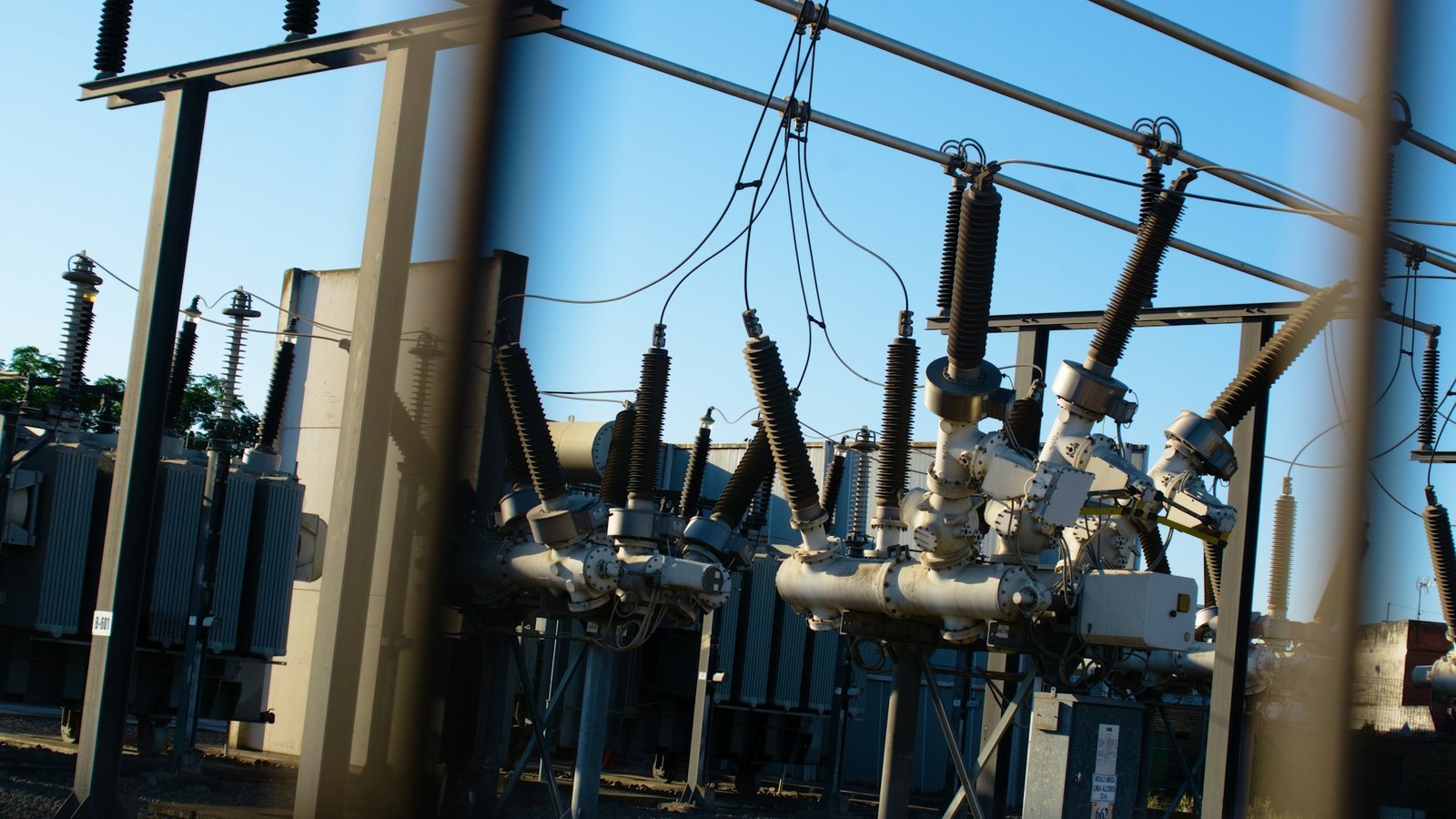 Project 54High-voltage substation switchgear and insulators seen through a fence against a blue sky.
| United States | One Big Beautiful Bill Act removed corporate average fuel economy civil penalties; Department of Energy repealed earlier energy conservation standards for selected appliances | Weakened |
| United Kingdom | Plans to phase out new gas boiler installations revised | Weakened |
| Canada | 2026 zero emission vehicle mandate paused to give automakers more time | Delayed |
| Eurasian Economic Union | Minimum standards for energy consuming devices and industrial motors delayed from 2025 to 2028 | Delayed |
| European Union, Canada, United Kingdom | Plans to delay or cancel road transport standards and mandates | Signalled weakening |
| Global aggregate | Standards covering 30 per cent of energy demand loosened or delayed, against 17 per cent tightened | Net weakening |
Why are governments rolling back energy regulation in 2026?
It is mostly arithmetic, and reading it as ideology will cost you accuracy in front of a customer.
The IEA's chapter on government energy spending sets out the fiscal position. Energy related government provisions reached roughly USD 405 billion in 2025, about 1.4 per cent of total direct government expenditure, against roughly 1 per cent historically and 0.8 per cent a decade earlier. Spending roughly doubled from 2019 levels, with disbursements of about USD 370 billion in 2024. In some countries energy reached up to 5 per cent of general expenditure. For comparison, health and social protection grew about 1.4 times over the same period while energy more than doubled.
That growth was driven by crisis response rather than by transition policy. Affordability measures, mainly short term consumer subsidies for oil, electricity and gas, accounted for 20 to 30 per cent of government energy spending in 2022, at USD 119 billion, and in 2023, at USD 101 billion. Cumulative affordability spending across 2022 and 2023 was highest in the United Kingdom at USD 61 billion, then Germany at USD 46 billion and Japan at USD 45 billion.
Then it was withdrawn. The IEA records that 2025 revisions cut projected energy spending through the end of the decade by an average of USD 110 billion a year, although allocations remain more than twice their late 2010s levels. The United States enacted legislation in July 2025 ending solar and wind tax credits for new projects starting in 2026. China cut renewables subsidies and phased out feed in tariffs for new projects in 2025.
The executive summary frames the shift directly: energy has become a core national and economic security issue, and 2025 was dominated by cost of living, competitiveness and resilient supply chains. Stringency did not lose an argument about climate. It lost a budget argument to affordability, and a political argument to competitiveness.
There is a precedent the IEA itself raises. It notes that most responses so far are emergency measures, but that past shocks such as the 1970s often triggered more structural shifts in energy policy, while also arguing that today's technology and policy base could support faster reductions in oil and gas use than were possible then. Both things are in the same report, and a supplier should quote both.
Can energy suppliers still sell on regulatory deadlines?
They can, but the deadline is no longer the whole argument. It is now a claim with a counterexample attached, and the buyer has the counterexample.
Consider the shape of a typical energy B2B business case written between 2021 and 2024. It opened with a mandate, gave the compliance date, quantified the penalty, and closed by positioning the product as the cheapest route to the date. That structure worked because the mandate was treated as fixed. Every element of it except the product is now contestable: Canada paused a 2026 mandate, the United States removed the penalty mechanism in CAFE, the Eurasian Economic Union moved a date by three years.
The failure mode is predictable. A procurement lead who has watched one mandate slip applies a discount to every future mandate in every deck they read. That discount is applied silently, inside the buying committee, and it shows up as a stalled deal rather than as an objection you get to answer.
The repair is not to stop citing regulation. It is to stop making regulation the load bearing wall. A durable case carries at least one argument that survives the rule being delayed: an energy cost saving that pays back inside the budget cycle, a security of supply exposure the customer already owns, or a capacity constraint that exists whatever the rule says. Where a compliance deadline is genuinely binding, say which one and name its legal instrument, because a specific, checkable deadline reads differently from a general appeal to direction of travel.
This is the same discipline we set out in our positioning and messaging framework for energy B2B, applied to a moving input rather than a fixed one.
There is also an honesty dividend. A deck that names the rollbacks before the customer does is the only kind that can then credibly say which deadlines are still hard. Suppliers who keep presenting an unbroken ratchet will be corrected in the room.
Which areas of energy policy are still tightening in 2026?
Security of supply, and it is tightening quickly enough that it is now the better commercial surface.
The IEA counts 32 countries with supply chain resilience policies, against 150 with policies supporting renewables and nuclear and 130 with efficiency and electrification policies. The resilience number is the smallest and the fastest moving, which is usually where a supplier wants to be.
The critical minerals picture is the sharpest version of it. Eleven of the 20 critical minerals essential to the energy sector were subject to export controls at some point during 2025. Thirty five new critical minerals policies were adopted across 19 countries in 2025, and 45 new policies affecting trade in key clean energy technologies were implemented in the same year. The IEA also notes that for many key clean energy components, the largest supplier accounts for more than 70 per cent of manufacturing capacity.
The gap inside that trend is the interesting part for anyone selling equipment. Only four countries have formal stockpiling requirements for energy related equipment, against emergency oil and gas supply measures legally in place in 60 countries and stockholding legislation covering countries that account for 95 per cent of global oil imports. Governments have built reflexes for molecules and have barely started on machines. We looked at the molecules side of this in our analysis of emergency oil stocks and diesel releases.
Public money is following the same logic. Public investment in advanced clean technology manufacturing runs at about 12 per cent of total investment in clean energy technology manufacturing facilities, equivalent to around USD 24 billion. That is support attached to building domestic capability, not to meeting an efficiency threshold.
The practical reading: a proposition framed as resilience, substitution or domestic capability is selling into a policy direction that is still hardening. A proposition framed as compliance with an efficiency standard is selling into one that measurably softened last year.
Are 2035 climate targets strong enough to drive energy demand?
Less than most forecasts assume, and this is checkable rather than rhetorical.
As of April 2026, 65 of the 194 Paris Agreement parties had not yet submitted 2035 nationally determined contributions. Of those that had, more than 80 per cent set similar or slower rates of emissions decline than their earlier targets. So the pledge layer is both incomplete and, where complete, flatter than its predecessor.
The IEA puts a number on what that means. If the energy components of all NDCs were met, energy related emissions would fall by 0.3 per cent a year until 2035, against 0.8 per cent a year in the IEA Stated Policies Scenario. Stated Policies is not an ambitious scenario. It is built on policies governments already have in place or have announced, not on aspirational targets. The pledges, fully delivered, run slower than it.
There is a parallel effect on efficiency. Without the 2025 relaxations, delays and rollbacks, the IEA calculates that energy efficiency stringency would have increased by 50 per cent over the next five years. The expected rise is now 30 per cent. The direction is still upward, which matters, but the slope is roughly two fifths shallower than it was going to be.
For anyone building a 2030 revenue model on regulatory pull, those two figures are the ones to run sensitivities against. Treat the pledge layer as an upside case rather than a base case, and hold the base case on legislated policy and on cost.
How should energy B2B teams respond to the policy rollback?
Five things, in order, none of which require waiting for more evidence.
First, audit every live proposal for load bearing regulation. Find the sentence that makes a mandate the reason to buy. If removing that sentence collapses the case, the case needs a second leg before the next meeting, not after the deal stalls.
Second, rebuild the base case on legislated policy and energy cost, and move the pledge layer into the upside case. The IEA's own arithmetic, 0.3 per cent a year against 0.8 per cent a year, is the justification to put in the footnote.
Third, re-segment by policy direction rather than by geography. The regulatory premium between advanced economies and emerging markets has narrowed on passenger car standards, so a territory plan that assumes advanced markets regulate harder is working from a 2023 map.
Fourth, build the resilience proposition properly, because that is the tightening surface. Only four countries hold formal stockpiling requirements for energy related equipment while 60 have emergency measures for fuels. If your product sits in a supply chain where one country holds more than 70 per cent of manufacturing capacity, the exposure argument is already true and does not depend on a rule arriving.
Fifth, change what you monitor. Tracking announced targets has become a poor predictor. Track statutory instruments, budget lines and auction calendars instead. With auctions and market mechanisms expected to account for nearly 60 per cent of gross capacity additions from 2025 to 2030, and the United Kingdom's Low Carbon Contracts Company alone receiving an all time high of USD 56 billion in 2025, the auction calendar is now closer to a demand forecast than the pledge register is.
The honest summary for a board is short. The regulatory tailwind is weaker than the plan assumed, the security tailwind is stronger, and the companies that notice the swap first get a year of clear air in the messaging.
Listen & take it with you
Prefer audio, or need the deck for an internal review? The full briefing is available as a podcast episode and a downloadable slide presentation.
A 2030 efficiency mandate your product's business case depends on has just been delayed. The customer noticed before you did. What is the right move in the next meeting?
Frequently asked
It is the International Energy Agency's annual stocktake of energy policy as implemented rather than as announced, published in 2026. The 2026 edition extends its examination of energy security policy across the period 1973 to 2025. It measures what governments actually legislated, spent and enforced during the year, which is why its findings on regulatory rollback carry more weight than a survey of stated ambition.
Yes, on net. The IEA found that minimum energy performance standards covering 30 per cent of global energy demand were made less stringent or had implementation delayed during 2025, while standards covering 17 per cent of covered demand were made more stringent. Fifteen countries had changes take effect. The IEA describes the result as a historic reduction in coverage and stringency, and puts the aggregate 2025 policy signal at roughly the level of legislation enforced in 2019.
The IEA names several specifically. The United States removed corporate average fuel economy civil penalties through the One Big Beautiful Bill Act and repealed earlier energy conservation standards for selected appliances. The United Kingdom revised plans to phase out new gas boiler installations. Canada paused its 2026 zero emission vehicle mandate. The Eurasian Economic Union, covering Armenia, Belarus, Kazakhstan, the Kyrgyz Republic and Russia, delayed minimum standards for energy consuming devices and industrial motors from 2025 to 2028. The report also flags plans in the European Union, Canada and the United Kingdom to delay or cancel road transport standards.
No, and treating it that way would be an overcorrection. The IEA is explicit that rolling back minimum performance standards does not cause an immediate drop in efficiency, because the effect runs through what manufacturers choose to build over several years. Efficiency stringency is still expected to rise by about 30 per cent over the next five years, down from the 50 per cent that would have applied without the 2025 relaxations. The commercial change is that a mandate can no longer be the only load bearing argument in a business case, because buyers have watched mandates move.
Energy security and affordability. The IEA's executive summary describes energy as having become a core national and economic security issue, with 2025 dominated by cost of living, competitiveness and resilient supply chains. The measurable expression of that is on the security side: 32 countries now hold supply chain resilience policies, 35 new critical minerals policies were adopted across 19 countries in 2025, 45 new policies affecting trade in clean energy technologies were implemented, and 11 of the 20 critical minerals essential to the energy sector faced export controls at some point during the year.
Get the next intelligence drop
Join energy and industrial leaders getting our marketing, AI-growth and revenue-architecture intelligence, direct, no filler.
You're on the list
Welcome to The Energy Growth Brief, watch your inbox for the next dispatch.